REVIEW: CITY

CityCity by Clifford D. Simak

My rating: 3 of 5 stars

This is what I couldn’t help but imagine the talking dogs in this book looked like (together with the robotic “hands”). Minus the gun, cause dogs in City never kill.

Read this in audiobook form. I think it was the same guy who narrated the Replay audiobook. Maybe, can’t bother to check.

City is 8+1 connected stories passed down to the dogs of the future that tell of Earth and man (if such a being ever existed and isn’t just a product of legend). There’s a quasi-logarithmic time interval between each of the stories: the first takes place in the ’90s, the second somewhere in the 21st century, the last is something like 17,000 years in the future.

Even though dogs, robots and ants appear as successors to human civilization on Earth, with each species following a different philosophy inspired by or directly influenced by mankind, and although the stories are supposed to be retold by talking dogs of the far future, this is basically still a story about humans. Make no mistake, people in the future will obviously instill the same kind of vain belief in the march of progress and Prometheanism to any and all prospective “managers” of Earth. Under the dogs, who are first charged to follow mankind’s footsteps when our foolishness won’t allow us to “reach our true potential”, a “brotherhood of animals” is formed to unite all mute animals and make them useful, i.e. workers. That’s progress.

Really?

I don’t blame Mr. Simak. This is quite old sci-fi and it makes sense that works from the ’50s would succumb to such, ahem, easy ideas, or at least outmoded to our eyes. While listening, I caught myself often thinking “no, Cliff, you’re going too big on this. You’re missing the trees for the supposed forest. This future feels lifeless, lost in the blur of abstracted big idea”. And true, I was not sure what in the end was the point of it all, even with the added story which served as an epilogue and which was added decades later.

I don’t feel as if I caught any kind of glimpse of alternative universes, worlds or future societies: just a curious collection of stories based on ’50s American/Western ideals projected to the blank canvas of times yet unseen. At some point there is the notion in the book that humans would invent the bow and arrow in all possible timelines, and that, if given the opportunity, they would always go all the way from there to the atomic bomb. Humanity’s free, as long as they go down this predetermined path. Like in my last game of Civilization.

However, I must admit that the segment on Jupiter alone pushes Cities up a star for me. I found it much more innovative, prescient of trends in what’s been passed down as the changing collective human consciousness and culture in ways the rest of the book just wasn’t.

I’m closing with this little segment that explains parallel dimension beautifully:

He patted Ebenezer’s head and pulled Ebenezer’s ears.

“Look here, Ebenezer, I don’t seem to place these cobblies.”
“They aren’t any place,” said Ebenezer. “Not on this earth, at least.”
“I don’t understand.”
“Like there was a big house,” said Ebenezer. “A big house with lots of rooms. And doors between the rooms. And if you’re in one room, you can hear whoever’s in the other rooms, but you can’t get to them.”
“Sure you can,” said Webster. “All you have to do is go through the door.”
“But you can’t open the door,” said Ebenezer. “You don’t even know about the door. You think this one room you’re in is the only room in all the house. Even if you did know about the door you couldn’t open it.”


View all my reviews

MEDIA FAST REPORT

A couple of weeks ago I wrote a little something about doing a short media fast. Here is my experience and my short conclusion:

  • You don’t automatically have more motivation when you have more free time, but when you get rolling you’re more likely to keep working and keep creating.
  • The longer you’re away from the internet the less you miss it. Doing my half-hour per day wasn’t as inviting as I thought it would be.
  • My guess is that that is so because when you have a time limit, you have to prioritize. And prioritizing probably means excluding. It feels safer and easier to just avoid things rather than being forced to make decisions like including/excluding.
  • Cooking counts as creating. Oooh yes.
  • Media including movies is a bitch.
  • Next time we should probably do no books and see what happens. Julia Cameron had something to say about that, didn’t she? In The Artist’s Way, the theme for one of the weeks was not read a single text for a week. Again, back then there was no net.
  • This thingie below would have never existed if we hadn’t sat down with Daphne and said “okay, let’s make a collage”.

collage

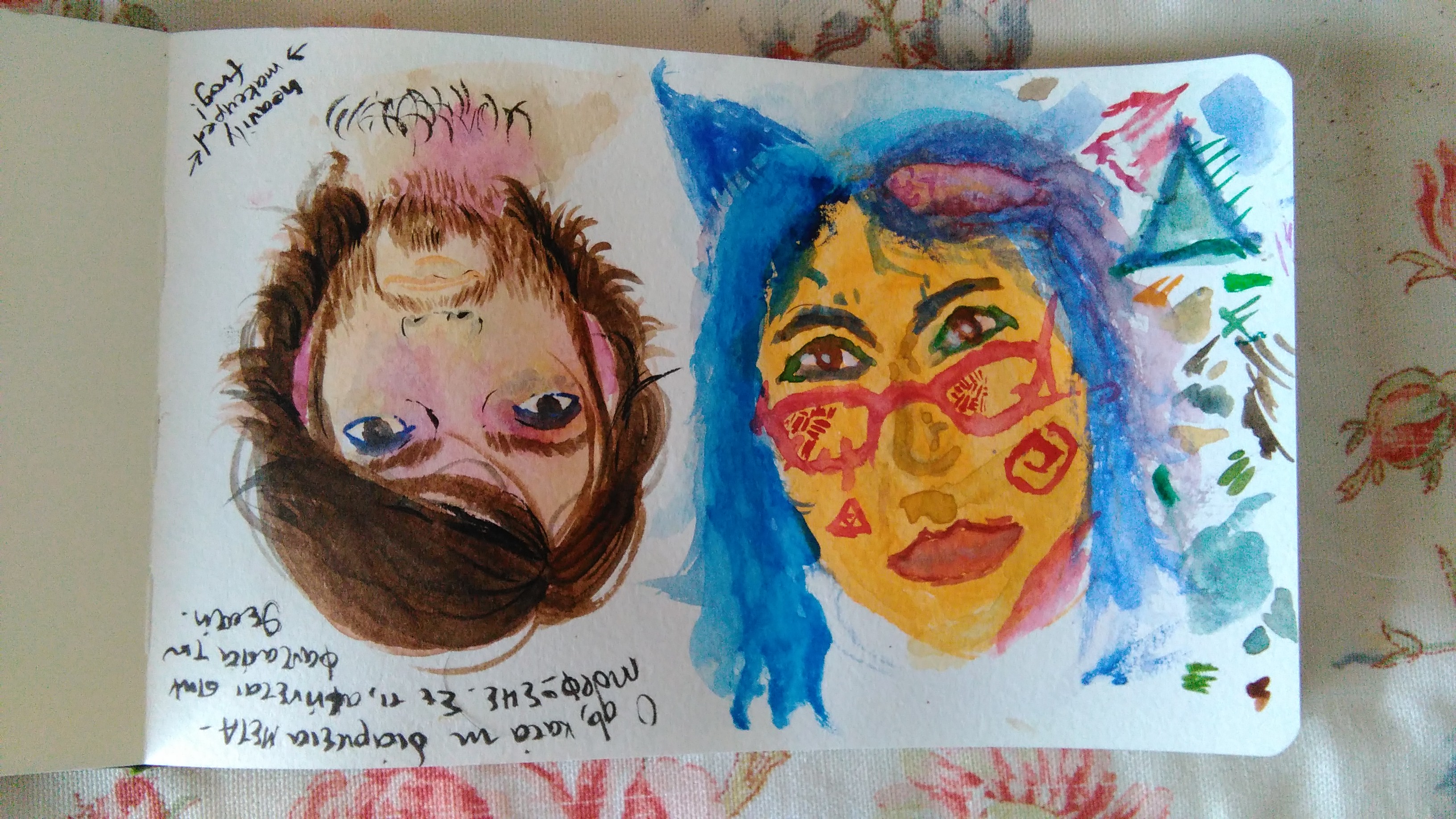
And this would have never existed if we hadn’t said “okay, what should we do now? Let’s paint!” — “OK, what?” — “eachother!”

painting_eachother

But motivation is still a limited resource that can be separated into qualitative levels: you can have good motivation, bad (negative?) motivation, pure motivation and unstoppable motivation. All the lack of distraction does is bring forward the standard kind of motivation that under ordinary circumstances simply isn’t strong enough to become a greater priority than habit and addiction (media/internet). I suppose the kind of motivation we’re after is the one that needs no media fasts to rear its elusive head; it just trumps anything and everything!

But then again, you have people like Frank Herbert who just wrote motivation, inspiration, or no… How about it, qb?

REVIEW: THE AGES OF GAIA

The Ages Of Gaia: A Biography Of Our Living EarthThe Ages Of Gaia: A Biography Of Our Living Earth by James E. Lovelock

My rating: 3 of 5 stars

It took me many months to finally finish The Ages of Gaia. I suppose it’s because a lot of it was dry in the way scientific writing is dry to people who are not scientists but wish they could understand what scientists say. Daisyworld, for example, is an interesting supposition and thought experiment on how planetary phenomena influence and are influenced by life on a smaller scale — an idea that today seems typically banal but was novel at the time it was brought forward. I understand it intuitively, but the relevant science flew over my head, along with a great part of what else made this book important, I’m sure.

Where Lovelock’s writing was more approachable, I found it profound and enjoyable to read. I particularly enjoy how some of it could easily be divisive among ecologists and could be used to spark discussion, for instance his careful (and in my humble opinion, very balanced) examination of nuclear power, or the suggestion that anything alive is by definition a polluter to its environment, helping some species thrive and others wither away in a delicate eternal dance (or war, if you prefer that analogy). The chapter “The Contemporary Environment” is a must-read for anyone who’s interested in big-picture ecology and where it fits today… or where it used to fit 20 years ago and more. Even his early approach to geoengineering, long before it was an unwelcome reality, is enlightening to read: “So that’s what the scientists were thinking before the big shots took control of global climatic planning.”

Generally speaking, Mr. Lovelock displays great wisdom on a number of different subjects, the discussion of which is seldom characterised by either lucidity or farsightedness (widesightedness?). However, looking at his views today, which show that in his very old age he’s somewhere between trying to be pragmatic and being resigned, they are even more difficult to digest. Has he gone off his rocker, is he paid or is he just that big of a visionary? Google him and you’ll see why I’m asking these questions in particular.

To end with his hypothesis: will Gaia “do” anything (to the limit of her proactiveness) to preserve life on her surface, much in the same way our body would react to anything which could harm the microscopic (our cells and tissues) as well as the macroscopic life — us? Are we really a terminal threat to life on Earth, or could it be that:

“Looked at from the time scale of our own brief lives, environmental change must seem haphazard, even malign. From the long Gaian view, the evolution of the environment is characterized by periods of stasis punctuated by abrupt and sudden change. The environment has never been so uncomfortable as to threaten the extinction of life on Earth, but during those abrupt changes the resident species suffered catastrophe whose scale was such as to make a total nuclear war seem, by comparison, as trivial as is a summer breeze to a hurricane. We are ourselves a product of one such catastrophe, the extinction of many species 65 million years ago. Could it be that we are unwittingly precipitating another punctuation that will alter our environment to suit our successors?”

View all my reviews

REVIEW: UNBELIEVABLE

Unbelievable: Investigations into Ghosts, Poltergeists, Telepathy, and Other Unseen Phenomena from the Duke Parapsychology LaboratoryUnbelievable: Investigations into Ghosts, Poltergeists, Telepathy, and Other Unseen Phenomena from the Duke Parapsychology Laboratory by Stacy Horn

My rating: 3 of 5 stars

There used to be a Parapsychology lab at Duke University. It started working during the Interwar period and closed down sometime in the ’70s. Its figurehead was a man named J.B. Rhine. His goal was to scientifically prove the existence and significance of ESP and psi phenomena. Unbelievable is a journalist-style investigation into the story of that lab, the people who manned and womanned it and its discoveries.

We all know today that no such concrete proof exists. That, however, is not so because there are no cases that could suggest their existence. Rhine’s work included many interesting cases, most featured in this book, that seem to have been truly paranormal, in the sense that they’re still inexplicable in the conventional sense. For example, take the case of Hubert Pearce, who scored so consistently highly in the card tests, the only explanation barring ESP would be fraud — and that is, of course, what critics insist all this amounts to. The math checks out, the guidelines were followed, but the research was scarcely taken seriously. It is understandable, however. The effects of telepathy, ESP or psychokinesis were detected in multiple instances, but no kind of underlying theory was ever properly produced. But wow, imagine what kind of shit that would’ve got.

My opinion is that, ultimately, sadly but inevitably, no kind of evidence would have convinced the critics. Rhine’s life work was a doomed effort, as many people at his side also concluded by the end. How can you recreate the conditions, usually emotionally charged situations together with other highly subjective variables, to consistently produce ESP-related phenomena in the lab? Until we (somehow) change scientific methodology to include what’s left outside the lab, in order to make it more lifelike and less sterile, science will have very little room reserved for ESP and related effects. That, and it needs a theory.

In any case, apart from the fact that this book is a handy reference for the studies that were the foundations for the scientific inquiry into the paranormal, it was a book that tells a story. A story that is still valuable today, because for all that’s changed from the middle of last century, little really has. The paradigm hasn’t shifted as much as other kinds of progress could warrant. But remember, half a century or seventy years really isn’t such a long period of time. Who knows what science, physics and consciousness studies in a few centuries will have to say about the matter.

Got this book at Green Library last year.

View all my reviews

GROWING SICK OF THE ‘NET YET AGAIN: INCOMING MEDIA FAST

I’ve been disciplining my body these days more than I ever have. Namely, I’ve been following Reddit’s Starting Stretching, Bodyweight Fitness Training Routine for beginners and I finally restarted going for runs, aiming to relive the “glory days” of being able to run up to 10 kilometres, which in fact I managed to do exactly one year ago while I was in Sofia (post about me finally running 8k).

For the past few weeks, I’ve been going to the Alsos almost every day, rotating the bodyweight fitness (push-ups, pull-ups, handstands, L-sits etc) with the running. And it feels grrreat! Daphne has been helping a lot with cooking healthy and nutritious vegetarian meals with lots of protein, not that I’m shy of the stoves, but  I tend to cook the same three or four things, not experimenting unless in the mood, and with her in control we’ve been eating like vegetarian kings. It activates me and it’s bringing in some good skills to have. I don’t know if I would be doing it if I didn’t have all the free time I have now, but that’s beyond the point. Having a workout and exercise routine helps me bring some (illusion of) order to my disorganised life, and with some much appreciated visible results.

Nevertheless, what I haven’t been able to organise, discipline and harness at all– seriously, AT ALL — is my mind.

In June last year, apart from running 10k, I posted this little write-up I’m still proud of:

I’M SICK OF THE INTERNET – AREN’T YOU? GETTING THROUGH INTERNET ADDICTION

Trouble is, I didn’t go through with what I pledged I would do. As far as I can remember (which isn’t a lot, because, as typically happens when you regress to addictive behaviour, your memory-forming functions give way to the reptilian dopamine-releasing pleasure centres, quite conveniently, too, because you don’t really want to remember in shame the ego-shattering moments when you and your actions fail to hold up to your initial intention), ten days later I was again browsing the web, free as a bird — or, to be more precise, free as a bird enclosed in a cage made of invisible walls.

A few days ago, while I was running no less, the thought came to me: why don’t I try again with this whole less internet, less  media thing? I could use the extra time to think and create. I seriously miss creating…

The next 4 days I’m going to be in Loutra doing a media fast with Daphne: each day, we will be allowed to use the internet for just 30 minutes, and that’s just for e-mail, practicalities and Rights4Water. The rest of the time, anything with a screen will be off-limits. No movies, no games, no TV, no smartphones — I will switch mine to battery-saving “dumbphone mode”– no distractions from the interestnet. The only exception will be my Sansa Clip Zip I will be using for audiobooks, podcasts and music for when I’m doing exercise. The idea is to limit options, minimise distractions and allow for deeper thought and even boredom, which will force us to be creative instead of us automatically turning to the mind-numbing net for excitement and stimulation.

Let’s see how it goes.

QUOTES ~ ΑΠΟΦΘΕΓΜΑΤΑ №… HUH. OH WHO CARES ANYWAY. THIS ONE’S ABOUT INTROVERSION

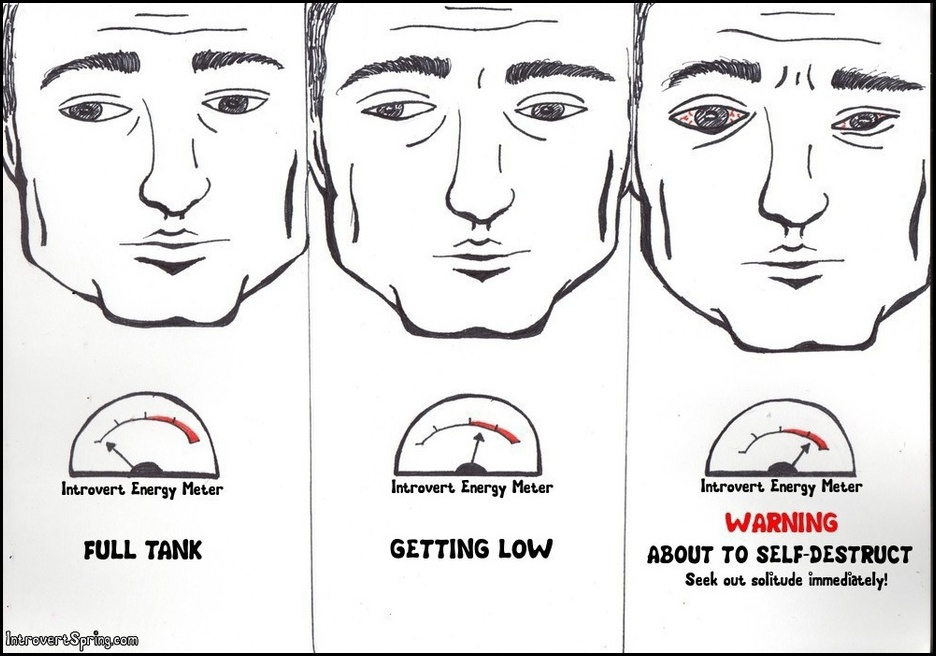
“As an introvert, interacting with other people feels like exercise. I feel better about myself every time I do it; it makes me stronger and healthier. It also exhausts me, and if I do it too much I feel sore and cramped. But if I go too long without it, I feel sluggish and stifled. Ultimately, it is the space between that energizes and sustains me. And some days, I just don’t feel like working out and would rather sit on my ass and read a book by myself.”

-Daniel Miles

introverspring.com
introverspring.com

REVIEW: DUNE

Dune (Dune Chronicles, #1)Dune by Frank Herbert

My rating: 5 of 5 stars

“Unique among SF novels… I know nothing comparable to it except The Lord of the Rings.” ~Arthur C. Clarke

I’ll begin with what I saw when I first checked what my Goodreads friends had to say about their experience with Dune:

Thank the gods it was Kivayan, my friend Kuba from Poland, who first made it clear to me how important it was that I read Dune, and not just the first book, no, the whole original series, because only then would I be able to witness the genius of Frank Herbert’s grand image (that there was my attempt to express “big picture” in a more fittingly epic way). Thank the gods it was him and not someone else’s opinion which would have left this book under my personal radar, where it had been for many years.

Scratch that. It hadn’t been under my radar. I’d been aware of it since I was little, mainly from video games or perhaps Karina—I just didn’t know exactly what it was about. All this desert, the sandworms… It looked boring. Like something too slow, deep or intricate for me to enjoy. And let me tell you, I wasn’t wrong: if I had dipped my toes in the spicy sand before I’d reached a certain point in my life, I’m confident I wouldn’t have enjoyed it at all. If I had to say, I’d place the point in question around the time I started watching Game of Thrones, playing alt-history games and reading books like The World Without Us or The Dark Tower.

I had started being able to enjoy books like Dune, only I couldn’t make the connection in my head and notice the switch. There was nobody to suddenly come up to me and tell me that the famous, apparently super-influential old SF book I’ve always thought I wouldn’t enjoy, actually involves loads of topics I’d find very appealing: religion, feudal politics, anthropology, psychology, history, ecology and many others, creating a narrative about how narratives, and historical narratives in particular, work, which I expect to discover further in the next books. Well, there was someone: it was Kuba. But if it hadn’t been for him and a few other people like Amberclock who told me about Jodorowsky’s Dune or JMG who often mentions Dune in his Archdruid Report posts, I’d still have the impression that the book is a boring classic, that it’s to SF what perhaps Proust is to modern literature: supremely influential and important, but not enjoyable.

Of course, I was wrong. I may be wrong about Proust, too. But that’s the point: we’re talking about preconceptions here.

What surprises me is that, for it’s alleged importance, very few people I talked to about Dune while reading it even knew of it. For a book that supposedly played an important role in the popularisation of ecology as a word as well as a term and for one which is among the all-time bestsellers of the genre, it is forgotten today by most. I’ll go down a path I don’t think it’s fair to go down on, but how many people know of Tatooine and how many of Arrakis, Dune, the Desert Planet that surely inspired it?

Nevertheless, I found its ambience as a contemporary read very comfortable, even if 50 years have passed since it was written. Water as a super-valuable commodity (with all related cultural conventions) feels right and is played perfectly. Arrakis is majestic. Reading about the Fremen was very interesting and convincing, and I thoroughly enjoyed discovering the book’s unknown world by looking up the juicy neologisms in the appendix (every book like this should have one!)

Not all’s perfect with Dune, don’t get me wrong. Its characters can feel one-sided or shallow, even Paul, who at times comes off superhumany… but then, hey, he’s supposed to be the one, isn’t he? The various political actors and the role of spice in all of this aren’t very clear, but you know, it’s one of these books you’ll read again and next time it’ll make more sense.

But the weak points don’t matter. Dune is a classic, period, and I’m happy for once to have truly enjoyed a classic because it’s a classic, not despite the fact. What can I say? Herbert’s foreword to the book reads:

“to the people whose labors go beyond ideas into the realm of “real materials” — to the dry-land ecologists, wherever they may be, in whatever time they work, this effort at prediction is dedicated in humility and admiration.”

Good man.

View all my reviews

REVIEW: IDLEWILD

Idlewild (Idlewild, #1)Idlewild by Nick Sagan

My rating: 3 of 5 stars

“This guy obviously has a sense of wonder in his DNA… an essential upgrade for The Matrix generation — download now!” Stephen Baxter

This quippy blurb was written many years before e-books appeared. When he’s saying “download” he’s simply using tech lingo. People didn’t use to download books just ten years ago. Just making sure.

Well, Stephen Baxter’s quote about Idlewild, which features several times in this book, including most prominently on the cover, is what it’s all about really. I imagine Nick Sagan hates continuously being compared to his father in such a way, but I can’t imagine a better ad for the book itself. I mean, it’s the reason I got interested in it in first place (“huh, Carl Sagan’s son wrote a sci-fi book?”), and to be perfectly honest, I can’t shake the feeling it has a lot to do with why it was written, too.

Anyway, Idlewild reads a lot like a cross between The Matrix, Harry Potter (or other books similar to it that have many special youngsters studying their powers together), Neuromancer and Doctor Who, because of the virtual reality time-and-space-travel. If that sounds entertaining to you, I think you will have a good time reading it (I did).

Admittedly, I thought that the characters were much stronger than the plot itself: while reading I was much more interested in seeing what kinds of new and interesting interactions could emerge between them than I was reaching the end. Nevertheless, I have to say that the plot twist came completely out of the blue, and yes, I’m mildly curious about the sequel. I might read it at some point.

Finally, I would have given it four stars if it wasn’t for the fact that at times I could notice instances of Mr. Sagan attempting to flex his literary muscles. With truly masterful writing this may or may not be perceivable, but it doesn’t really matter, because the reader is inclined to surrender, to suspend disbelief. “This was so cheesy, but I love it!” Here I often caught myself realising that I was reading parts of the book that the writer, Carl Sagan’s son, rewrote many times while actively trying to make them appear as intelligent and techno-cool as he possibly could. Did he succeed? Well, I guess it depends whether you’re asking about the appearance of or the actual intelligence hidden within.

View all my reviews

FUN VS. CHANGING THE WORLD

From Ran Prieur’s May 11th 2015 blog post:

May 11. I left off last Friday with this quote from Sarah Perry: “For many people, time is not a gift, but a burden, to be filled with alcohol and television and other palliative technologies.” My disagreement is not with that sentence exactly, but with two ideas that might seem to follow.

One is that it’s bad to have fun, or that all this fun stuff is distracting us from rising up and making a good society — as if we all agree about what a good society looks like and how to get there. This whole way of thinking is based on an assumption about the purpose of life: that merely having a good time is a bad use of your life, and the correct use of your life is trying to make a better world.

Humans have been trying to make a better world for thousands of years. In many ways we have failed and accidentally made a worse world, so we should be skeptical of making a better world as a noble goal. And to the extent that we have succeeded, we should appreciate and enjoy the ways the world is better, instead of being like an ambitious person who is never happy in the moment. Sometimes the path to a better world is doing something that seems fun and useless, and it leads to somewhere unexpected.

Notice that people who condemn TV and video games and recreational drugs never condemn books. Of course books are better in some ways, but the thing that’s best about reading can be good about any entertainment: it can expand your consciousness and show you other ways of being. I think even spectator sports are helpful because they generate public stories that are more honest than the public stories in politics, so someone who follows sports can more easily recognize political bullshit.

A reader sends this article from the Guardian about Eve Online, a massive multiplayer sci-fi game that has outlived similar games by making good decisions to keep players interested. People play games because they’re better than society: they’re a better fit for human nature. When we understand this, there are at least two directions we can go: make political decisions to make society more like a good game, or make society as stable and harmless as possible, and use it as a platform for artificial worlds.

While I agree with Ran deep inside of me, I’ve been influenced all my life by and gravitated towards people who strongly believe in making the world a better place, or that such a thing is possible. I’ve grown into the position that a balance between fun and “making the world a better place”, whatever that means, again, is more desirable than just having fun or following one’s one path, which might not necessarily include improving the paths of others. However, this implicit drive has brought me much conflict, self-doubt and guilt.

I find that I’m the most comfortable when I confront that “making the world a better place” is perhaps not such a good way of spending one’s time here, if purely for the quasi-impossibility of seeing results, unless one can have fun or feel good about it at the same time.