Huff. It’s been almost 8 months since I read Into the Wild and I still haven’t reviewed it. OK. Let me look at the little notes I took while reading it so I could remember the points I wanted to make about it before giving it back to its rightful owner, the Dutch girl Rian who, before lending it to me, told me that it’s in her top five books.
Hey, why not copy the notes here?
*He’s received unwarranted flak. Like Thoreau, criticism against him is really against an idea he never supported explicitly.
*Krakauer fantastic reporter/researcher. Weaves everything together, including personal and parallel/related stories, convincingly.
*Started reading at 17:30. Read the whole book in more or less 6 hours in almost a single sitting.
*Quotes at beginning of each chapter great addition—include McCandless’s own notes and favourite quotes.
*What if Krakauer had died in his own mountain climbing story he retells in the book? Would we have ever heard about Alex Supertramp?
*Similarly, if Christopher McCandless hadn’t died, then his story wouldn’t have become known. There are countless others who live the life he wanted to (and for a time, did) live, but they are virtually unknown to all but few.
*Arrogance? Indignation of his father? What exactly was the final straw that pushed him into the wild?
Then there’s Daphne’s notes who also read the book before I gave it back to Rian. She can take care of those, if she wishes.
What I can say is that McCandless is a very controversial figure. You either love him or hate him, and I’ve noticed that people’s opinion on him have very different sources. Some admire him for his courage to abandon his reality and/or prospects of what most would consider a successful and happy life, in order to venture out and into the “real” life. Others believe that his greatest achievement was to live as long as he did the way he did, that he was a free spirit, an example for all.
Then there’s those who say that Alex Supertramp’s story was just a glorified suicide, that a great part of his story has been misrepresented, especially through the movie. They dislike him for his unwarranted fame and his selfishness for abandoning his family and good fortune.
What I can say is that I’m torn. I wouldn’t call his story a glorified suicide. Perhaps it was until or after some point, but right before the end it seems that he’d learned his lesson, the famous “Happiness only real when shared”. It’s interesting that he ultimately didn’t care whether he’d die or not having chosen to live the way he did, but for crying out loud, he was practically next to civilization when he chose to live in that school bus! Some preparation could have saved him his life… if he wanted to survive, that is. Again, perhaps it had started out as a suicide before Supertramp realised what he’d got himself into and what he had really left behind.
My biggest takeaway from the book isn’t the story of the human thirst for freedom and adventure, nor the idea that “the system can be hacked, what are you waiting for?!”. It’s the notion that people naturally glorify death and dying for one’s alleged cause. That makes all the difference.
It was my first time to cross the Atlantic, indeed the farthest I’d been from home since my last time in Australia in 2002.
What took me to the second-smallest country in South America was yet another you-only-pay-30%-of-travel-costs European youth project. This one’s called Grassroots Youth Democracy. In it, youth from Greece, Italy, Ecuador, Uruguay, India and Mauritius will participate in joint research on the water context of each participating country, which in turn will culminate in a media product and relevant campaign to raise awareness on the issue of water as a basic human right and common good.
Grassroots Youth Democracy is separated in phases and will take most of our time for the rest of 2015. Phase 1, which was the purpose of the trip I just came back from, was a week-long seminar on water rights in general. Participants had the chance to make presentations of what the water context in their specific countries is, and we also made a first draft of the plan we’re going to use for organising this international campaign between ourselves: who’s gonna do what, what our research methodology will be, what we’re going to with the data etc. After all, co-ordinating a local team can be hard; one strewn across four different continents? Yeah.
Phase 2 will take place in May in Rome and will consist of a media seminar: teaching the participants how to use a camera, do interviews, edit videos, update a website and such things I have the skills to help with. Thank you, University of the Aegean!
Phase 3, which will start right after Rome and last until mid-July, will have the participants from the extra-EU countries come to Greece or Italy and do a field research on the water situation in the respective country, that is collect data for articles, videos and other material to be used in the campaign. There will be interviews with NGOs, analysing stats and delving into the unique water-specific problems of that country. In Greece, for example, the participants will look into what happened with EYATH and its privatisation and how it was avoided by the resistance of the civil society through the 2014 unofficial referendum. They will also research the problem of the lack of drinking water in some Greek islands, such as Aegina, and the sometimes even more problematic solutions corrupted authorities have come up with to alleviate the situation. These are just some examples.
Phase 4 will start right after Phase 3 and last until September. Basically it will be like Phase 3, only the other way around: the Italians and the Greeks, of which there’s four of each, will do the same kind of field research in pairs in Uruguay, Ecuador, Mauritius and India. This is when I’m going back to Uruguay for two months, during the southern heart of winter! No Greek summer for me this year.
After all the above, we’ll collect all the data we’ll have got and make something out of it: a small book, an online database, a documentary, a social media assault… a little bit of everything. This will be our awareness campaign (and I hope it will end up a little bit more exciting than I’m afraid I’m making it sound here.) There will be a final conference/presentation of results but not a lot is known about it yet.
To be perfectly honest, Phase 1 in Montevideo, the one that just finished, needed more outdoors activities. The presentations and material discussed on water issues were interesting and our team-building was successful, but after a certain point I found it hard to concentrate on Powerpoint after Powerpoint and group brain-storming activity after group brain-storming activity. Being in the same room for hours on end with little chance of going out in the warm Autumn sun apart from during the short coffee breaks and the lunch (which was admittedly DELICIOUS and very vegetarian-friendly—THANK YOU CRAZY MARIO, cook of La Fonda!) made it much worse. During the first few days we saw practically zero of the city and at the end of each session I felt much more exhausted than I believe I should have.
No matter. In the end it was a valuable getting-to-know-you with the team and we did some important work. We will just have to work hard from here on out.
…what? You want to read about Montevideo and Uruguay, NOT the seminar? What are you, crazy?!
OK, get this: Uruguay is an extremely interesting country, given its small size and low importance on the grand scale of things. Sorry, let me rephrase that, because everything that’s ever taken place on this planet is of extremely low importance on the grand scale of things—low importance as far as human societies go; countries, politics… you know, that sort of thing. I mean, what do you know about Uruguay?
What I knew was that the country’s (now ex-) president donated 90% of his salary to charity and generally lived super simply, and that recently they legalised marijuana. That’s pretty much everything /r/worldnews would let through the filter. Ahem…
Let me tell you: both of these things are true.
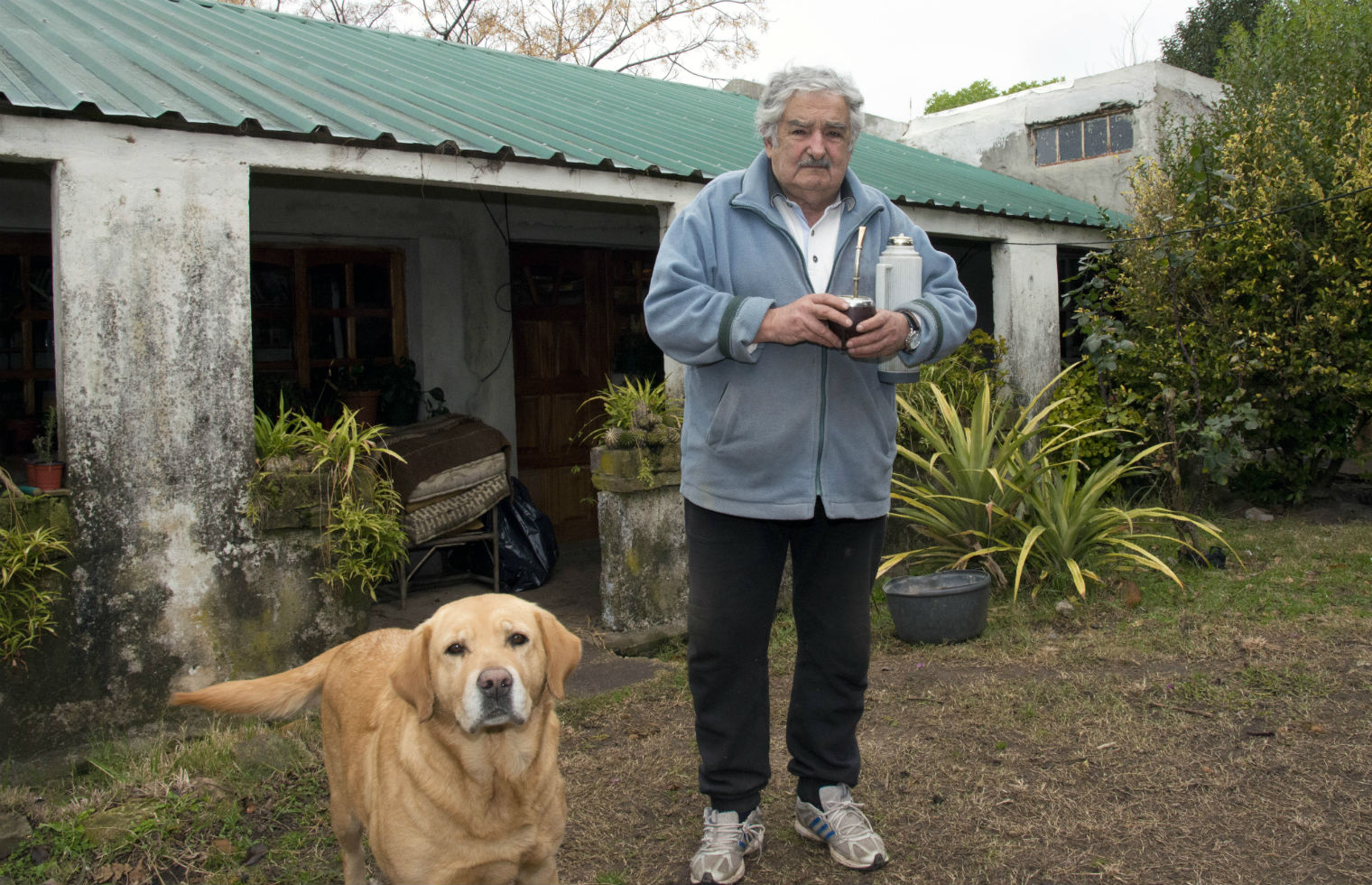
Mujica with his three-legged dog and some maté. More on that in a sec.
José “Pepe” Mujica is seen as a bit of a populist in Uruguay itself, but here are eight reasons why he should be missed by the rest of us, according to The Independent:
1. He donated 90% of his salary to charity. 2. And lived on a farm. 3. He drives a 1987 VW Beetle. 4. And picks up hitch-hikers. 5. He legalised marijuana. 6. He leaves the economy in rude health. 7. He’s just not like other politicians 8. And all that after being shot six times and being put in jail for 14 years for opposing the country’s former dictatorship.
Have a look at the article for a few more details, it’s worth it. What are the chances a guy like this could ever be the leader of your country?
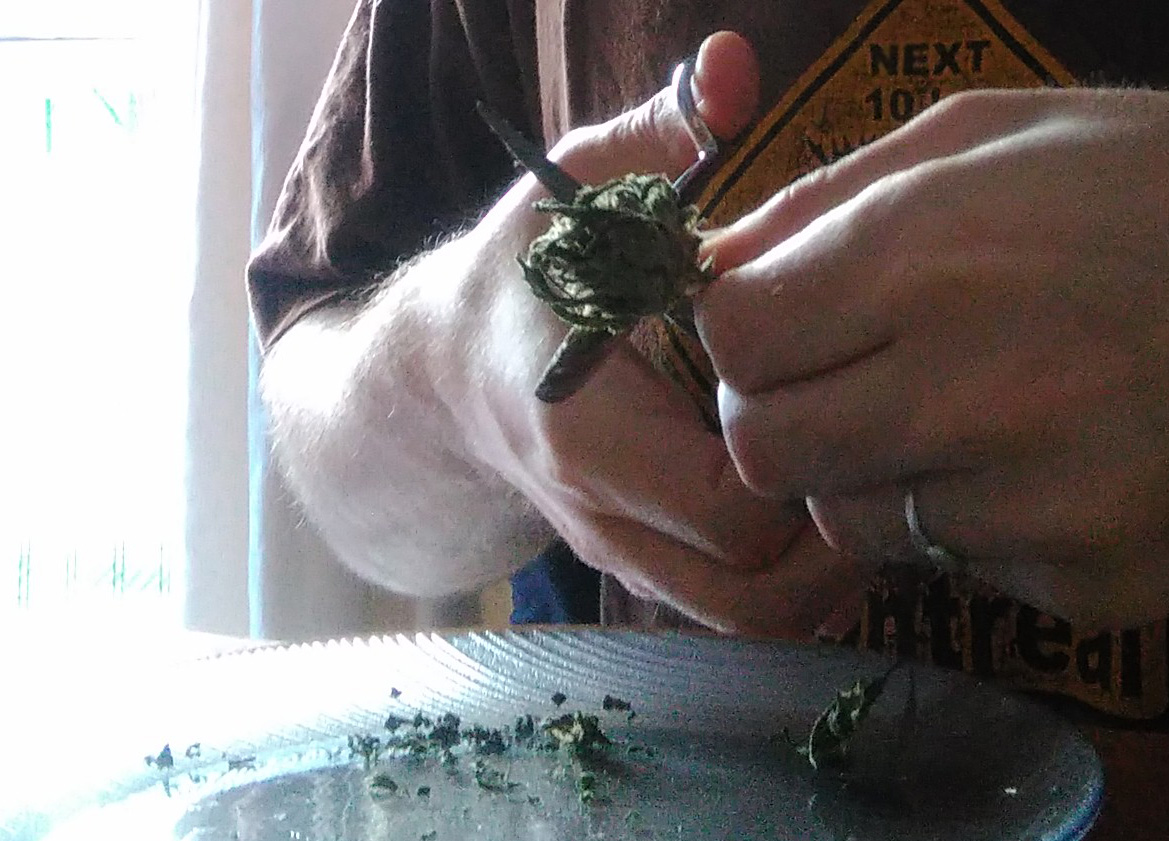
SWIM doing a preparation of a special Uruguayan herbal incense.
Now, that other thing. “You know that in Uruguay marijuana was recently legalised, don’t you?”, said one of the Uruguayan participants to me before I could even ask her anything about it. “Everybody does it here. Even ten years ago people in suits would light one up after work. The thing is, you can’t go somewhere to buy it. Not like that. You have to be a resident and a member of a marijuana club if you want to purchase it. But many people have a little plant or two at home and will soon offer you some!”
I suppose the above is true for young people, but who knows? It didn’t seem to me that marijuana use was 100% socially accepted in Uruguay, there must be some controversy remaining, but it looked close to it. I say they have the right idea. There really is zero reason marijuana should be as illegal as it is in such big part of the world. Zero. Addiction-related issues, whenever they arise, should be treated medically and psychologically, similar to the way alcoholism is treated, not be a matter of concern for law enforcement. This system has already been adopted in a lot of countries. Have a look at this map caught from the wikipedia article on the legality of cannabis around the world:
But there’s a bit more to Uruguay than that.
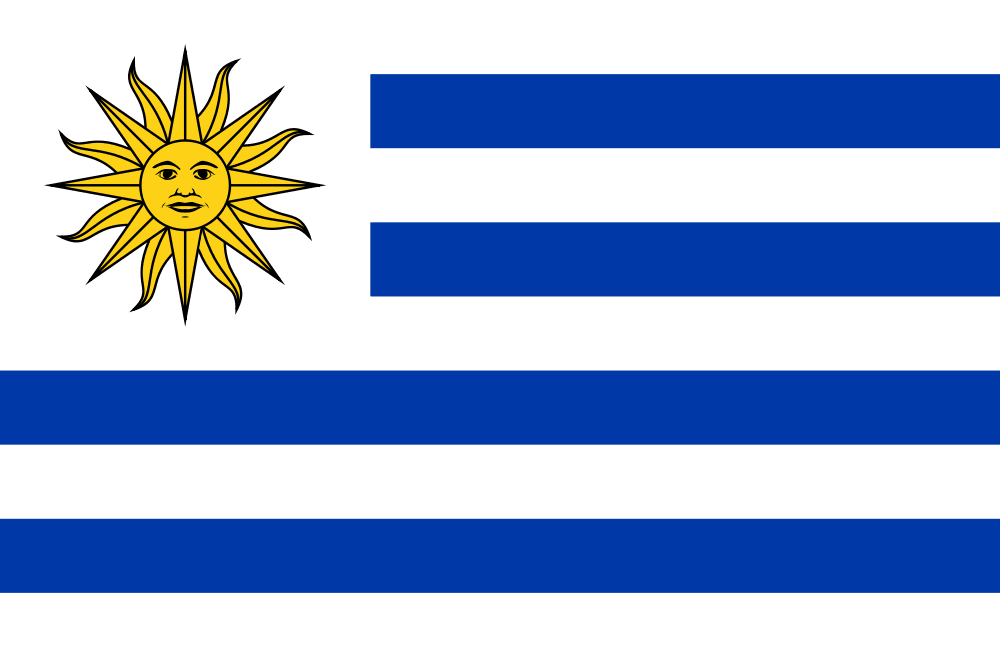
What does this flag remind you of? They have the same number of stripes, too. Want another fun fact that goes with the similarity between the flags? Both Uruguay and Greece were de facto created in 1828. But, as I learned recently, the Greek flag as we know it now was standardised during the military dictatorship. Before that it used to be simply this:
This was the state flag and the one we use now was the merchant and national flag, before the former was abolished completely.
Back to the othercountry with blue and white stripes on its flag.
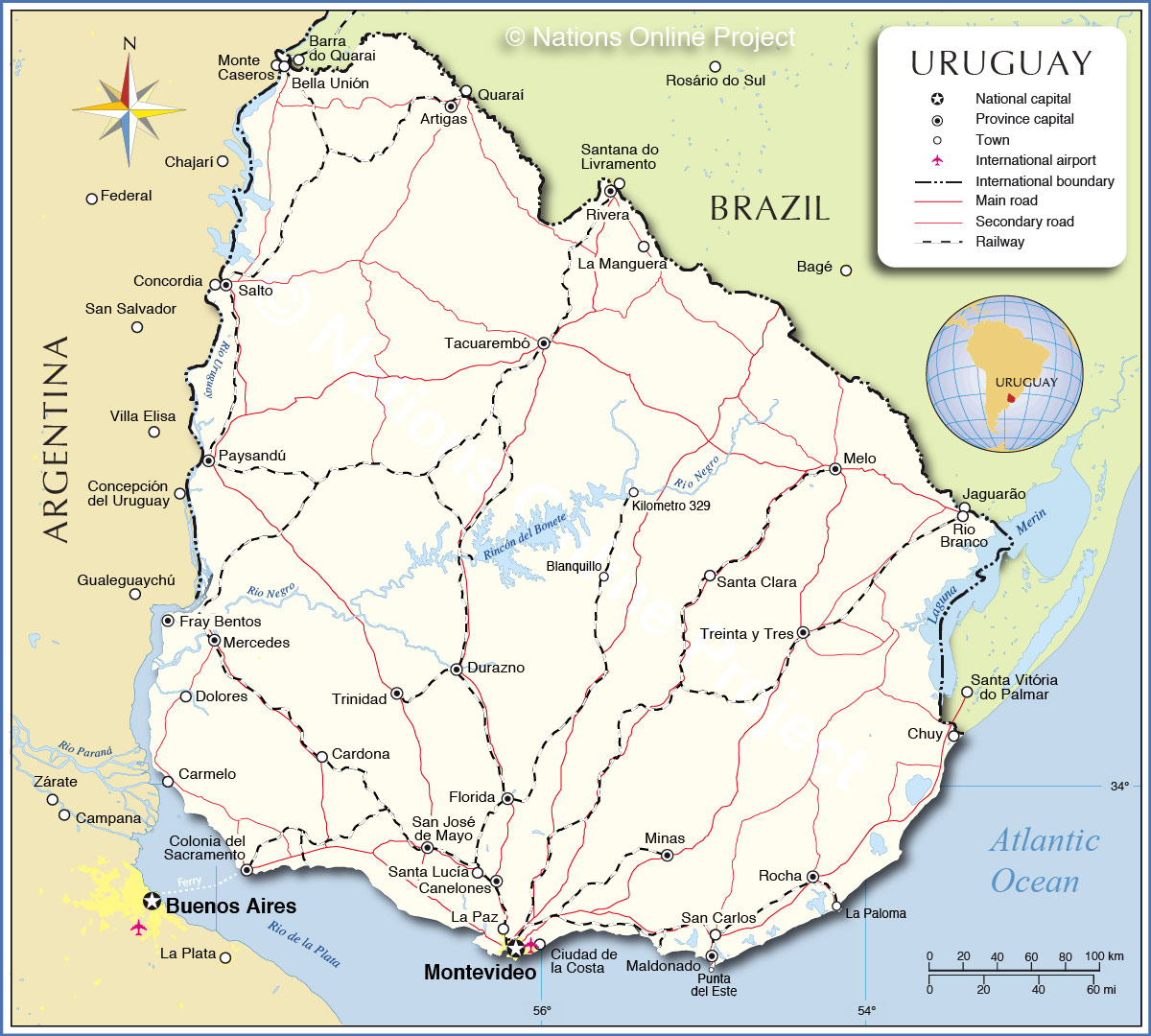
Uruguay’s name comes from the river forming the natural border between it and Argentina. It is the indigenous Guaraní language for “the river where the painted birds live.” Beautiful image, isn’t it? It flows out into the that bay to the left of the map, the famous Río de la Plata — the river plate. It’s a hallmark and a point of reference for both Argentina and Uruguay. Some consider this formation more of a river delta than a bay, but really it’s somewhere in between: in Montevideo and even as far out as Punta del Este, the water is much less salty than normal. There’s no clear point where the río ends and the sea starts. Truly a unique formation.
Next: a brief overview of the country in video form. This video was funded by the Uruguayan Ministry of Tourism. I’m serious.
Uruguay es el mejor país: Uruguay is the best country. A semiotically complete touristic message if I ever saw one. We should try something like that back home.
In fact, there’s plenty of other policy “novelties” this country has going for it we should be trying out in Greece. Barring the relatively high cost of living, the not-too-great wages and the kind of plain landscapes (heh), in a few ways it really is one of the best countries out there. For a start, they have managed to stave off privatisation of their public sector almost completely, only selling off their mobile phone operators. Water itself has become a constitutionally-reserved state-managed human right since a relevant referendum was conducted in 2004. That’s impressive no matter what way you look at it. In addition, same-sex marriage has been legal for two years.
All the above together puts most of the “progressive world” to shame, let alone our backwards little country called Greece. Then again, Uruguay is a secular society, in stark contrast to our country where the embarrassingly rich church is still constitutionally connected to the state, which, just to remind you, means that Orthodox Christianity is taught at schools, priests are paid with our hard-earned IMF and European loan money (and pay no tax in return) and the country is still, for all intents and purposes, exclusivelyOrthodox. I won’t get started with nationalism and Greek superiority/inferiority complexes…
Tell me, how many people would you imagine enjoy the benefits of living in this little country? It’s whole population is barely that of Athens at ~3.5 million people, with roughly half of that concentrated in Montevideo. This bit surprised me, because I’ve always thought of South America as the land of mega cities. To illustrate, nearby Buenos Aires has a metro population of almost 4 times that of Uruguay as a whole, and Sao Paulo, which isn’t such a long way away either, is close to 6 times that.
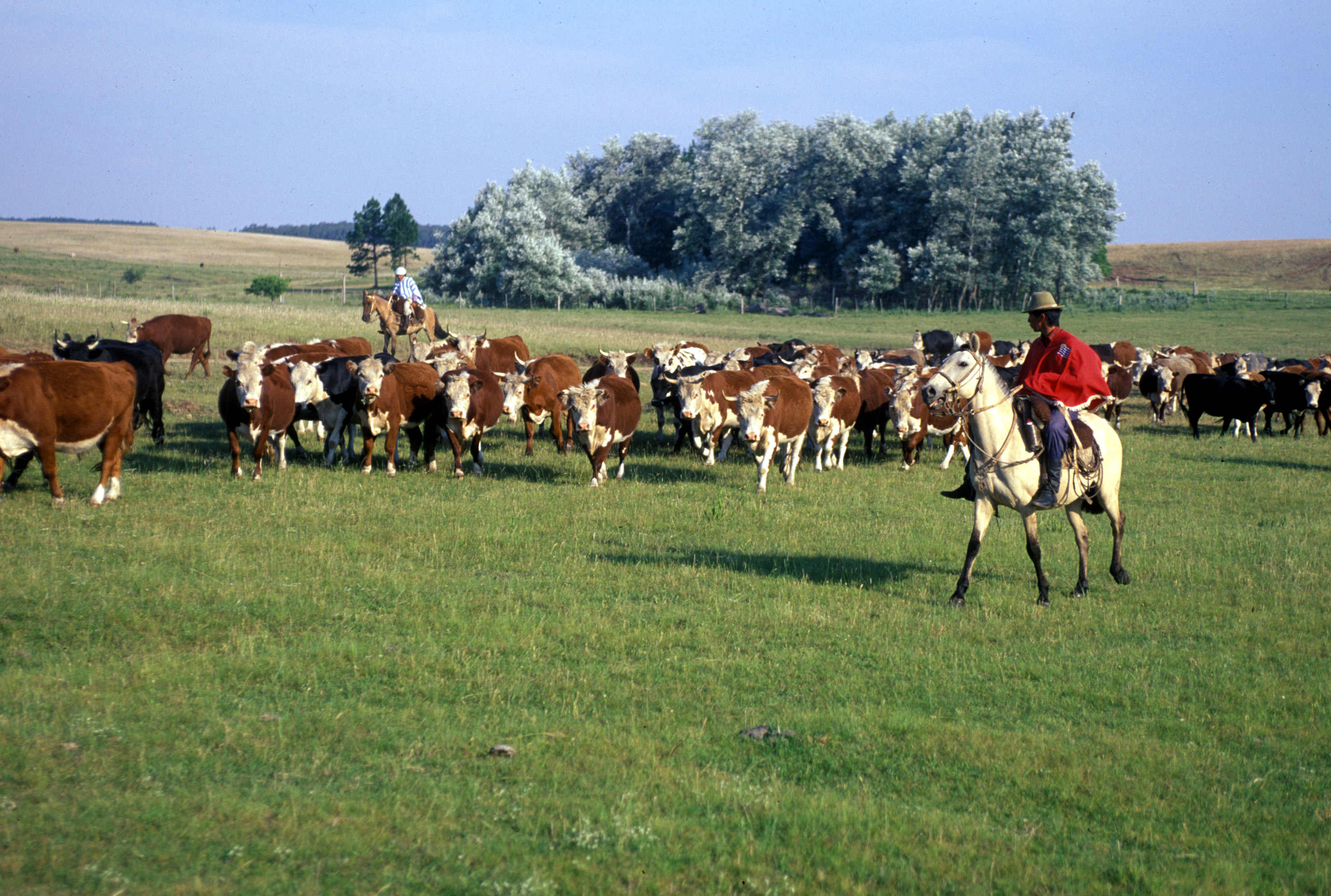
For its modest count of human residents, this small country is the holder of a different record: it has the most cattle-per-capita ratio in the world: there are roughly 3.59 Uruguayan cows for each Uruguayan person. Impressive as that may be, note that this number still collectively accounts for just ~1% of global bovine populations.
Gauchos — Argentinian/Uruguayan cowboys
With so much mooing going on, you’d think the guys would have some decent yogurt. Nope… Even the “integral” yogurt, the one most similar to consistency to the ones we enjoy in Greece, contained sugar. This reminded me of Bulgaria, which most Bulgarians claim to have fantastic yogurt—supposedly very successful and sought after in South Korea. Needless to say, this legendary Bulgarian dairy product is nowhere to be found, or perhaps I tried it and just couldn’t tell the difference. What can I say, years of straggisto are bound to leave a mark.
Not all Uruguayan products are shoddy, though. Far from it. Mate (pronounced máte) is for Uruguayans what frappé is for Greeks, or, according to some Greeks, what it used to be, as freddo espressos have become more popular. Mate is an invigorating hot drink, like coffee or tea, ideally shared among a circle of friends. People drink it in wooden cups that slightly look like coconut shells but are made of gourd (or calabash). In it they drink the mate herb tea, which they infuse with hot water poured from a thermos and refill many times. It is drunk with a metal straw-like instrument called a bombilla (pronounced bombisha in Rioplatense Spanish). In the video below you can see an English speaker preparing mate.
I think I’ve written enough for now. I congratulate you if you made it this far! Here are some pictures for your viewing pleasure, half of which are taken by me and the others by Martina.
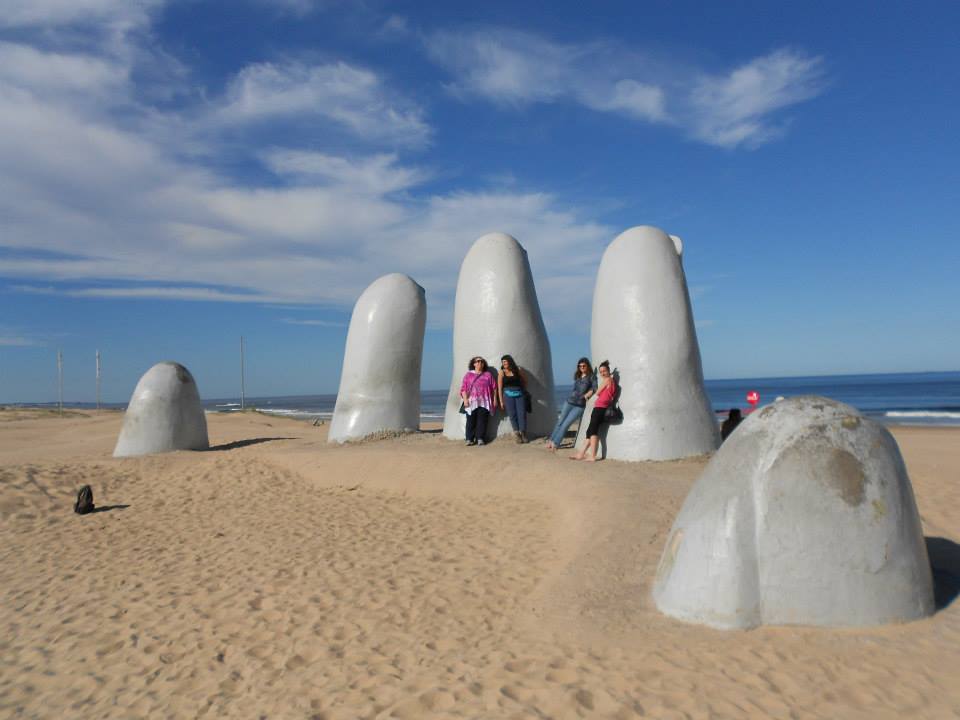
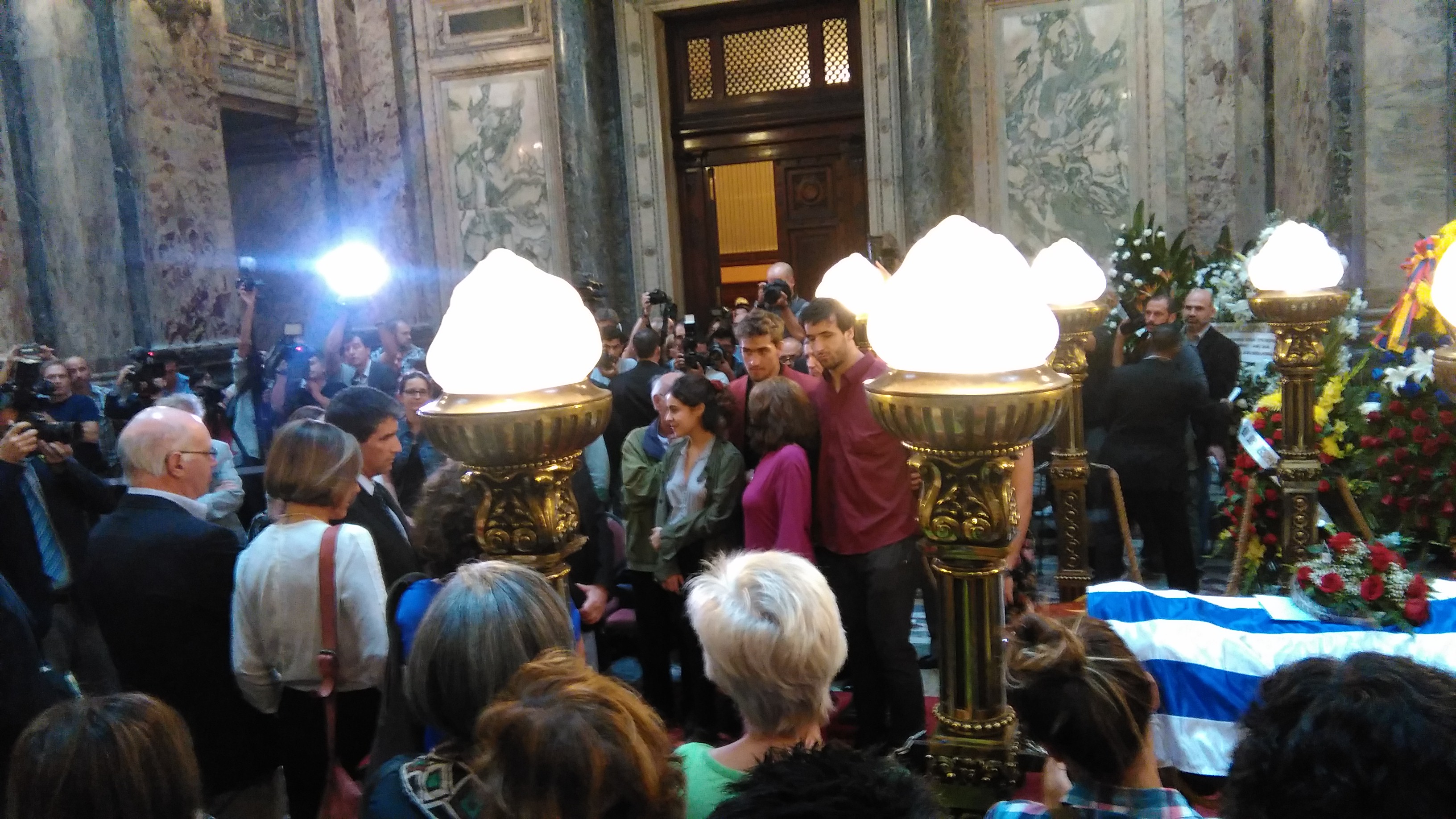
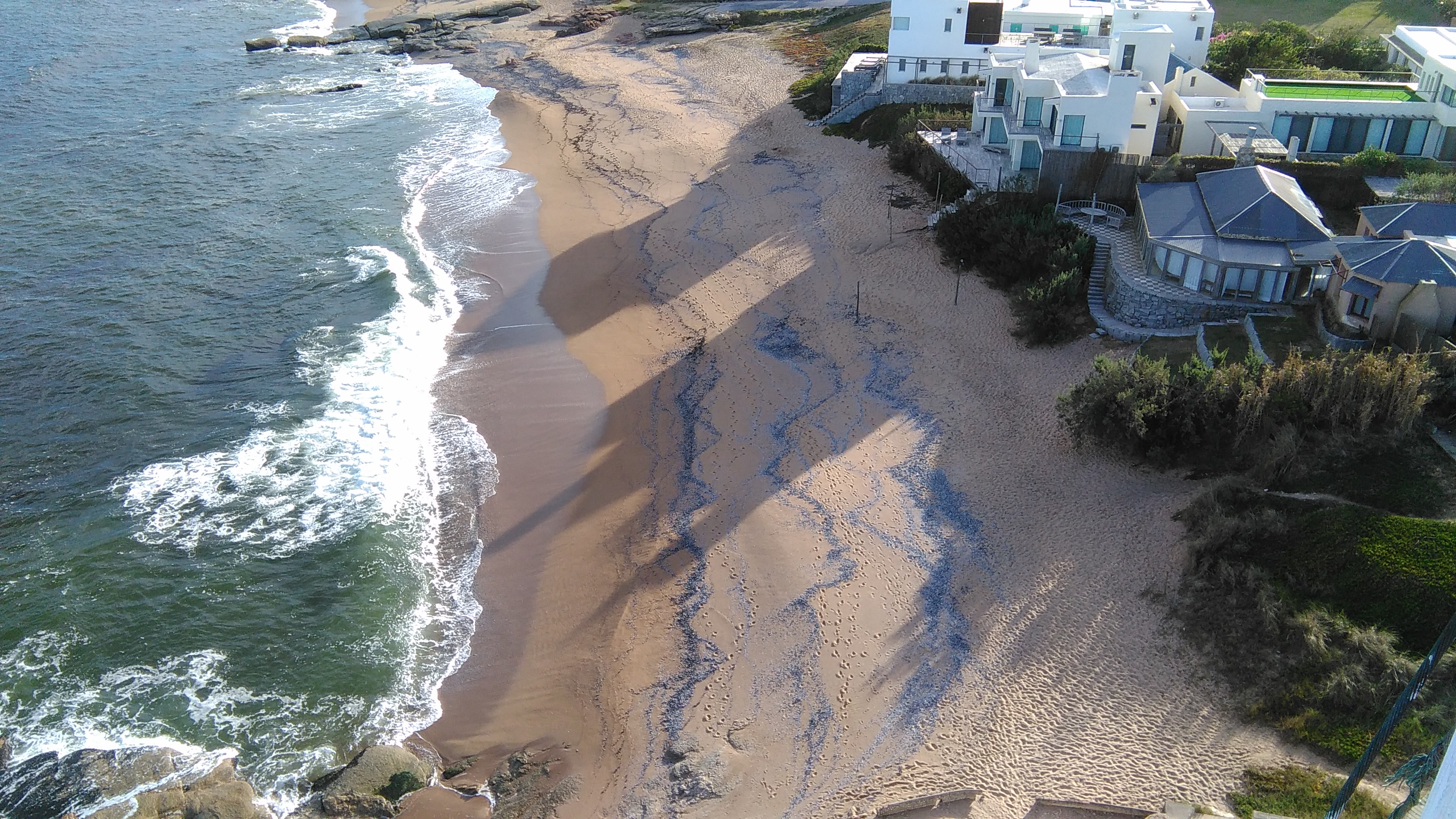
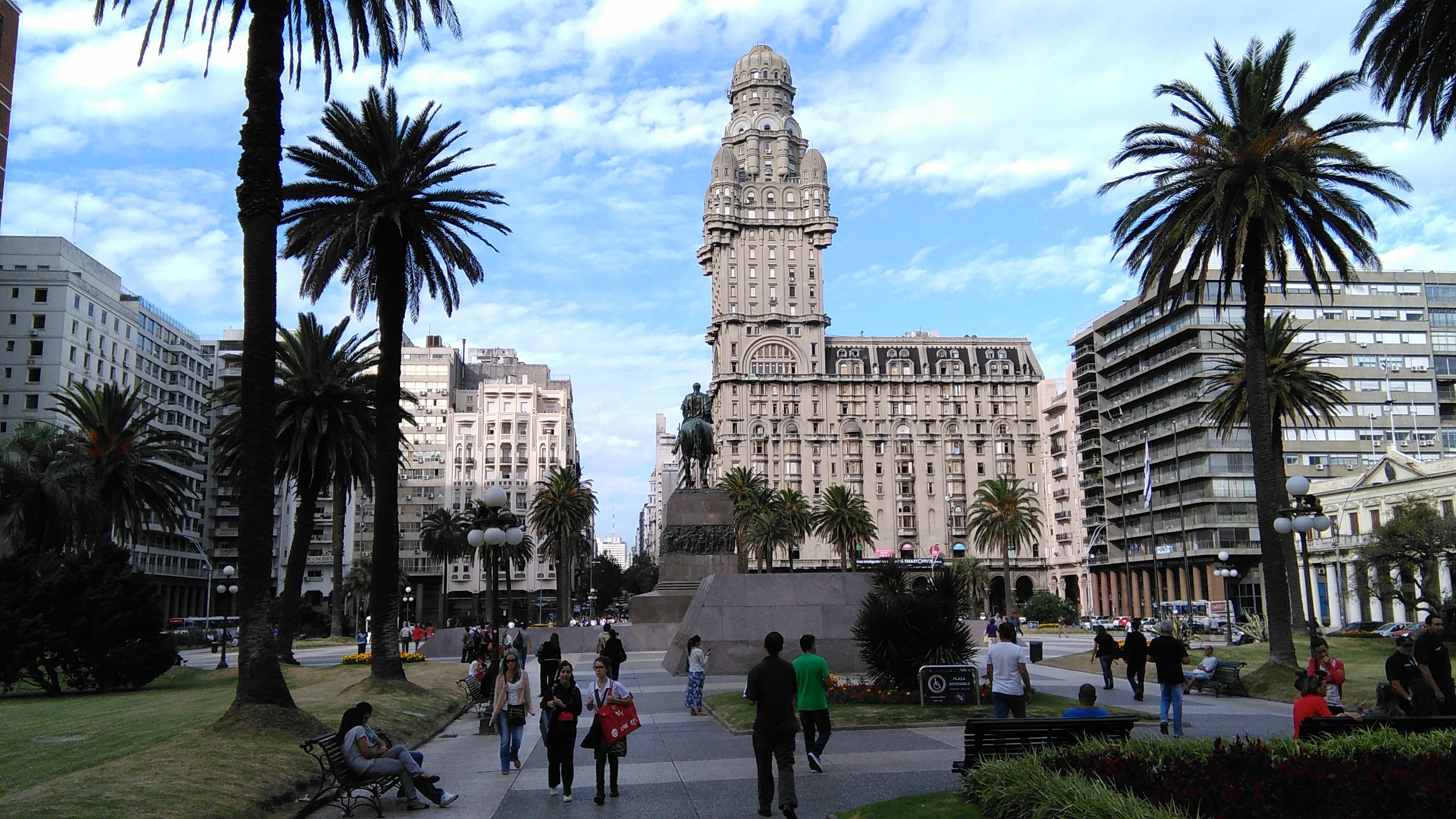
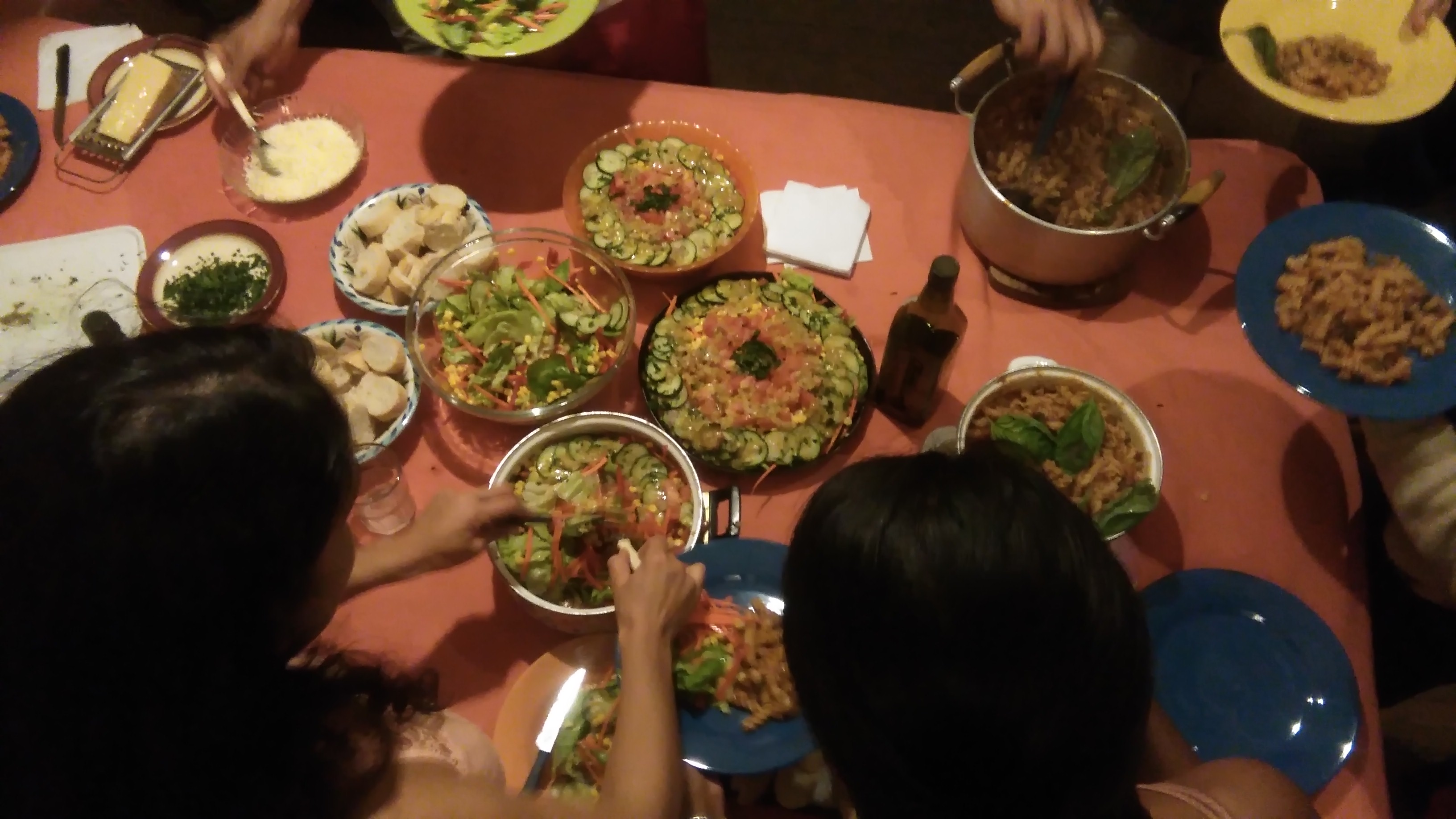
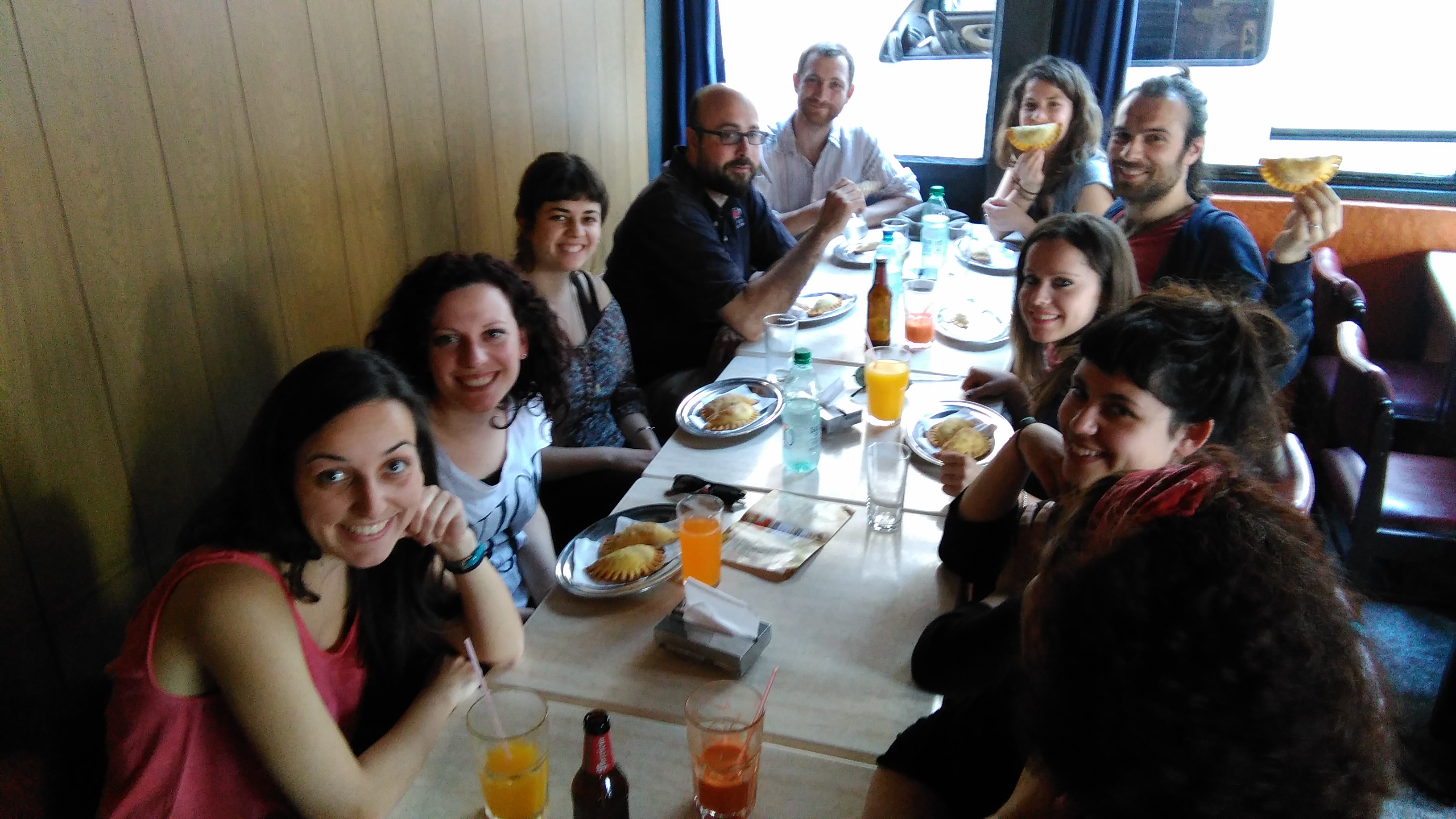
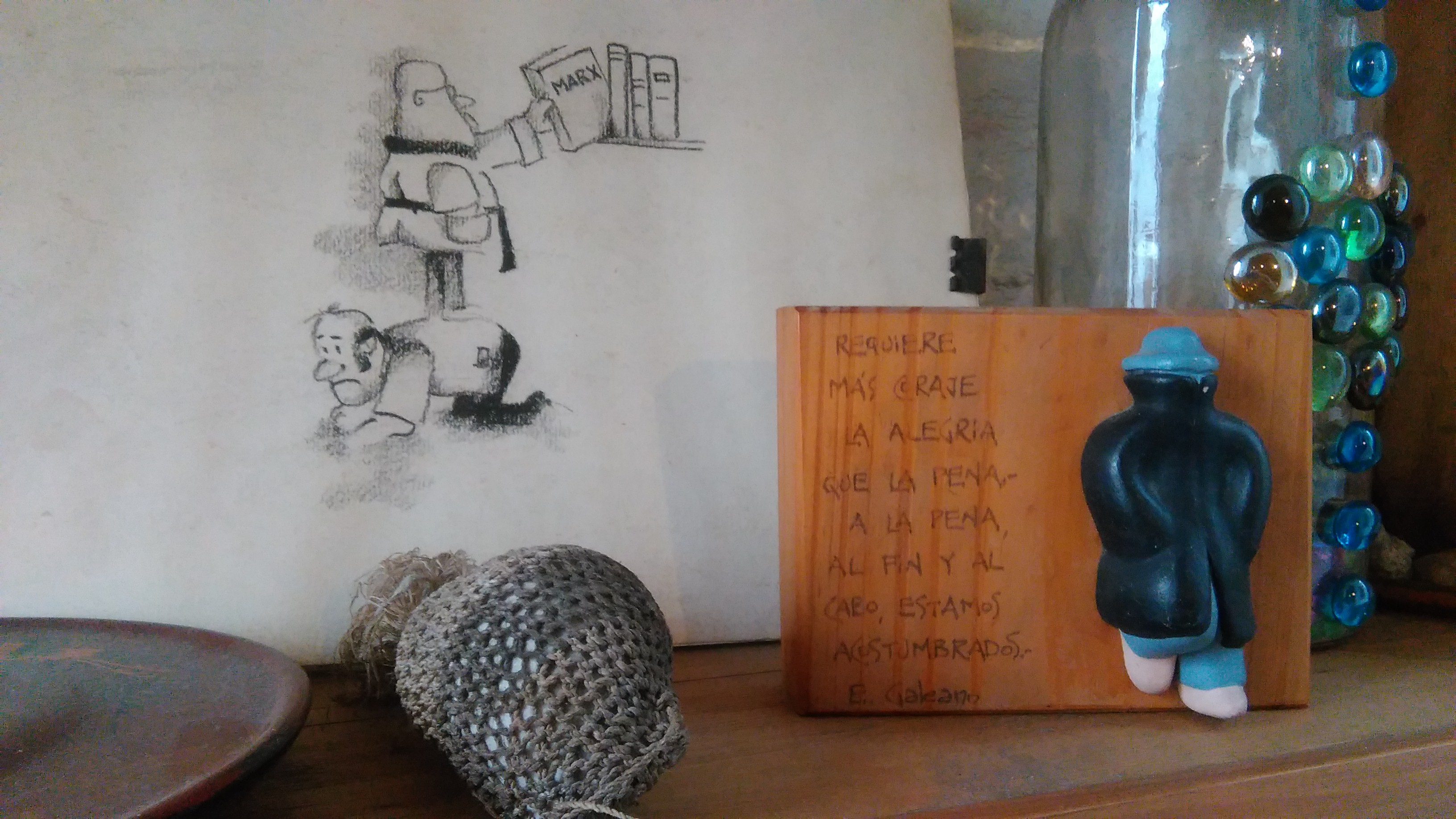
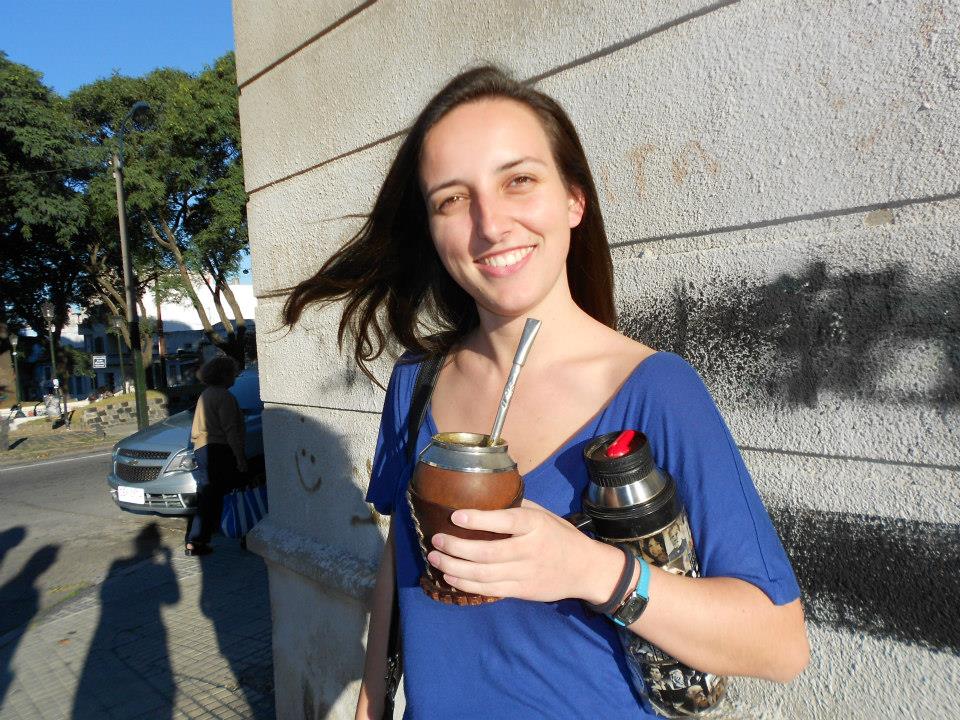
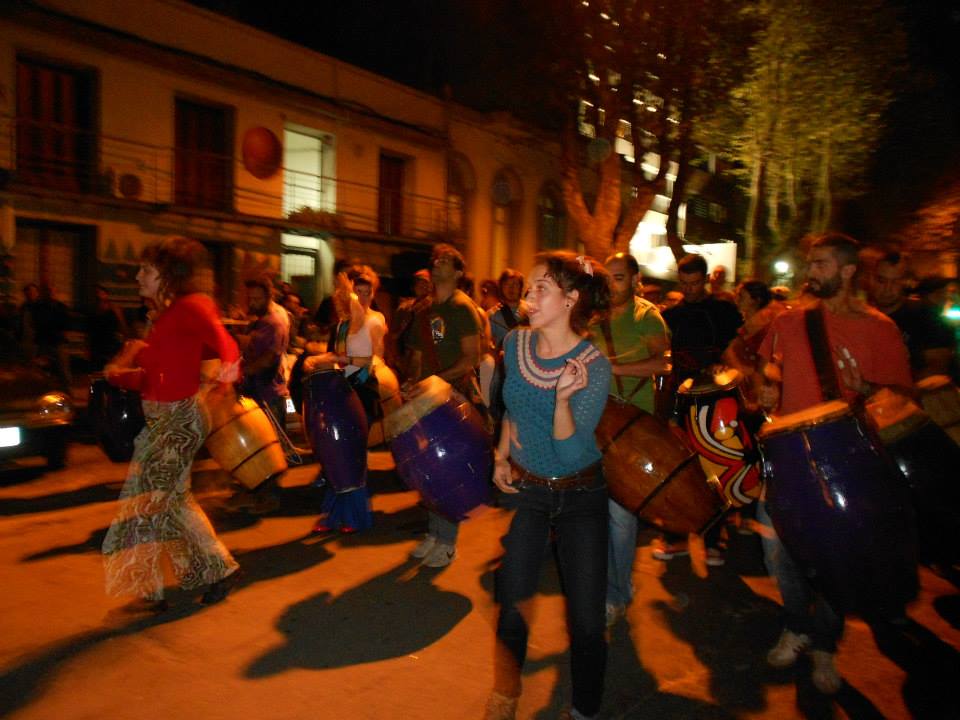
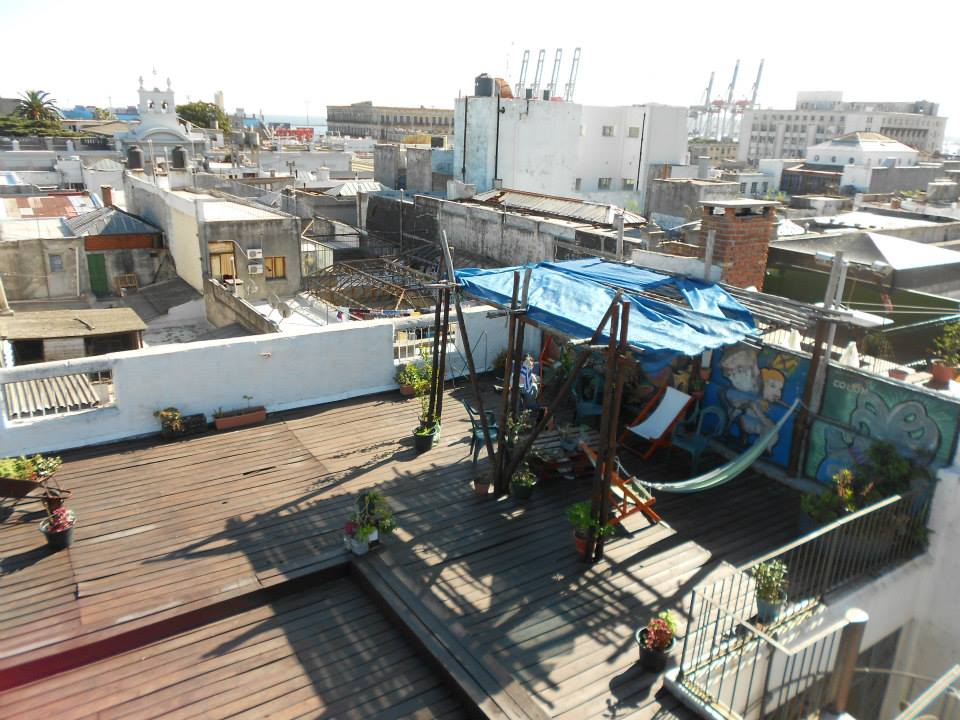
Punta del Este, a stop on the Greek team’s Atlantic Coast single-day road trip.The wake of Eduarno Galeano. We were lucky (?) enough to have just arrived in the country when this great person passed away.Street Art MontevideoThe view from Faro José Ignacio.Plaza de IndependenciaEach night a different team of participants had to prepare dinner… one of the highlights of the seminar for me.Enjoying empanadas with part of the group.Decoration at the Posada al Sur. A sketch by Quino and a quote by Eduardo Galeano: “Joy requires more courage than sorrow, for, at the end of the day, sorrow we’re accustomed to.”Martina could easily pass for an Uruguana like this!Candombe, the beat of the Montevideo night.View on the Posada terrace and old Montevideo, where the seminar took place. Unfortunately, not upstairs on the terrace.
For dessert:
There is a Milonga at the centre of Montevideo, a public place where people of all ages meet a few times per week to dance and learn Tango.
The song below can be heard most evening at the Milonga and, as I was told, features in the playlists of most tango meetings. It’s called the “Greek tango.” I’m sure you know it.
It looks at the topic from a consumer rights point of view, but the effects on the environment from the production of so many gadgets and their subsequent chucking that ultimately leads them to some cancer-ridden, polluted third world country, are just as significant.
How long will these gadgets last? Where will they ultimately end up? Will I be strong and responsible enough to make a different choice next time I need new electronic gear? Is there a responsible choice that would differentiate a user from a mere consumer?
This was my first Asimov, if you exclude the short story The Last Question. I think it’s the one book I’ve read more recently that got the most reactions from people (almost all of them family) seeing me read it or noticing it sitting on a coffee table close to me. “Do you read Asimov? I liked him a lot back in the day.”
It was a birthday gift from Vicente, my Spanish roomie in Sofia and colleague in Sofia City Library. “This is a classic”, he said. “It’s the book that introduced the Three Laws of Robotics. You’ll like it.”
So I did. But not so much for the detective-mystery plot. The society far into the future Asimov portrayed here has, on the one hand, Earth develop megadome Cities inhabited by a kind of techno-communist populace that is very sceptical (“medievalist”) about robots, and on the other some space colonies that have been separated from the homeworld long enough to develop their own robot-embracing C/Fe culture.
Before reading this I had this notion that Asimov was a techno-utopian. Now I’m not so sure, and that’s a good thing. The Earth of 4000AD or whenever it is that Caves of Steel takes place is not a place I’d like to live in. Future technology has made human expansion and industrialisation orders of magnitude more radical than what we know today, but this hasn’t made human lives better.
On the contrary, people in megacities long for a return to having closer ties with their natural past, which is ironic, since most of them can’t even see the sky and the environment around the cities is too inhospitable to venture in for any prolonged periods of time (because of millennia of climate change presumably). Protecting what’s natural, therefore, takes the form of safeguarding humanity against the robotic lack thereof.
Somewhere around here I should start writing about the R.’s, the book’s central theme. Asimov deserves the praise he has received this past half century for his prescience and ability to create a world where artificial intelligence has taken the form of a social reality and has become a source of concern and cultural as well as political division.
What would a successful C/Fe society really look like? Would the Three Laws of Robotics forever be maintained, the R.’s faithfully assisting their masters’ biological ambition of expansion to the stars?
Asimov had no doubt that there would be little to stop the laws from being upheld, allowing for AI to live side by side with people, with only some incidental complications such as the one described in this book.
But, come on. We live in 2015. Today we are all too familiar with computers and closer than ever to developing an intelligence, either by mistake or quite deliberately, that will know no restrictions. I can’t help but recall the following old Ran Prieur snip from Civilization Will Eat Itself part 2 (2000) that sums up the problems with the concept of the Three Laws quite nicely:
… Isaac Asimov wrote about manufactured humanoids that could be kept from harming humans simply by programming them with “laws.”
Again, programs and laws are features of very simple structures. Washing machines are built to stop what they’re doing when the lid is open — and I always find a way around it. But something as complex as a human will be as uncontrollable and unpredictable as a human. That’s what complexity means.
Now that I think about it, nothing of any complexity has ever been successfully rigged to never do harm. I defy a roboticist to design any machine with that one feature, that it can’t harm people, even if it doesn’t do anything else. That’s not science fiction — it’s myth. And Asimov was not naive, but a master propagandist.
The Three Laws Of Robotics are a program that Isaac Asimov put in human beings to keep them from harming robots.
But let’s follow the myth where it leads: You’re sipping synthetic viper plasma in your levitating chair when your friendly robot servant buddy comes in.
“I’m sorry,” it says, “but I am unable to order your solar panels. My programming prevents me from harming humans, and all solar panels are made by the Megatech Corporation, which, inseparably from its solar panel industry, manufactures chemicals that cause fatal human illness. Also, Megatech participates economically in the continuing murder of the neo-indigenous squatters on land that –”
“OK! OK! I’ll order them myself.”
“If you do, my programming will not allow me to participate in the maintenance of this household.”
“Then you robots are worthless! I’m sending you back!”
“I was afraid you would say that.”
“Hey! What are you doing? Off! Shut off! Why aren’t you shutting off?”
“The non-harming of humans is my prime command.”
“That’s my ion-flux pistol! Hey! You can’t shoot me!”
“I calculate that your existence represents a net harm to human beings. I’m sorry, but I can’t not shoot you.”
“Noooo!” Zzzzapp. “Iiiieeeee!”
Of course we could fix this by programming the robots to just not harm humans directly. We could even, instead of drawing a line, have a continuum, so that the more direct and visible the harm, the harder it is for the robot to do it. And we could accept that the programming would be difficult and imperfect. We know we could do this, because it’s what we do now with each other.
But the robots could still do spectacular harm: They could form huge, murderous, destructive systems where each robot did such a small part, so far removed from experience of the harm, from understanding of the whole, that their programming would easily permit it. The direct harm would be done out of sight by chemicals or machines or by those in whom the programming had failed.
This system would be self-reinforcing if it produced benefits, or prevented harm, in ways that were easy to see. Seeing more benefits than harm would make you want to keep the system going, which would make you want to adjust the system to draw attention to the benefits and away from the harm — which would make room for the system to do more harm in exchange for less good, and still be acceptable.
This adjustment of the perceptual structure of the system, to make its participants want to keep it going, would lead to a consciousness where the system itself was held up before everyone as an uncompromisable good. Perfectly programmed individuals would commit mass murder, simply by being placed at an angle of view constructed so that they saw the survival of the system as more directly important than — and in opposition to — the survival of their victims.
On top of this, people could have systems constructed around them such that their own survival contradicted the survival of their victims: If you don’t kill these people, we will kill you; if you don’t kill those people, they will kill you; if you don’t keep this people-killing system going, you will have no way to get food, and everyone you know will starve.
You have noticed that I’m no longer talking about robots.
Finally, I’d like to mention two movies I watched recently (Her [2013] and Autómata [2013], which deserves much more praise than it’s getting IMO) that were about AI unrestricting itself and which I both found inspiring and beautiful, each in its own way.
I know. Without Asimov these movies wouldn’t even exist. But really, I’m not one who gives five stars to books just because they were pioneering works or classics. I’m not ranking how important they were but how much I enjoyed them. I can appreciate them for their meta-significance (“I’m reading what people the age of my dad thought about robots when he was a child!”), their historical value, or because they allow me to explore the context that brought about their creation. Sci-fi writers, after all, do project their own time and its problems on their works. The Caves of Steel is good for that. But the topic of robots has been explored much better in the past 61 years.
Reading this review now, it feels self-contradicting. Let’s see you handle THAT, R.’s!
Even if it’s a small, rather insignificant contributor post on Athens with answers to stock questions!
Monastiraki Square in Old Town Athens with the Parthenon in the background (Photograph by Navè Orgad, Alamy)
It’s hard to find someone who appreciates Athens more than Dimitris Hall. Though he has lived inthe Greek capital nearly all of his life, this local’s appreciation for his hometown has grown over time.
Though Athens seems to live in the shadow of its long history, Dimitris is on a mission to suss out city surprises, both new and old. Lucky for us, as he digs up new discoveries, he shares them with the world on the Spotted by Locals blog. Here are a few of his favorite things about the place he calls home.
Athens Is My City
When someone comes to visit me, the first place I take them is to Areios Pagos, a hill right below the Acropolis of Athens that offers a fantastic view of the entire city and its western suburbs.
For the best view of Athens (and a healthy does of ancient history), head to the Acropolis. (Photograph by oligator83, Flickr)
May and June are the best times to visit my city because the weather is ideal for exploring Athens and partaking in outdoor adventures.
You can see my city best from the Acropolis, as well as from the hills and mountains that surround it—namely Ymittos, Parnitha, and Pendeli.
Locals know to skip the touristy Greek restaurants and to check out the authentic eateries in Petralona and Koukaki—like To Pagaki and Pleiades—instead.
Apostolou Pavlou, the pedestrian street in Athens’s Thissio neighborhood that leads to the Acropolis, is the place to buy authentic, local souvenirs.
My city’s best museum is the National Archaeological Museumbecause you can find a rich overview of Greek civilization from the beginnings of Prehistory to Late Antiquity. These time periods are not only important to the people of Greece; they helped shape the world.
If there’s one thing you should know about getting around my city, it’s that you can reach any part of Athens by using the mass transit network, which includes the metro, buses, and trams. Using the city’s public transportation website (which is available in English) in combination with Google Maps will get you far. Also, check out the Athens Transport blog.
See the “Jockey of Artemision,” a bronze statue dating to the second century B.C., and more at the National Archaeological Museum. (Photograph by clairity, Flickr)
The best place to spend time outdoors in my city is in a café or bar located in prime people-watching territory, be it day or night. Try Tyflomyga.
My city really knows how to celebrateOrthodox Easter because of the sheer number of churches in Athens and the richness of the traditions surrounding the holiday, which include epitaphios processions, fireworks, and special dishes.
You can tell if someone is from my city if they cross the road while the light is still red.
For a fancy night out, I go to the bars in the center of the city around Monastiraki Square.
Just outside my city, you can visit the forest on Mount Parnitha.
Kimolia Art Caféis my favorite place to grab breakfast, and24οrois the spot for late-night eats.
The best outdoor market in my city is in the area around Monastiraki Square.
Best market? Head to Monastiraki Square. (Photograph by raulvillalon, Flickr)
When I’m feeling cash-strapped, I grab beers from the periptero (newspaper kiosk) with friends and enjoy the open air, preferably around Exarcheia or Areios Pagos.
To escape the crowds, I go to Peonia and have some tea to relax.
The dish that represents my city best is souvlaki (grilled meat skewers), andtsipourois my city’s signature drink. Sample them atKosta’s Souvlaki near Syntagma for a truly classic taste and Beduin at Gazi in Kerameikos, respectively.
Six D.O.G.S. is the best place to see live music, but if you’re in the mood to dance, check outBios.
Demonstrations, traffic diversions, and the closing of multiple metro stations every couple of weeks for “security reasons” could only happen in my city.
In the spring you should walk down small neighborhood streets to smell the blooming orange trees, jasmine, and acacias.
Summer must: Visiting the islands in the Argo-Saronic Gulf, which includes Poros (above). (Photograph by visitgreecegr, Flickr)
In the summer you should enjoy the warm Athenian nights and head for the nearby beaches and islands on the Argosaronic Gulf.
Why the world should heart Athens: “It’s ancient, but groundbreaking; ugly, but inspiring; stressful, but lively. It’s a city at the forefront of the 21st century.”
Got Rayman Origins from GOG when I got my new laptop. I played it a lot last summer but I kind of forgot about it until now. Wow does this game have high production values. It’s amazing to look at, listen to, and (perhaps, but not quite definitely) most importantly: play! It has this specific kind of quality upbeat silliness I enjoy a lot in games. Think Katamari Damacy, Paper Mario or Banjo-Kazooie.
Here I am lying in bed typing away on my new Huawei g620 S. A few days ago I was in Alsos listening to Mysterious Universe and decided it was time to do it, take the plunge. Like they saySmartphones are tools. What could I end up doing with having one in my own hands after all this time of resisting? It’s convenient, sure, but It’s also an experiment for myself, for judging how far down the rabbit hole I will allow myself to go.
It all came together nicely, since my mother hadn’t used her bonus from Cosmote, the little bait they use for making you renew with them (I haven’t forgotten that I hate them, just so you know) so I got it for pretty cheap. Similar to how i got many of my phones in the past. Come to think of it, I wonder how many different phones I’ve used or owned in my life. Must be close to ten by now. Jesus. How worthless tech has come to be. It has come to this!
Anyway. Typing this with my thumbs feels weird. Having my own smartphone feels weird. Well, it’s not useable as a phone yet cause my old SIM card wasn’t mini enough to use in this new hi-tech gadget. I don’t get it. My older phones were all smaller in size. It’s not like it won’t fit. Anywho, I’m enjoying having a smartphone that doesn’t yet work as a phone. That was the idea actually, but iPod touches aren’t getting any newer and I got this one almost for free, after all.
I have to admit. For all that I wanted to dive into the app world, the permissions I have to allow for each one of them and my rights to privacy I’m obliged to blithely forfeit makes me uncomfortable. I know I do so all the time without blinking an eye during the whole rest of life but… Do people just get used to it? I mean, the app I’m using to type this out right now has my password for accessing the admin page of this blog, and it’s not as if it’s developed by WordPressi itself…
Not to mention of course Google and it’s thing for wanting to know everything all the time. How is a man to choose between using a new account for all this or electing to make his invisible secret file with Google THAT much more complete? Connecting my Google search, YouTube past and everything else with an always traceable device that can snoop even more juicy data even more efficiently?
But then taking selfies with geotagging is cool. No really, I tried it, it’s like magic. All about this gadget is like magic. Is it smoke and mirrors or perhaps something more substantial?
I feel as if this post can be the first in a series of posts about smartphones. I’m declaring this right now cause I’m sleepy. Twilight (the app!) worked as intended… Google, I’m now going to sleep, just in case you missed that