Splitscreen: A Love Story – Pitch from JW Griffiths on Vimeo.
Eξαιρετικό.
Relevantly Irrelevant
Splitscreen: A Love Story – Pitch from JW Griffiths on Vimeo.
Eξαιρετικό.
The Meaning of Liff (link to full text/book)
By Douglas Adams and John Lloyd
In Life*, there are many hundreds of common experiences, feelings, situations and even objects which we all know and recognize, but for which no words exist.
On the other hand, the world is littered with thousands of spare words which spend their time doing nothing but loafing about on signposts pointing at places.
Our job, as wee see it, is to get these words down off the signposts and into the mouths of babes and sucklings and so on, where they can start earning their keep in everyday conversation and make a more positive contribution to society.
Douglas Adams
John Lloyd
*And, indeed, in Liff.
Some favourite picks:
OSHKOSH (n., vb.)
The noise made by someone who has just been grossly flattered and is trying to make light of it.
WIMBLEDON (n.)
That last drop which, no matter how much you shake it, always goes down your trouser leg.
SIMPRIM (n.)
The little movement of false modesty by which a girl with a cavernous visible cleavage pulls her skirt down over her knees.
SCROGGS (n.)
The stout pubic hairs which protrude from your helping of moussaka in a cheap Greek restaurant.
MOFFAT (n. tailoring term)
That part of your coat which is designed to be sat on by the person next of you on the bus.
HATHERSAGE (n.)
The tiny snippets of beard which coat the inside of a washbasin after shaving in it.
AINDERBY STEEPLE (n.)
One who asks you a question with the apparent motive of wanting to hear your answer, but who cuts short your opening sentence by leaning forward and saying ‘and I’ll tell you why I ask…’ and then talking solidly for the next hour.
ΛΙΩΝΩ!!!
“Perchance he for whom this bell tolls may be so ill, as that he knows not it tolls for him; and perchance I may think myself so much better than I am, as that they who are about me, and see my state, may have caused it to toll for me, and I know not that.
…
No man is an island, entire of itself; every man is a piece of the continent, a part of the main. If a clod be washed away by the sea, Europe is the less, as well as if a promontory were, as well as if a manor of thy friend’s or of thine own were: any man’s death diminishes me, because I am involved in mankind, and therefore never send to know for whom the bells tolls; it tolls for thee.”
John Donne (1572-1631), Devotions Upon Emergent Occasions, Meditation XVII: Nunc Lento Sonitu Dicunt, Morieris
My rating: 4 of 5 stars
1964, Berlin, Greater German Empire. A week from Adolf Hitler’s 75th birthday. No-one remembers what Germany was like before the war. What does it matter? The Führer is God, he saved Germany from mortal danger and raised her to become the world’s mightiest. All follow the Leader completely blindly, a Goebbelsian utopia come true. All? Gestapo officer Xavier “Zavi” March is the right man, at the right place, at the right time, and is about to catch a glimpse of the Third Reich’s best kept and most horrible secret…
1964 Nazi Berlin is very convincing. World politics following a Nazi victory in the War also make the mood for this alternate history fittingly gloomy. Albert Speer’s Germania plans for Berlin have all come to pass, including the awe-inspiring Great Hall. An illustration of the book’s timeline’s central Berlin welcomes the reader right at the beginning of the book setting up the climate quite “appropriately”.
Xavier March is a burdened man. His son, a result of his failed marriage, looks to the regime for a father figure instead of him. He’s been working for 10 years as a successful Sturmbannführer but with no promotion. “The Fox”, his work nickname, is a great lead character. He’s surprisingly clever (he’s an investigator and this is a thriller, after all!) but his weaknesses and mistakes are easy to spot throughout the story, grounding him and making him a realistic lead. I was rooting for him all the way.
A thing I liked about Fatherland and Robert Harris’s writing is that it had little details that made it easier to imagine each scene or situation. Insignificant descriptions, like the way some-one breathes or what he or she looks like while walking away, associations March makes with things he notices, hears, touches or smells give the story a much more personal feel, it makes it easier to identify with the –thankfully, unknown for us– circumstances. I could really feel as if I was actually there, as if I was — shudder– March myself .
The plot can be a bit confusing at first, reflecting the lead’s own confusion with the case of the murder by Lake Havel, but as it thickens, as no-one you think could be trusted comes through, as some things become apparent and others come as shocking revelations and turnarounds, everything is made clear and fits well. It took me maybe three weeks to read the first half of the book. I don’t have great experience with police mysteries, but this is more than that. It took me another three days to finish it. This should tell all.
Some of the films I will remember from Nordisk Panorama 2011, a Nordic-centred film festival that took place in Aarhus.
From The Animation Workshop in Viborg. I’d love being an animator myself…
I regret this does not exist online in its entirety, I’m sure everyone would love it as much as I did. I still sing “Eg har klina med ein skallamann!” whenever I remember it, not caring about the risk of people misunderstanding me!
Eläimiä eläimille, a deliciously disgusting Finnish short. No trace of it exists online. I hope one day it does so it is available for all to see.
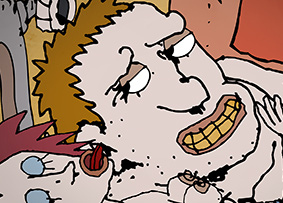
And the one that struck me the most, The Green Wave, on the forged elections of Iran in 2009 and the uprising that followed (click on the link just for the website design excellence, if regrettably you are not interested in the film itself).
THE GREEN WAVE teaser (ENGLISH) from PORT AU PRINCE on Vimeo.
Green is the color of hope. Green is the color of Islam. And green was the symbol of recognition among the supporters of presidential candidate Mir-Hossein Mousavi, who became the symbolic figure of the Green Revolution in Iran last year. The presidential elections on June 12th, 2009 were supposed to bring about a change, but contrary to all expectations the ultra-conservative populist Mahmoud Ahmadinejad was confirmed in office. As clear as was the result, as loud and justified were the accusations of vote-rigging. The on-going Where is my vote? protest demonstrations were again and again worn down and broken up with brutal attacks by government militia. Images taken from private persons with their cell phones or cameras bear witness to this excessive violence: people were beaten, stabbed, shot dead, arrested, kidnapped, some of them disappearing without trace. What remains is the countless number of dead or injured people and victims of torture, and another deep wound in the hearts of the Iranians.
THE GREEN WAVE is a touching documentary-collage illustrating the dramatic events and telling about the feelings of the people behind this revolution. Facebook reports, Twitter messages and videos posted in the internet were included in the film composition, and hundreds of real blog entries served as reference for the experiences and thoughts of two young students, whose story is running through the film as the main thread. The film describes their initial hope and curiosity, their desperate fear, and the courage to yet continue to fight. These fictional ‘storylines’ have been animated as a motion comic – sort of a moving comic – framing the deeply affecting pictures of the revolution and the interviews with prominent human rights campaigners and exiled Iranians. Ali Samadi Ahadi’s documentary is a very contemporary chronicle of the Green Revolution and a memorial for all of those who believed in more freedom and lost their lives for that.
After watching The Green Wave in Øst for Paradis, the local cinephile theatre, there was a live Skype discussion with members of Amnesty International (one of them was in Iran in 2009) and Ramy Raoof, an activist from Egypt that leaked info out through Twitter during the “Arab Spring” (and still does). He tried to make clear the point that Facebook and Twitter, often used as the taglines of the Arab Spring by Western media, were not pivotal in organising the revolution; even after Mubarak had cut off the Internet and SMS, people of course used other means along side digital means. Ramy stressed that, even if Twitter and Facebook had not existed, the revolution would still have taken place…
…and added that, in Egypt today, the “temporary military government” after Mubarak has taken too many liberties and is not looking to be all that temporary at all…
This film shook me as few have. Imagine living in a country where you could be tortured or killed just because you were out in the streets demanding your vote to count, where the government would stop at nothing to muff you or your blog. Where merely me posting this could be deemed a crime punishable by… well, any means necessary. Maybe it’s far too easy to imagine other countries having such horrible regimes. Anyone who has read or watched Persepolis will be familiar with Iran’s difficult recent past and to see that things have certainly not improved is at least troubling. It also made me think about our own situation in Greece and how far things could go before spiraling into a similar scenario… When Alex Grigoropoulos was shot in December 2008, Greece was in flames for a couple of days. What would happen if (young) people got shot every day? Would people still go out to protest? Or would our generation freeze in terror, remembering that real protest against governments caught with their pants down could very well mean very real death, or worse? I have to admit that I don’t know how I would act if faced with these options. Looking at all of history’s failed revolutions, I do not want to shed blood for a pre-determinedly lost cause. Hell, even if the cause was not lost, I don’t want to die! Would a successful revolution won with the blood of hopefuls be worth it? Is anything won with blood worth it?
15.000 τόνοι ψαριών κάθε χρόνο πετιούνται στη θάλασσα νεκρά. Κάνε click και πάρε θέση για να τα σώσεις!
via Εσύ πόσο τον έχεις;.
(δεν είμαι σίγουρος πόσα μπορεί να καταφέρει αυτή η κίνηση, αλλά γιατί όχι; qb)

Why Life Speeds Up As You Get Older: How Memory Shapes our Past by Douwe Draaisma
My rating: 2 of 5 stars
“You’ll come away with hopefully more questions that you had at the beginning”. It says something along these lines on the back cover on “Why Life Speeds Up As You Get Older: How Memory Shapes our Past”. I didn’t come away with more questions. In fact, I didn’t even get an answer for the title of the book! It’s structure and content is such that it doesn’t analyse the problems at hand in depth or in a way that led to some visible conclusion (I’m one of the people that accepts the conclusion of no conclusion quite alright. Imagine.) Instead, it’s little more than a collection of case studies. Interesting case studies, I have to give Mr. Draaisma that, but ones that do not come very close to trying to tackle the huge chapter of human life that is autobiographical memory. This book could be so much more. Instead, it’s just a text of well-organised and researched memory-related anecdotes that might be interesting by themselves but come across as superficial. A pity; memory, together with time, is one of my favourite topics.
It’s the equinox, the middle of the seasonal change. This time of year, day gives way to night three minutes every day at my latitude, at its annual max. Every night from today til the Winter Solstice will still be longer than the previous one, but getting longer at a slower rate. The slowing will turn into a grinding halt on the Solstice itself, also known as Christmas, when the day will start gaining ground again. And long and cold nights they will be, here in the north. Let’s hope they’ll be hyggelig as well.
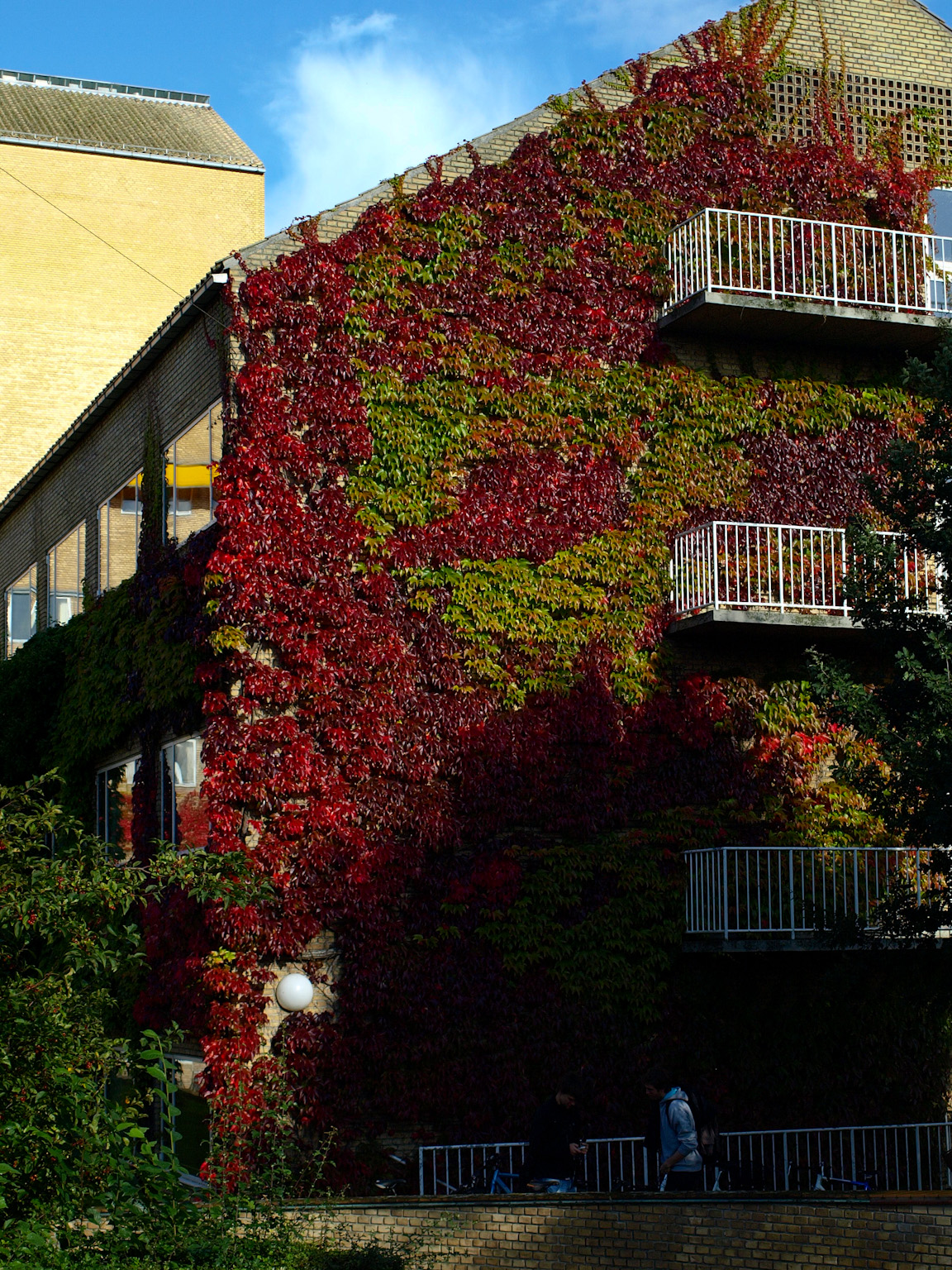
So it’s the first day of Autumn, if you’re one that prefers his astronomical seasons to the arbitrary calendrial ones. If you’re like me. A lot of leaves have already put on their jackets for the coming cold (it’s already ~12C every day here). They’re very pretty in their last days of life, their colours saturated with deep, earthly reds. As the days pass, more and more leaves will find their beautiful deaths on the wet streets. It feels wrong drying them, preserving them, when their rightful place in the circle of life is death and non-preservation, becoming food for bacteria and fungi.
This environment is quite perfect for going to lessons and having to preoccupy yourself with creative ideas. Perfect environment for sitting at home when you’re not out walking in the rain listening to music or Spanish lessons, doing your assignment for Media Management and Journalism 3.0 in the Digital Age, on Search Engine Optimization and Croud-Sourcing… What’s better than being at a Great Works of Art class, it pouring outside and you analysing Monteverdi and Vivaldi inside, in the cozy warmth of knowledge, academia and the body heat of art-thirsty colleagues?
…they should have sent a poet…