Before 4:20 it’s great. After that it’s even better. From Opeth’s upcoming album “Heritage”. Incredible that this has been my earworm for the last couple of days even before the album’s actual release. Such are our times.
Author: Cubilone
This is me. Or so I believe.
June 15th Moon Eclipse Incredible Photograph
June 15th was a cloudy evening in Mytilini and me and my friends weren’t able to catch the lunar eclipse, much to my extreme disappointment. But now that I see this, I hardly care that I was not able to catch it…
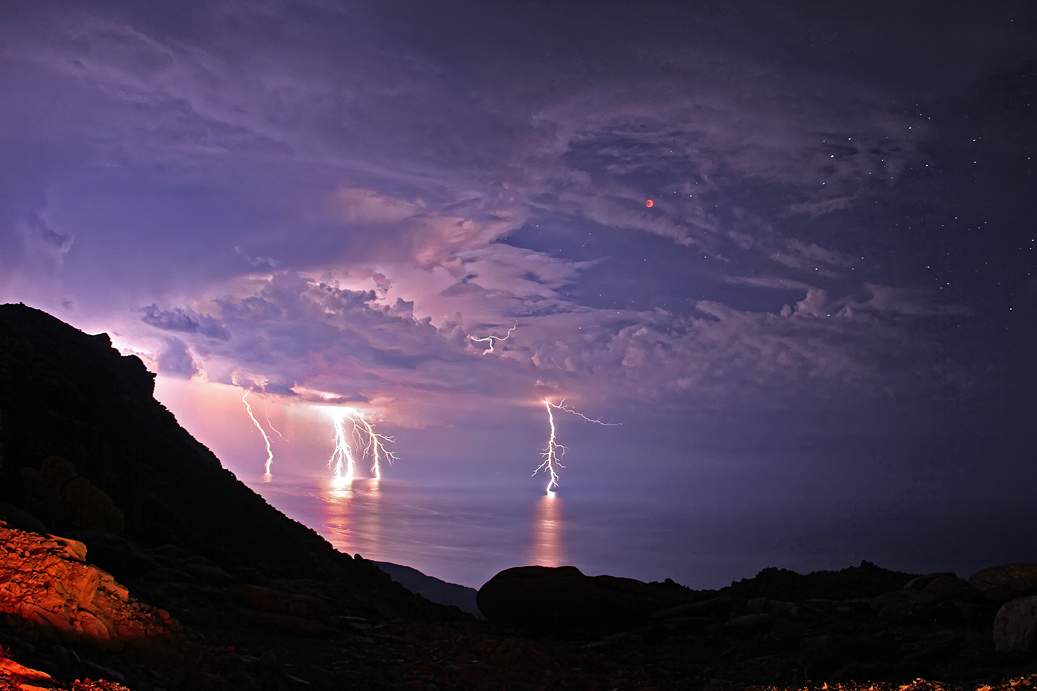
After months of anticipation and exhausting preparations and planning for taking photos of the total lunar eclipse, everything went wrong due to a severe thunderstorm during the phenomenon. Everything? Well…fortunatelly no, because for approximately 10 minutes in the middle of totality, a small window in the sky allowed me to see the Moon in the Earth’s shadow and shoot this unbelievable photo. The shot was taken from Ikaria island at Pezi, an area known as “the planet of the goats”, because of the rough terrain with the strange looking rocks.
Source: http://www.greeksky.gr/files/photos/moon/20110615Eclipse.htm
Τα συγχαρητήρια μου στον φωτογράφο, αυτή η εικόνα είναι απλά ύμνος στην ομορφία του ουρανού…
Life and Debt
A 2001 film showing how IMF and globalisation destroyed Jamaica and its unknown side, unknown for us that only know the country for its reggae, rasta and marijuana.
Any similarities with 2001 Greece are purely coincidental and the display thereof is has not been intention of the author.
(Jamaican accent, beautiful as it is, can be a bit tough on our unaccustomed ears. I didn’t find a Youtube video with subtitles but it shouldn’t be a problem downloading the film and finding English subtitles if you really feeling like watching it. It’s worth the effort)
Steven Wilson – Track One
A preview of Steven Wilson’s upcoming second solo album Grace of Drowning, which he says is his best work yet — pretty big words if you ask me. The video is simple (just a single take?) but very, very effective!
Review: The Hitchhiker’s Guide to the Galaxy: The Trilogy of Four

The Hitchhiker’s Guide to the Galaxy: The Trilogy of Four by Douglas Adams
My rating: 4 of 5 stars
I was thinking of starting my review with a quote from The Hitchhiker’s Guide to the Galaxy. It would neatly go to display exactly why the probability of this book’s humour and insight into the ways of the universe actually existing are two to the power of two hundred and twenty-six thousand seven hundred and nine to one against. You see, after coming in contact with the universe that sprung out from the genius that was Douglas Adams, your life gets torn into the period before having read H2G2 and after. It shapes your mind, it makes you think about the world in ways you never thought possible — or it makes you realise that this is exactly the way you used to look at the absurdness of the Universe, only life on this mostly harmless planet has made you think in mostly harmless ways yourself.
It’s such a yummy, well-mixed recipe of dead-pan, random, black, so-funny-because-it’s-so-true humours, all served with hearty amounts of insight you can’t help stuffing your face with the whole pot. There’s also a secret ingredient which talks to your philosophy loving side… It leaves you lighter as you laugh with lines so clever, a writer so talented and situations so bizarre you can hardly believe your eyes. It’s the hash brownie of scifi…
The only breaker for me was the characters as well as the plot. Both of them serve as little more than means to present the jokes. I get the meaning of the story is to be bizarre but at some points it went so overboard I had little idea of what was happening. The characters were also inconsistent and to some point interchangeable. Maybe that was Douglas Adams’s intention? I don’t know. But still, four books later, I have no clear view of the plot or of the characters, they’re blurs more than anything else. Which is a shame, for they were means for some pretty unique situations.
I thought that the first and second book were the best, with the third one having the strongest messages but the most confusing situations and plot. “So Long And Thanks For All The Fish” had its moments, especially between Arthur and Fenchurch but it was generally disappointing. I read however that Adams was forced to push through a deadline for the fourth book and was generally disappointed by the end result himself.
The Trilogy of Four is aptly named for my rating standards: I’m giving it a four overall because it didn’t maintain the stellar quality of the first two books throughout the series. I know I’m not finished. This is only my introduction to this extraordinary and hilarious world of not only The Hitchhikers Guide To The Galaxy but Douglas Adams in general. Now I must play the game, read the rest of the books, see or hear the shows…
And to think I may had not read the books in the end because I hated the film…
Danish Diaries #6: Skagen & Råbjerg Mile
Το περασμένο Σάββατο, το Studenterhus διοργάνωσε μια εκδρομή στο Skagen. Δεν μπορούσα να την χάσω, ήθελα να πάω στο Skagen χρόνια τώρα. Από τότε που ο Andy, ο υπέροχος μισοταϊλανδός-μισοδανός τύπος που φιλοξένησε εμένα και την Άλεξ στην Κοπεγχάγη πάνω από τρία χρόνια πριν, μας είχε πει πόσα όμορφα ήταν εκεί και πόσο επέμενε ότι έπρεπε να πάμε, ενώ μιλάγαμε στο ισόγειο του ξενοδοχείου που δούλευε και είχε καταφέρει να μας μπάσει τσάμπα. Και από τότε, δεν ξέχασα αυτό το όνομα: Skagen. Που, όπως πρόσφατα έμαθα, δεν προφέρεται Σκάγκεν αλλά Σκέι(ε)ν — το ε στην παρένθεση το προφέρετε μόνο αν θέλετε, αν νιώθετε πως έχετε την διάθεση ρε παιδί μου, έτσι είναι η προφορά των Δανέζικων, μπορείτε να μισοπείτε-μισομασήσετε μια λέξη και έτσι να είναι πιο αυθεντικός ο ήχος…
Πήγαμε λοιπόν στο Skagen με όλη την συμμορία από δω, ή με σχεδόν όλη. Η τιμή ήταν απαγορευτική για μερικούς: 350kr — κάτι λιγότερο από 50 ευρώ για μια μονοήμερη. Όμως είχα ελέγξει τις εναλλακτικές για να πάω μόνος με τραίνο: έβγαινε ακριβότερα και λεωφορείο δεν νομίζω να πάει εκεί πάνω. Οπότε για μένα τουλάχιστον ήταν μια μοναδική ευκαιρία και παρ’όλο που το παραδάκι μου ήταν μικροσκοπικό, τόλμησα να το υποβαθμίσω στο επίπεδο του “σχεδόν ανύπαρκτο” και να πάω κι εγώ. Όχι που θα κώλωνα.
Τι είναι λοιπόν το περίφημο Skagen; Είναι πολύ απλό. Είναι το βορειότερο ακρωτήρι, το τέλος της Δανίας, το σημείο που δύο θαλασσίτσες συναντιούνται και άλλες δύο θαλασσάρες μπλέκονται, δύο θαλασσάρες στις οποίες ανήκουν, θεωρητικά πάντα εφόσον όλα είναι θέμα ορισμών, οι μικρότερες θαλασίτσες. Στο Skagen, το Skagerrak κονταροχτυπιέται με το Kattegat. Aυτές οι θάλασσες θα μπορούσαμε να πούμε ότι ήταν για τους Vikings ότι ήταν για τους Έλληνες το Αιγαίο. Στο ίδιο σημείο, η Βαλτική μπλέκεται με την Βόρεια Θάλασσα. Και το ανακατεμένο αποτέλεσμα, με τα κύματα των δύο θαλασσών να έρχονται από αντίθετες κατευθύνσεις, δημιουργεί ένα σημείο που η οργή του Βόρειου Ποσειδώνα δεν κατευνάζεται ποτέ.
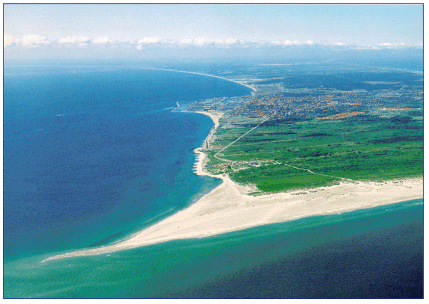
Τα ρεύματα πανίσχυρα, τα ναυάγια πολλά. Τα ρεύματα μεταφέρουν πολύ πράγμα το οποίο προστίθεται στην ακτή και επιμηκύνει το Grenen, όπως λέγεται η τελευταία άκρη του Skagen, περίπου 8 μέτρα κάθε χρόνο. Και έτσι, αφού ότι είναι τώρα θάλασσα σε λίγα χρόνια θα είναι άμμος και χώμα, πολλά από τα ναυάγια των περασμένων αιώνων είναι τώρα διάσπαρτα πάνω στην δυτική ακτή. Ποιος ξέρει τι περισσότερο θα μπορούσε ένας δεινός δύτης να βρει σε αυτή την περιοχή; Όχι πως θα ήταν ότι πιο ασφαλές, γιατί εκτός από υλικά τα ρεύματα έχουν το κακό συνήθειο να παρασέρνουν και ανθρώπους που νομίζουν ότι μπορούν να κατακτήσουν την θάλασσα, και γι’αυτό το κολύμπι γύρω από το Grenen απαγορεύεται.
Μερικά χιλιόμετρα από το Grenen βρίσκεται το Skagen, μια σχετικά βαρετή πόλη η οποία ευδοκιμεί χάρης του τουρισμού που προσελκύει αυτό το πολύ ιδιαίτερο σημείο της χώρας (ναι, μιλάμε για πολύ τουρίστα, πριν πάω στο Grenen φανταζόμουν πως θα είναι κάπως έτσι:
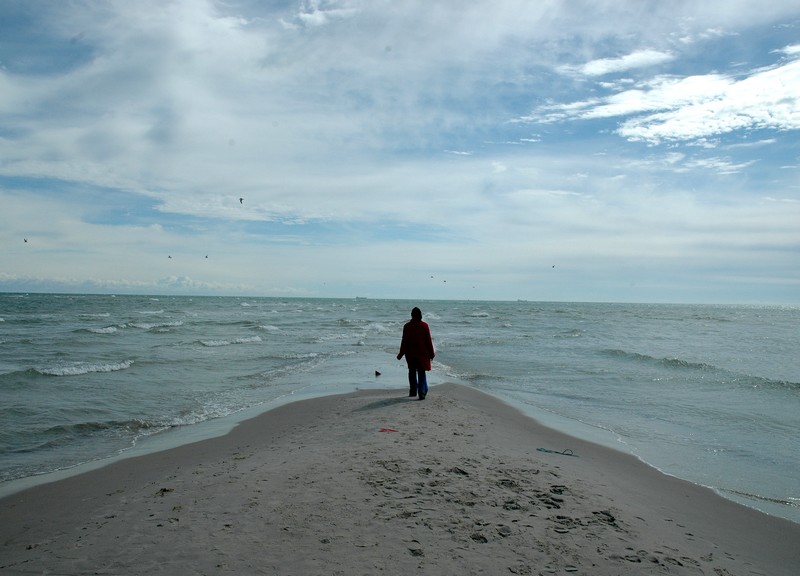
όμως ήταν κάπως έτσι:
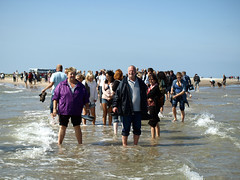
Στο Skagen έζησαν στα τέλη του 19ου αιώνα πολλοί ζωγράφοι οι οποίοι εμπνεύστηκαν από το μοναδικό φως του Grenen και δημιούργησαν πολλά έργα εμπνευσμένα από την καθημερινότητα των ψαράδων και των κατοίκων της περιοχής. Τελικά η παλιά Δανέζικη ζωγραφική μου αρέσει πολύ, απ’όσο τους είδα στην πινακοθήκη του Skagen αλλά και στο ARos.
Μερικά χιλιόμετρα νότια ακόμα, βρίσκεται κάτι που πραγματικά δεν περίμενα να βρω στην Δανία. Πρόκεται για το Råbjerg Mile (Ρόμπ-γιεα Μίλε), μια αμμοθίνη που εκτείνεται για ένα τετραγωνικό χιλιόμετρο περίπου και στο ψηλότερο σημείο της είναι 40 μέτρα. Για να μην πολυλογώ, είναι σαν να πήρες ένα κομμάτι της Σαχάρας και να το έριξες στην μέση –ΟΚ, στην άκρη– της Δανίας. Με την διαφορά βέβαια ότι η Σαχάρα δεν είναι 1 τετραγωνικό χιλιόμετρο, αλλά 9.400.000, για να καταλάβετε την διαφορά, αν το Råbjerg Mile ήταν ένα τετραγωνικό εκατοστό, περίπου ένα νόμισμα των 5 cents, η Σαχάρα θα ήταν μια έκταση 32μ x 32μ… This is some serious desert…
Το πιο παράδοξο είναι ότι γύρω από την περιοχή του Råbjerg Mile υπάρχουν δάση, λίμνες, ανεμογεννήτριες, στο βάθος … Οπότε το σκηνικό κάνει την εμπειρία αυτής της θίνης ακόμα πιο σουρεαλιστική. Το Råbjerg Mile αποτελείται και αυτό απο “κινούμενη άμμο”: κάθε χρόνο μετακινείται ανατολικά γύρω στα 15-20 μέτρα. Οπότε, γύρω στο 2200, θα χάθει μέσα στο Kateggat. Eξωγήινοι, αθάνατοι και λοιποί αιωνόβιοι, προλάβετε! Αν και τουλάχιστον οι Δανοί το 2200 θα αποκτήσουν μια καλή αμμώδη παραλία στην ανατολική ακτή, γιατί τώώώρα…
Η δυτική ακτή της Δανίας είναι όλη περίπου σαν τις ακτές του Skagen (και μου θύμισε τo Scheveningen κοντά στην Χάγη που είχαμε πάει με την Νένη πέρσι, αυτή την απέραντη αμμουδιά…) Το Aarhus είναι στην ανατολική ακτή. Ένα θα πω για την ποιότητα των παραλιών και της θάλασσας της ανατολικής ακτής: κάτι ήξερε όποιος την ονόμασε Βαλτική…
Πολύ θα ήθελα να είχα μείνει περισσότερο σε αυτά τα μέρη, όμως το αυστηρό πρόγραμμα της εκδρομής μας άφησε μόνο λίγη ώρα σε κάθε ένα…


<iframe width=”425″ height=”350″ frameborder=”0″ scrolling=”no” marginheight=”0″ marginwidth=”0″ src=”http://maps.google.com/maps?f=q&source=s_q&hl=en&geocode=&q=skagen,+denmark&aq=&sll=37.439974,-99.84375&sspn=17.278909,43.286133&vpsrc=0&ie=UTF8&hq=&hnear=Skagen,+Denmark&z=10&ll=57.725004,10.579186&output=embed”></iframe><br /><small><a href=”http://maps.google.com/maps?f=q&source=embed&hl=en&geocode=&q=skagen,+denmark&aq=&sll=37.439974,-99.84375&sspn=17.278909,43.286133&vpsrc=0&ie=UTF8&hq=&hnear=Skagen,+Denmark&z=10&ll=57.725004,10.579186″ style=”color:#0000FF;text-align:left”>View Larger Map</a></small>
Higher Education, Lower Expectations
Higher education has been a hot topic for years in Greece. There has been a tug-o-war between the government and the academic community. The latter has been at worst trying to maintain a status-quo and at best seeking some beneficial changes in the educational system in Greece that have, however, thus far been stopped by greater social problems, for example: deep corruption, the constant loss of ground of government-owned services to private companies (the most prominent of which have indeed managed, quite [c]overtly to become caliphs instead of the “democratically-elected” caliphs) and a general collapse of any sense of unity or consensus on any subject among the Greek population, a live-and-let-die, every-man-for-his-own, a rise of absolute individualism that is in tune with the global spirit of the times. The government is under pressure by the powers that be, whoever those may, to act in accord with the spirit of these times: a deep and scary neo-liberalism that seeks to destroy any and all social and consciential conquests of the past few centuries in the name of the “free market”. It is a paradoxical aim, since at the same time this “free” market remains free only for those that already have the means necessary. The rest of the population is carefully prevented from coming close, with more severe taxation, liquid work contracts, lower salaries and worsening social care. A free market for a slave population. It reminds me of the good old tidbit of wisdom: “Fighting for peace is like fucking for virginity”…
I decided to write this post today for three reasons. The first is that the Ministry of Education’s reform for Greek universities, a plan born by and completely in agreement with the above spirit of the times, is being discussed, agreed on in the Parliament and being set for immediate enforcement as I’m writing these lines. The second reason is that I have seen the quality of education possible and desirable in Denmark where I’m currently living — here they’re following the same spirit of the times as mentioned above, but at least they’re doing it well, with a straight face and with a clear conscience. The result is a higher education of great standards in every single way (and it’s free). To compare the situation in Greece and in Denmark just because they’re based on theoretically similar economic models would be like comparing a souvlaki bought from Plaka to one bought from your favourite souvlatzidiko. Just because they’re based on the same recipe does not mean they’re one and the same.
The third reason is that I’ve talked to Spanish people a lot about the situation in Spain, where similar laws and measures as the ones being cooked up in Greece as we speak have been in effect for a long time. Students not only have to pay for every single ECTS point they study for, if they fail their subject they have to pay for it again, and again… They have to pay for every single book, they have to pay for their enrollment, they have to pay for pretty much everything. This has neither made studying fairer nor has it upgraded the quality of education, it’s just the government freeing resources for other, presumably more important things (such as the Papal visit). My friend Ana, whenever I tell her that education in Greece is basically free, shakes her head in disbelief, uttering Spanish curses. Whenever I tell her that the Greek government wants to make things just like in Spain at the same time having a huge smile about it and shamelessly blurting out things like “national bet” and “responsible decision”, she cries: “Don’t let them Dimitris! You are so lucky to have free higher education. You must fight for it and defend it. Don’t let them take this away from you! Don’t be like us…” It’s a wake-up call, a sudden change of perspective, even moreso because I’m seeing extraordinary cultural similarities between Spain and Greece and the patterns followed in our economical problems. I can relate to the Spanish people and they can relate to us.
So what are we going to do about all this? Are we going to let them do as they please with our prospects and our lives? Will the spirit of post-modern individualism mark another victory this day? If it is does, I’m afraid it’s going to be another early, black celebration…
Danish Diaries #5
The past few days haven’t been all that much to write home about. The main reason for this is my almost complete lack of money. I knew before coming here that costs of living would be extreme, I thought I was prepared (was I ever…) but I didn’t expect that even going to the supermarket or downtown could be so frightening to my wallet and the full range of its contents. That together with a few unlucky money-sucking occasions have meant that I’ve been forced to put a few limits to my wanderlust and learn to enjoy the finer pleasures of looking at the four walls of my room and my laptop’s screen. Fortunately it’s not as bad as it sounds; I’ve got company in my kronerlessness, as well as grass and trees around Skoldhøjkollegiet.
For you to understand exactly how easy it is for money to disappear in ways unexpected, allows me to disclose a recent episode of my dorm life. Every week two of the twelve rooms in Spobjergvej 58 have to do the cleaning up. One is responsible for the kitchen and the other for the other common areas (the common room, the staircases and corridors etc). An inspection takes place every Tuesday to determine if everything’s clean as it should. If not, little notes are left for the respectiverooms to notify them of what they have to do by the following day. If they still fail to clean they are charged completely unreasonable amounts of money for the cleaners that do the job for them.
It was my turn to clean the common areas last week and of course I didn’t want to make my already atrocious financial situation that much horrible. So I took extra care to vacuum every carpet and linoleum surface and mop anything that could be mopped. Alas, Tuesday’s check unequivocally concluded that my vacuuming had been unsatisfactory. To top it all off, before I knew it, the common room floor surfaces were covered with grass and mud again — it was a rainy day and my flatmates were not paying much attention, why should they, it wasn’t them that had to clean up, was it? I begrudgingly did my part and slept easy, believing I had escaped the villainous clutches and voracious wallets of the cleaning ladies staff (they’re very serious about gender equality here, it’s even reflected in their language. Not that I disapprove, of course). Next day I was greeted with a beautiful 154 kr. (~20€) for “cleaning performed due to insufficient cleaning”. If they had chosen to be a little bit thorougher, costs of unwanted cleanliness could have easily reached 400kr for the likes of “vacuuming the furniture”, “keeping escape routes free” and “washing the lamps and tables”. At least they were kind enough to add “the hall of residence will collect the amount for the cleaning on the next month’s rent of the relevant resident”. Oh, it’s OK, I don’t have to pay it right away, only with my next month’s rent! >:ε What strikes me as the oddest is that none of my flatmates seems to know with any amount of detail what the cleaning entails or just care about it for that matter. The three weeks I’ve been here it’s not the residents that have done the cleaning but the company. It shouldn’t surprise me now that I think about it; my flatmates do strike me as the kind of people that would rather pay than clean up themselves, out of sheer boredom most likely.
My new Andalusian friend Ana and I have made a habit of going for walks and cooking dinner together every evening — Spanish, Greek and new experimental recipes. We are in a compatible economical situation (one that does not permit lots of going out) so we can make the best of our limited means. That includes buying beer with the highest price-for-alcohol ratio (but still the cheapest) and watching documentaries on Youtube. Joy: I’ve found yet another friend with which I can agree about how the entirety of our world is a social construction! Our discussions are sometimes limited by language barriers at a higher level, but hey, she’s already trying to teach me Spanish and doing a good job of it too, so ¿quién sabe? I totally used Google Translate for that, by the way.
Apart from cleaning, being with Ana, watching In Treatment and How I Met Your Mother (almost done with season 6, finally!) most of my past days I’ve been trying to make my laptop work with Skype. That would be an easy task normally. Thing is, I’ve been trying to run Linux for a few weeks now and I promised myself that this time I WOULDN’T give up and return to Windows after the 50th time I would be forced to do something the hard way, if at all. Well, this time, I’m not so sure. PulseAudio is driving me absolutely crazy. I’ve been scouring the web for days trying to get my microphone to work but it’s all been little more, or should I say less than a headache. And it’s not just Skype and all the friends and family I’d love to actually talk to instead of merely hearing. What I was also looking forward to was posting videos of me trying to speak Danish! Now I can’t do even that.
Sorry Linux, I love you just as I love free stuff and sticking to my ideology and beliefs –not to mention doing my part of anti-conformity– but sometimes you just can’t resist that […ooh, as if I’d share with you my forbidden pleasures… ~^,]
By the way. If I love something more than receiving postcards, letters and packages, it’s receiving them with no prior notice. For everyone that might want to surprise me and make a grown man cry tears of joy, here’s my address here in Denmark:
Dimitris Hall
Spobjergvej 58 vær. 3
8220 Brabrand
Mange tak!
Daft Punk ~ Interstella 5555 ~ The 5tory of the 5ecret 5tar 5ystem
If you only know Daft Punk from their high-school-party hit One More Time, you just don’t know them enough. The French duo impressed me a lot once I dug a little deeper into their music. This video is their 2001 album “Discovery” set as the soundtrack to a one-of-a-kind anime film that tells the tale of an alien rock band being abducted to Earth (yes, the other way around from what we’re used to) and the dark secret behind the abduction… You might already be familiar with, indeed, One More Time, Aerodynamics, Harder Better Faster Stronger and others that, for me at least, became personal favourites. There’s no dialogue;the only narrative mediums are Daft Punk’s music and the animation, creating a followable story, a satisfying sync of audio/video that serves the purpose of the music video and an experience open for interpretation all at the same time. What else can I say? Enjoy!
As a sidenote, I might add that I’m sharing this with you despite having no delusion that most about no-one will watch a random video, just because I or indeed anyone said so, if it’s longer than just a few minutes. In this case, it’s 65 minutes. The medium is the message and ours has become the medium of the frighteningly short attentions spans…)
Review: Liquid Love: On the Frailty of Human Bonds

Liquid Love: On the Frailty of Human Bonds by Zygmunt Bauman
My rating: 3 of 5 stars
Liquid Love is an ambitious book. It tries to tackle the contemporary problem of the “frailty of human bonds” in its microscopic but also trans-social implications. In other words, it studies how capitalist society has made people more reluctant to form close bonds (so that they can easily “buy” new ones with minimum possible pain inflicted), to how cities are built in a way to distance people from each other and disallow strangers from stop being strangers, to how nation-states are treating immigrants (a problem that I have seen in Greece as well as Denmark manifest itself in exactly the same way).
I liked the book but I found it difficult to follow a lot of the time, that’s why I’ve been reading it on and off for more than, ooh, one and a half years? Zygmunt Bauman is very quotable in some parts of the book but when he’s not I found I couldn’t catch his drift at all, I may have read two pages without understanding anything. That may come down to a lack of sophistication on my part; there did seem to be some sort of underlying premise in the four chapters but a lot of the time that premise was sort of rendered irrelevant.
Those said, I must agree with the summary on the back-cover: “It will be of great interest to students and scholars of sociology and in the social sciences and humanities generally, and it will appeal to anyone interested in the changing nature of human relationships.”