My first sample of work from Montevideo. I’ve been here three weeks already and all I have to show is this, but the Uruguay team is not really a team, it’s just me.
In fact, I wrote the questions, shot, cut, transcribed, translated and subtitled this all by myself (with the help of Roberto who asked the questions is arranging most of the interviews, so THANK YOU ROBERTO!), so I kinda feel proud about it, as a token of “I can do all these things!”
Ah, page, we meet again. Hello. Today I decided to write. Express myself, as it were. I fought the distractions… Avoided starting Battlestar Galactica Season 4, despite the fact that Season 3 ended with a bang, it did; I decided not to play Planescape Torment, even though I’ve just started getting into it (and for this kind of games it means playing 10 hours or so). In typical qb style, I even fought off work! I had a nice, warm shower, lay in my warm bed (it’s winter… still hard to wrap my head around it), put some music on that phone that still hasn’t taken full control—I chose Vangelis’ Cosmos—and now I’m here in this right place. The phone proved its supposed smartness by reminding me not to put the volume too high so as to avoid damaging my hearing. As tonight’s token act of proving to myself I’m an adult, I heeded its advice. Maybe the machines aren’t out for us. Pah, who am I kidding.
OK, let’s go. Today I fucked up.
Or, rather, I should say yesterday. But only today did I realise, so it counts as today. Once again I let my overconfidence that everything will be alright cloud my judgement—that sounds suspiciously like a “write 100 times on blackboard” punishment at Jedi school. Sigh… It is one of my greatest weaknesses, and many have noticed, especially those that know me well enough to have pierced at my essence that is invisible to me, similar to a bird who’s only ever known flight can never imagine what it means not to fly, or what sort of happiness a snail might know. Tell a bird it might be flying a bit too much and it’s gonna cock its head inquisitively at you like birds tend to do.
I just aren’t careful. I either want to move fast to be getting to the next task or activity, or, in the face of what we’d call danger in this case, I take that annoying, solipsistic view: “it won’t happen to me, no need to worry!” This is personhood’s very own little facepalm—no, that’s not a good translation of αυτομούτζωμα. I like to take pride in my care-free attitude, or at least the appearance thereof; don’t I know I’m constantly anxious about an entire small museum’s collection of “must-dos”. But that’s another story. I like to say that people don’t really have “positive and negative aspects of their personality.” They only have a single hunk of personality, and according to what side you look at it from, you see different things and judge to whim. Hey, that’s almost exactly like saying that people have personalities and those personalities have positive and negative aspects.
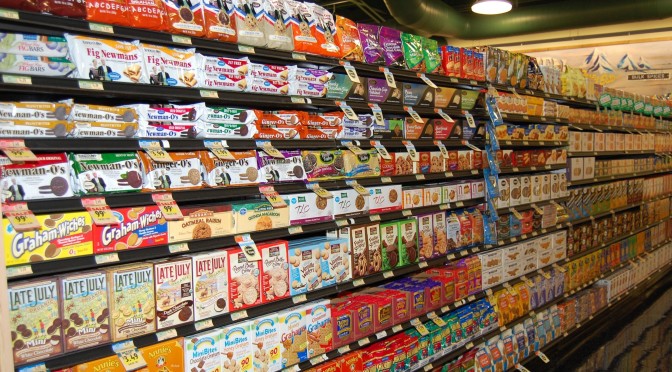
But let met put it this way. Take for example myself. I’m careless and carefree, right? Yes. But these two aspects of me aren’t separate; they’re one. It’s like those digestive biscuits that have chocolate on top. The chocolate is the carefreeness and the underside the carelessness. The whole thing is part of my personality, and the whole box of carelessfreeness, quielation, friendiculousness or abstrant, openular mind is me. I’m this box of biscuits that look the same, because I look the same no matter which biscuit of mine you’re eating. You smell me and taste me the same, and you either love me or hate me… or you might also not particularly care about me. Do you like chocolate digestives?
When I began writing about boxes of biscuits a few lines ago, the point to which I wanted to conclude was that we all are assorted boxes of still different biscuits down a supermarket aisle. Then, however, I chose to pursue the realisation that came to me while writing that yes! People are like food.
Some are so sweet you get sick of them after just a few bites. Others are simple but fulfilling. Others yet are only to be had at parties or thrice-a-year family dinners. You can find each type of person at the supermarket, but there almost always exist the same kind of foodstuff produced locally and tasting better, like that amazing Greek artisanal Nutella that’s not only better, it’s also cheaper.
Some are fancy, others to be enjoyed as part of a familiar routine, some are fresh and organic, many are rotten and/or appear fresh solely because they’ve been peppered with preservatives. We have changing tastes in people and so do we in food. Maturing tastes, perhaps? Some are hot, some are bland. But! The too-bland ones can always spice themselves up; the hotter ones will probably just leave you in tears and gasping for air. But so do onions, at least the crying part. Similarly, there’s a whole lot you have fond nostalgic memories of, but regret every trying them again 20 years later to see if they taste the same. Others are like heaven consistently forever… I presume, I wouldn’t know.
There are hard people, soft people, sweet, bitter, sour and… salty people. Many, sadly, are just plain meat but, although a selective omnivore I may be, it’s sadder when they’re vegetables instead. This is starting to have a Dr. Seuss rhythm to it.
Finally, you would never, ever consider that it’s the broccoli’s fault that Roberto (that’s my Italian coordinator here), with all his exquisite and discerning palate, hates it. I can’t get my head around it: how is it normal for us to think that a person has anything to do with whether others like them or not? Anyway, broccoli can rest easy: I hated it, HATED it when I was a child, you know, it was the archetypical go-to yuck food. Nooow, however, I sometimes even eat it raw. I love it. Broccoli just used to be too sophisticated for my untrained taste buds. There.
One of Terrence McKenna’s famous quotes goes: “”. qb’s version: “the cost of being sophisticated in this society is being the person-equivalent of broccoli.” Or, while we’re at it: sushi. Lentils with yoghurt. NOT eggs: they could crawl back into the chicken’s ass whence they came and I wouldn’t spill water for the dead. Beans. I was damn near allergic to the things most of my life. Now I can eat them no problem due to my insistence to eat them no matter my stomach’s complaints. I can imagine it quietly giving in after all this time: “okay dude, I get it, you took that little song about beans and the heart a bit too seriously, I don’t agree but I can’t stop you… you should know though that this IS going to put a strain on our relationship.”
Wow. This really worked. Remember? Near the top of this text it says I wrote “I fucked up”. It’s even the title of the post. But I’m better already. All day I’ve felt like shit because the bike I rode yesterday for 25km up and down Montevideo’s Rambla and took the following video,
that is, Laura’s bike she hadn’t rode in years and I paid 1000 pesos to have repaired and use it and got it 4 days ago… well, that bike was stolen. All I did was just leave it outside the Posada. Given, it was locked, but with a lock that cost less than 5€ and could probably only protect anything of any value up to that amount. Only today did I notice that all the locked bikes that had caught my eye on the pedestrian street Calle Pérez Castellano during the day, all those bikes I had subconsciously noticed to give my carefreelessness an excuse to run wild, were nowhere to be seen at night, and so was mine by next morning. I can just imagine it sitting there, alone, singing in the dark: “I’m old and rusty, though orange with some new parts e.g. pedals and handles, I’m safe from harm and theft ♪!”
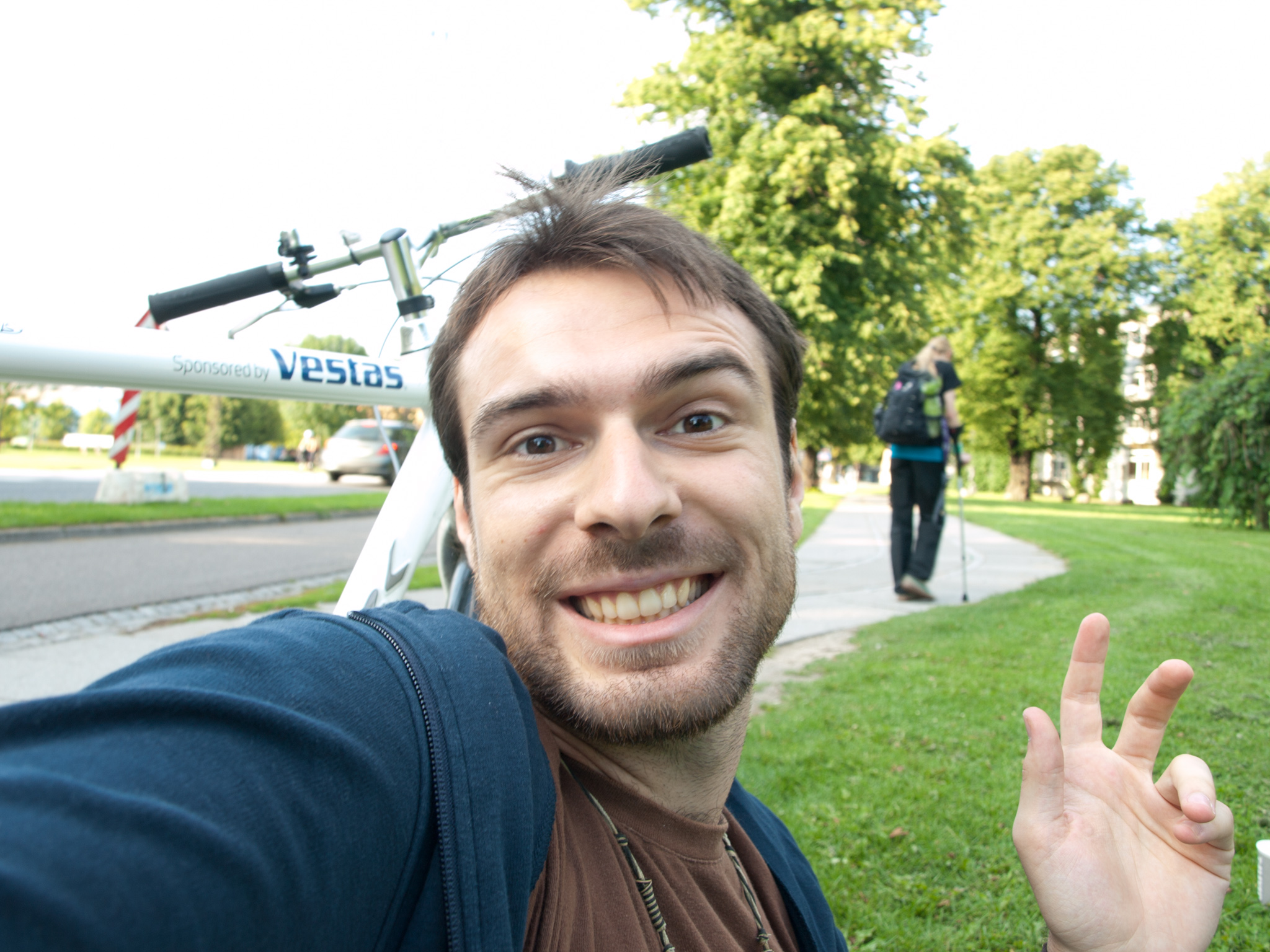
The worst part is that this bike had sentimental value to Laura, so having to tell her that I almost presented the her old bike to thieves and having to deal with questions such as “really, did you leave it outside?” was less than fun. The second worst part is this makes it the, what, 3rd time I’ve had my bike stolen. Last time was in Denmark, where I idiotically left mt bike unlocked going to Danish class, forgot about it for hours after the lesson, went around town, only remembered about it that evening when I had to ride it back home and was all disappointed that the mere act of remembering about it hadn’t been enough to protect it from theft or bring it back.
August 2011, Denmark. This is like one of those “last selfies.”
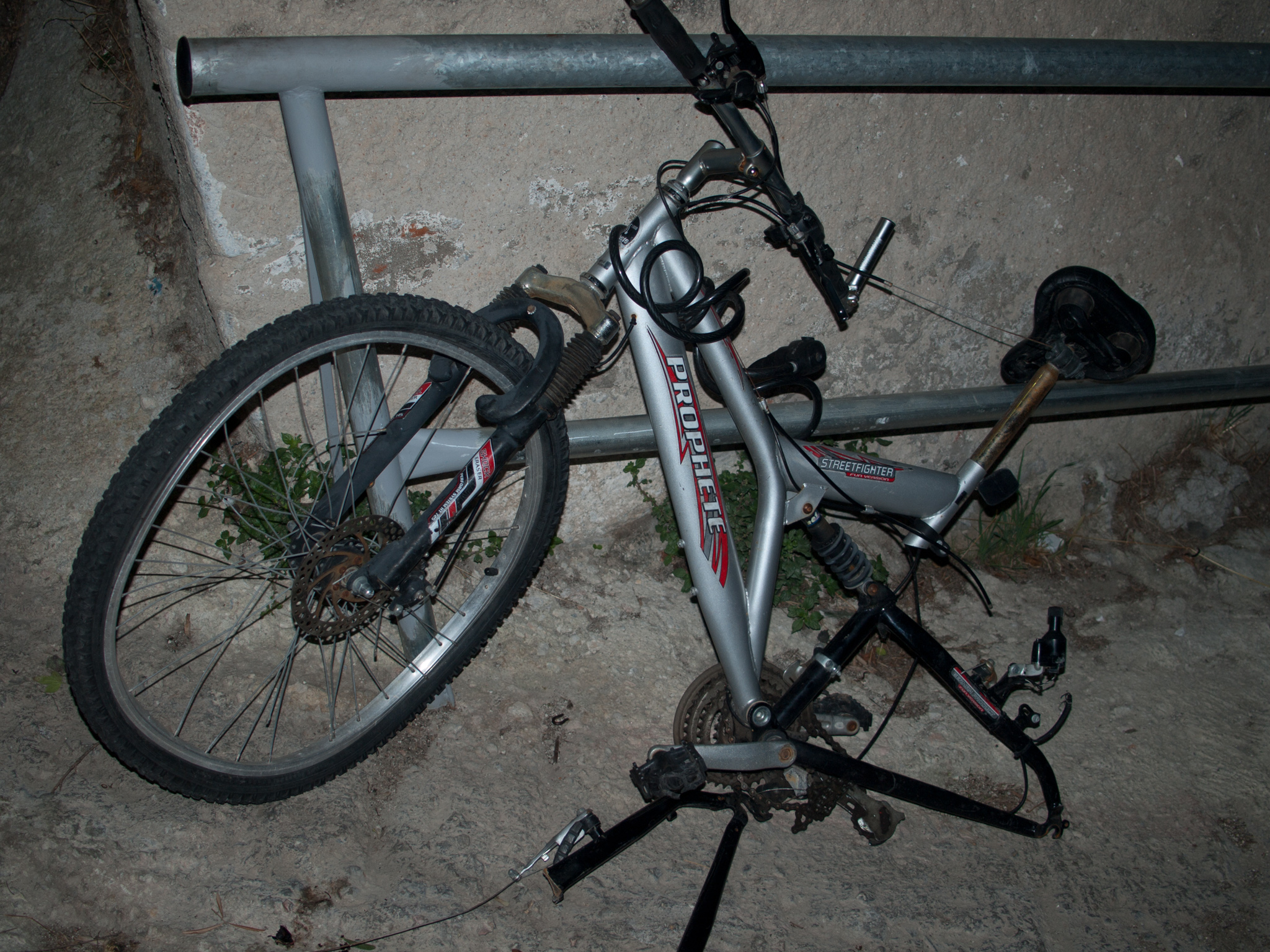
And there was this other time somebody vandalised my bike parked at Sapfous in Mytilini. I was totally Anakin bringing back his mother from the sandpeople that evening. Only I didn’t slaughter anyone like an animal. I’m civilized. I only ever hold passive-aggressive grudges.
The carcass of my ride on Minwos and Lavyrinthou. Notive the crooked front only wheel
Anyway, back to today. I went to the police office to report the theft as it was suggested to me I do, because apparently Ciudad Vieja is monitored 24/7 by video surveillance; by checking in their records from last night, the police might be able to find the culprit and track them from camera to camera, if they did stay within the boundaries of the Old Town, that is. I can tell you that if my bike is indeed located by the use of video surveillance tech, I’ll be hit by a small-to-medium-sized train of cognitive dissonance. I hate to be that guy, I know how fashionable it is to hate on the police (I don’t like them myself), but ever since my mum’s handbag was robbed and after declaring the theft and the police guys actually CALLING us home to tell us that the bag had been found at a place where “a lot of τσαντάκηδες leave their discarded prey”, it’s been easier for me to feel a tinge of empathy for people who support the police and are disdainful of anarchy. I mean, suddenly when it happens to you, it doesn’t seem so oppressive, does it?
Anyway №13 or something. I fucked up and writing this relaxed me a lot. Its intent was to be a kind of Post-It for futurue qbs to be wary of carelessfreeness, no matter how many times things turn out to be OK in the end, and to remember that it fucking sucks to let people, friends and yourself down and destroy their trust.
But hey, at the end of the day, I’m a chocolate digestive. Some will like me, some will hate me, some will simply not care about me, forget that I exist until I appear before them (at which point they’ll either choose to munch on me absent-mindedly or ignore me) and some will eat the last part of me that’s left in the box all crumbly and melted, but still like me and recognise that not all chocolate digestives from then on out will be crumbly and melty and that if next time I’m in no condition to eat on my own, just throw me on some ice cream or oats, that would be yummy.
When I read things like this, I tend to regress to my “what’s the point?” mode. But then I realise there’s still so much road to pave for the possibility of a prospect of a better future for those who make it, those who weather the crumble. The article mentions this and focuses on the importance of positive narratives. There’s little we can do to reverse the situation now, so shouting at the top of your lungs “we’re screwed!” won’t help, and anyway, people at large who have elected to ignore reality thus far will go all the way before they reality grabs them by the face and locks stares with them forever. So a positive message, ideas for transition, building suitable, sustainable communities for preserving the good parts of what we have created seems to me like the only viable, or at the very least productive, idea we can start working on right now.
Cli-fi though… Apart from clitorises, it reminds me of JMG and preparing for the Long Descent, which will have its ups, down, needs, challenges and inevitably present new opportunities. The world will be much more unpredictable, ugly and much easier to get you caught up in misery, but people will still be (mortal) people, such as they always were. Music shall still be played—a mix of AI-produced synths and traditional ethnic music? Dinners will still be cooked—vegetarian meals based on new recipes that take into account the limited variety and availability of ingredients? Laughs will be enjoyed over new jokes or memes—much needed black humour at the sorry state of humankind that couldn’t resist taking its own daydream for the truth?
Life will move forward into the unknown. But this unknown is being shaped right now by the collective force of our species. Each one of us is steering this force as much as a spec of sand can choose, or not choose, to take part in a destructive sandstorm. But a spec of dust in the right place can allow vapour to condense around it and become a drop of rain.
Sandstorms, wind, rain… like different moves in a poi dancer’s repertoire.
Another post-war American dystopian classic scratched off the (small) part of my to-read list that’s dedicated to… *pensive look*… older books.
Fahrenheit 451 impressed me. I expected it to be good, but, dutifully as I do when the proper time comes, I made all the right connections that proved in my eyes how a 70-year-old book might as well be speaking about today.
They say that “the past is a foreign country”, yet at some unique moments of lucky insight we can get to realise how much we do share with the people from foreign countries, who at first might seem distant, locked away by the fences of culture, yet at some point we take notice that there’s still the gap between the bars through which we can see the other side. Replace the Parlors with tablets and the Firemen with… I don’t know, the NSA, and there you have it.
While it would be a wild stretch to say that books are even slightly hated or feared in today’s society, I would argue that they’re increasingly insignificant. No, actually, it is not books we’re talking about here—just as Faber told Montag that it wasn’t the books themselves, as in the scrawled, bound sheets of paper, that he wanted to save. What we, in the company of Montag and Faber, are talking about, is books as symbols of mindful dedication, a capacity to pay attention to detail and a thinking or intuiting mind behind the scrolling eyes able to connect with what it reads and care about it.
Some minor spoilers ahead.
In the scene where Montag and Mildred go through the books Montag has saved, try to read them and find they are unable to understand them, I was reminded of young Greeks today unable to understand ancient Greek or even Katharevousa, or me trying to read Dostoyevsky a couple of years back and giving up because “I can’t stand the classics.” Beatty’s admission that books were essentially banned (or, to phrase it more precisely, reading was slowly abolished by the government by discouraging literacy) in order to avoid conflicts of opinion that could make people invested in some idea or its counterargument, brought to mind how there exists now a dominant mainstream narrative that requires from people globally to accept it more or less at face value, while every discordant (rational?) opinion is painted as crazy. It’s got to the point where if one does not believe the official story, they are a conspiracy theorist, which seems to be the broad-brush contemporary insult of substantial equivalence to “communist”.
You can go to Reddit these days to get an idea of what’s allowed and not allowed to be discussed in mainstream discourse, although I like the idea that the more taboo a subject is, the closer it is to our cultural blindspot, what people in the future will laugh at us (or curse us) for failing to see, and in a way to the truth—if we can speak of such a thing without missing the point.
I can’t say whether Bradbury was ahead of his time—this would imply a linear, rational process of how the progress of humanity works I don’t agree with—but what I’ll say is that in certain respects, the times themselves have not changed all that much since when Bradbury was fresh out of school and was typing away in the basement of UCLA on penny-operated, time-constrained typewriters. In certain respects. And that includes man’s (and woman’s! {and genderqueer’s! {{[and other terrestrial and extraterrestrial sentient beings!}}}]) thirst for meaning, and the survival, or the continual re-imagining in the aftermath of disaster, of what truly matters.
In short, yes, you should read this book—as another step to protect its family and heritage from their slide to insignificance. Alternatively, you could listen to the unabridged audiobook like I did. It’s just over 5 hours long and the narrator is good.
I enjoyed Sweet Tooth‘s insight into ’60s and ’70s British life more than I did any of the characters, who I honestly didn’t care about all that much. It happens to me a lot, enjoying the setting and background more than the actual story, and it happens to me not only with books, but also with movies, games, sometimes even with people. Often I feel as if everything else apart from the protagonists, the setting, the situations, the world events taking place somewhere unseen and the emotional backdrop are the real centrepieces of a story. Here, it wasn’t Serena Plome or any of her lovers: it was MI5 and the world of domestic intelligence, the Cold War and the sides the public, or rather intellectuals, would pick in the “war of ideas”, be it consciously or subconsciously. Or somewhere in between.
Yes, I definitely enjoyed being transported to that era as a little observer; an era when a lot of things were the same as now, but they didn’t have phones or the internet. However, they did have a growing eco movement. They did have rock—in fact a lot of the rock stars we’re still idolising were alive back then, like my father often observes, who incidentally gifted me this book the Christmas before last; they did have marijuana, leftist movements and activists, they did have secret government services running the show in ways which will probably never be disclosed. A lot of what is still part of public discourse had its roots in that era. We think we’re being original, when we just haven’t done our homework. Am I ranting? I think I’m ranting.
What truly surprised me was the meta ending. I wasn’t expecting it to come from a story such as this, but then again, and this is probably another reason why I enjoyed it, Sweet Toothwas a book about books, authors and literature.
deriving ideas, style, or taste from a broad and diverse range of sources.
Greek: εμπάθεια/empáthia
intense negative emotions towards somebody; enmity.
English: empathy
the experience of understanding another person’s condition from their perspective.
I’ve been using both of these words incorrectly, the one in English, the other in Greek (like a true bilingual, yay) and I only found out recently. Who can blame me?!
I’d heard that the second part of the Dune saga is a bit of a disappointment after the grandiose first part, and as I do hate to admit it, I struggled to finish it. I couldn’t exactly follow what was happening, the characters’ motivations, their positions and the parts they were playing in Muad’Dib’s empire. Most of all, I couldn’t visualize how he was visualizing what was happening to him and the intrigue that was taking place around him… or if I did, which I might have, I thought it was confusing and not very interesting. The whole ghola/Idaho subplot (subplot? wasn’t that the book’s main storyline?) left me terribly indifferent.
I’m happy to have put Dune Messiah behind me. I can start seeing why a sci-fi fiend acquaintance of mine told me that he dropped the series because of “way too much religion and mysticism.” Messiah indeed went overboard in this regard compared to its predecessor, but I’m still curious what might happen in the next books and whether the mysticism and religion at least in the rest of the story might prove to be a bit less hazy and interesting. Mind, in the first book, it was a big part of what made it feel so alive.
HAN: —Nay, not that: The day when Jabba taketh my dear ship Shall be the day you find me a grave man.
GREEDO: Nay oo’chlay nooma. Chespeka noofa Na cringko kaynko, a nachoskanya!
HAN: Aye, true, I’ll warrant thou has wish’d this day. [They shoot, Greedo dies.] [To bartender:] Pray, goodly Sir, forgive me for the mess. [Aside:] And whether I shot first, I’ll ne’er confess!
I’m not a fan of Shakespeare. I don’t think I’ve never seen or read any of his plays. Since forever I’d thought that I would find the language or the story boring or something. You know how it is with some things; they rub you the wrong way once and you keep having an unexplainable prejudice against them for years thereafter.
Verily, I stumbled across this work while looking for Expanded Universe publications. At first I was skeptical for the reasons above but it didn’t take me long to discover the brilliance of this here tome. By the way, I read/listened to it in audiobook form, which felt much more like watching the play with the script at hand.
I shall try to be brief. William Shakespeare’s Star Wars not only is a masterpiece of genre mash-up, being something more than the sum of its parts. It made me laugh out loud (for real) with its deliciously tongue-in-cheek yet very serious and perfectly executed Shakespearean interpretation of the story we know and love: for instance, it’s written exactly like the script for something that would be put up in the Globe Theatre, with acts, scenes, entrances, exits, monologues — even Chewbacca and R2-D2 get a few [!!], plus it’s completely written in iamblic pentameter — quite an achievement in itself — and follows various classical drama tropes sublimely. It gave me new insight to the motivations of Han, Luke or Darth Vader; it even made me stop and think why I haven’t read Shakespeare before. In fact, the epilogue by writer Ian Doescher made me realise just to what extent good story-telling has been based on what Joseph Campbell’s introduced and explained in his work The Hero with a Thousand Faces, and how a cross between Star Wars and Shakespeare ultimately makes a lot of sense and can prove thoroughly enjoyable and illuminating.
If you like Star Wars, the English language or simply seeing how far-fetched yet creative ideas can strike gold when done right, I cannot recommend this audiobook enough, although apparently the printed edition comes with some clever and beautiful illustrations (check the cover).
Here’s a little snippet I’m posting here I couldn’t post on Goodreads. Just listen to Vader sharing his inner thoughts and motivations with the audience.
Have you watched The Perfume? Do you know this scene? The music above is the soundtrack to the lizard-brain serotonin-releasing real-world fugue-state equivalent your future self will look back to in the same kind of shame you experience when people retell you, with great amusement they do not want to show, your drunk adventures from last night you only remember disconnected pictures of.