I’M SICK OF THE INTERNET – AREN’T YOU? GETTING THROUGH INTERNET ADDICTION

For music, if you need some.

The simple fact of the matter is that I’m sick of the internet.

Got your attention?

I’ve been wanting to write this post for the past several days. It came to me when my laptop stopped working for a day, and I was somehow relieved that I had an excuse not to check my e-mail, my facebook, follow through with my obligations. In truth, I think I’ve wanted to write this for the past several years, but the time was never just right – or I was not ready to take things seriously.

Now the time is right. I know because I’ve had this heavy feeling in the greater area of my heart and stomach all day, the same bodily sensation I get every time I get the urgency to publish something important for me. In fact, it’s the exact same feeling I get before I ask a girl I like out, have an exam coming, or need to make a phone call to somebody I’ve never met before. It’s the flinch, but it’s funny how a simple sudden need to write something makes me experience the same physical reactions to insecurity, the knowledge of what’s to come, the question of whether it will be accepted or rejected (tell me again, which one’s worse?)

Before you say anything, I know. I know all that. All of it. I’ve had my life shaped by being online, guided by it. If there was a poster child for this brand new technology 30 years ago, I could have been it. I even studied the thing in university, both from a more theoretical, humanistic perspective and a drier, technical approach. The only reason I believe I might not be the most suitable person to talk about it today is that every day, to I’ put it politely, I’m becoming less of a fan.

To give you a rough idea of how long I’ve been a user, I have had access to the internet generally available to me since I was 8 years old – my father’s 28.8kbps with GroovyNet. That meant web surfing about twice a month on the weekends I used to spend with that side of my family. All I would search for on AltaVista or Yahoo would be related to Nintendo, Mario or Donkey Kong. I’m talking about 1997 here.

I’m not going to say more about my own personal history and milestones of net use (i.e. when I made my first e-mail address, when I first had a net connection of my very own, my first online game, my first download from P2P networks or my first social network account, even the first post on this very website), for the very simple reason that, for the majority of my life, these internet-related milestones had been so closely connected (heh) to my real-life history, that any attempt of recording or writing about them would be like trying to write something about my life the past 15 or so years in general. The boundaries between online and offline life would be arbitrary. It would be like a book no-one wants to read, because they have their own sitting right next to them.

I won’t go into details about how the internet is important today, either, but I will do a rough run down. We all know about it more or less: it’s the fastest growing (tele)communications technology in the history of our species, at least as far as we know; it has created new dynamics in virtually every field, accelerating change in unprecedented rates and paving the way for greater shifts yet; it has proven a disruption in the status quo, an experiment gone wild, an almost unharnessable beast with inner workings that global capitalist, democratic, free market societies weren’t prepared for and still don’t know how to manage.

For human communities and communication, it’s been the culmination of all human inventions to this point, the convergence of all human endeavours to create this network of everything, everywhere, a single entity that contains the entirety of our heritage and makes it available to all. It’s the connection of anybody with anybody else. In 20 years – less! – we’ve created this thing, this pulsing, vibrating cybernetic superconstruction that would make science fiction writers of just 30 years ago pee themselves with excitement and anticipation. We live in the future!

How do you, personally, feel about that? Do you realise what important times we live in? Speaking for myself, writing the above gave me a rushing sensation, just for a second there. It was surprising, to tell you the truth: the net nowadays has been making me little more than numb.

Which brings me to my initial point. I’m sick of it.

Rant incoming.

I’m sick of Facebook. Sick of everybody obsessing over themselves so much. Sick of selfies, sick of  cries of attention which are answered by other, louder cries for attention. Sick of how our stupidity, our short-sightedness hasn’t been cured or at least lessened by our newfound ability to communicate more efficiently than ever, but instead we’ve inadvertently used these tools to make stupidity travel harder, better, faster, stronger.

I’m sick of having to think about checking my multiple e-mail accounts, their unusually high number explainable by my taste for playing around with nicknames and forever tranforming identities, and my peculiar distaste for comfortably centralising my communications. Call me also slightly paranoid – I’m sick of that too. I’m sick of having to worry about not replying as soon as possible, sick of “not having checked my e-mail” not counting as an excuse anymore. Who cares if I really don’t have a smartphone – for how much longer still unknown?

I’m sick of the routine of it. Checking the same site again and again, the pointless refresh. If I’m going to do something in the morning, why does it have to be checking the false news of a false world on a website full of shills paid to swerve public opinion this way and that? Do I really need to know what’s happening, all the time, if I can only ever remember so little of it, talk about less of it and act on almost nothing of it? If the net is the most democratic medium we have, what happens when, after everyone and their grandmother has facebook and can make their comment and opinion public for all to see and be somehow influenced by, the same shit we experience in everyday life is copied to the web?

I’m sick of a web, a “democracy”, where trolls set the scene and have the upper hand, sick of pitiful little men that externalise their social anxieties and complexes in a space that can’t really harm them, being the driving force in some of the worst cybercultural phenomena we get to see online. But I wish it was just trolls: I’m sick of everybody’s self-centered non-trolling opinions, too. If we give everyone a voice online, we should be able to call the bullshit. But why do our bullshit detectors work so much less effectively online than in real life? Isn’t it a little bit like the mere fact that somebody’s doing something online, it’s given more validity than if it were done offline? Is that just the novelty of the medium that will soon pass? It’s no wonder @AvoidComments exists and that some sites have disabled their comments features altogether…

I’m sick of people smugly declaring they don’t have a television when asked if they’ve heard of the news on this or that celebrity, but they spend more time watching Youtube videos or TV series than they ever spent on watching classic old WeTube in the past.

I’m sick of writing “I’m sick of”, so I’m going to externalise and project a little bit here.

How do you feel about having to stack up against the whole world with your creativity? How many times have you had a great idea but did nothing to make it happen, because the thought that “somebody else must have done it already” killed it on the spot, and to make matters worse, you googled it just to be sure and somebody else had already executed it 5 times better than what you had even conceived of, sending you even farther down that internal pit? How does that make you feel? Why?

When was the last time you talked to each of those tens of Skype/MSN/whatever friends? Are you still interested in what they’re doing? Would you consider that the internet is bringing you closer to them?

How about reading? What was the best article you read the past week? The past month? No, you’re not allowed to look up your browser history. Go on, tell me what it said. What’s that? You can’t?

The pictures you have online, things you wrote a while ago, all that… Do you ever consider that people looking up your name have access to that and can paint a mental picture of who you are now based on who you were 5 years ago? In another 5 years or 10 years from now, these numbers will have skyrocketed. Do you want that? How does it make you feel? For me it used to be really stressful that somebody might have the wrong idea of who I am (I have some form of social anxiety IRL about being misunderstood and rejected, which translates in interesting ways in the webosphere) but there’s increasingly nothing I can do and I’ve just sort of embraced the fluidity. You can’t win them all anyway. I suppose you just have to live with your everything being public and always be appropriately mindful of your actions online.

All this makes it very hard to disown things you did and said in the past, however. We’re not allowed to purge, which is I think very normal behaviour we should be encouraging more, and neither are we allowed to change as people; if we change we instantly create inconsistencies across the various existing representations of us online. If I wish to stop using the name cubilone, for example, because I no longer identify with what the name carries with it, who will be the tens of cubilones you can find on the web?

Talking about public, have you been finding it more stressful to decide what you should be sharing and what not? I have been very bad with sharing lately, and don’t consider most details about my current life as worth sharing with others, including things I would definitely post here in the past. Remember, though: I’ve had the ‘mension for almost 7 years. Who’s not to change his or her habits in that time?

But no, I’m talking also about sites like Tumblr, Pinterest etc. Sites that force the whole damn interestnet (read that again carefully) down your virtual gullet before you’ve even had the chance to blink/chew. Tumblr especially is excellent at making you insensitive to beauty. Time and time again I’ve caught myself and others scrolling down the feed, giving a split second of attention to pictures that under different conditions would have made it to our desktop background. What happened? Have we forgotten to stop and appreciate? If we haven’t yet, I reckon we’re well on our way down that path.

I’ve talked and written about the web and infinite novelty before but, as you can see if you click on that link, I wasn’t able to limit my susceptibility to it in the 7 months that have passed since the post above. It’s a dangerous thing that can silently devastate a mind such as mine that feeds on new ideas and connections and is always on the lookout for the novel and the untried. Indulging myself in infinite novelty feels right, more or less because surrendering myself to it is one of my strongest habits, but at this point I think it’s time I admitted that it’s poisonous for my creativity and my ability to concentrate; it’s detrimental for my already distracted personality constantly spread thin, and it’s bad for my mental health, my relationships and happiness in general.

Does any of this resonate with you at all?

Good. It’s time we did something about it, don’t you agree?

I’ve decided to do it the hard way, since everything else I’ve tried to this day has more or less failed. I will use the internet less – I will force myself to use it less. Everything: skyping, downloading, facebooking, e-mails, checking up on that book I learned about earlier in the day, writing on the blog, working on my sites… Everything.

At this point, I want to make it clear that I don’t think the internet is all bad. It’s an extremely powerful tool that can be used to do incredible things, spread world-changing ideas or just help people keep in touch, and it’s very practical, too. I’m not saying we should forfeit all the great things the internet has brought in our lives – at this point we can hardly turn back, anyway. What I’m trying to say with this post is that the power of the internet has to be harnessed. One has to be smart about using it and not surrender oneself to its siren song. I believe that by dramatically limiting my access to it I will be in the position to use it more purposefully, and I believe so would you.

My internet access days will be Wednesdays and Saturdays. I might add another day or two for emergency Skype calls that can’t be avoided, but generally, this will be it. I will keep it up for at least the next 24 days, the duration of the rest of my 7×7 challenge, but I aim to keep it up past that point.

This is a personal experiment, but I wish to find other people to join me in this quixotic quest. Will you take a stand with me, friends?
 

7×7 CHALLENGE

A few weeks ago, while looking on Reddit for some material on how to get motivated and disciplined, I stumbled upon this comment on this submission:

http://www.reddit.com/r/getdisciplined/comments/1x99m6/im_a_piece_of_shit_no_more_games_no_more_lies_no/cf9dz72

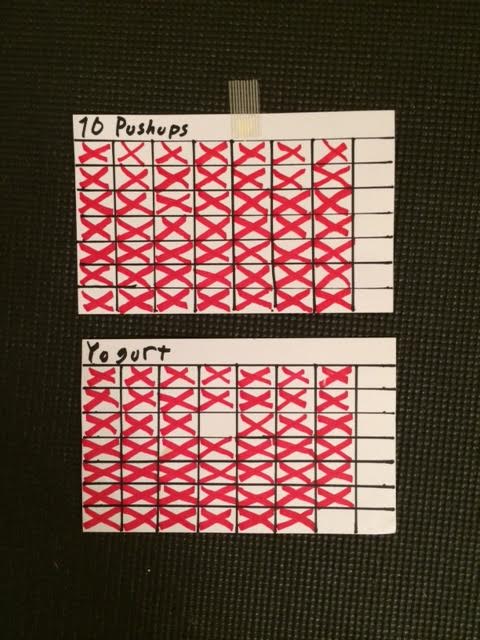
TLDR; in order to make a new habit stick, just try to do it every day for 7 weeks – 49 days. The catch? You have to have a card like a calendar on which you’ll physically draw a big red X on and for each day you’ve worked on your habit.

Like this:

From this guy: www.reddit.com/r/theXeffect/comments/21mv06/told_myself_id_post_this/

The above comment became such a hit (notice the 4× Reddit gold? That’s having won the internet) that it inspired a whole new subreddit, theXeffect, and even a whole new website dedicated to this idea, fortyninedays.com.

As you might have realised by now, I like this sort of challenge thingies, because they help me structure my life, which in its normal state makes a random splotch of red paint on a wall look like the epitome of predictability and order.

So I decided to try it.

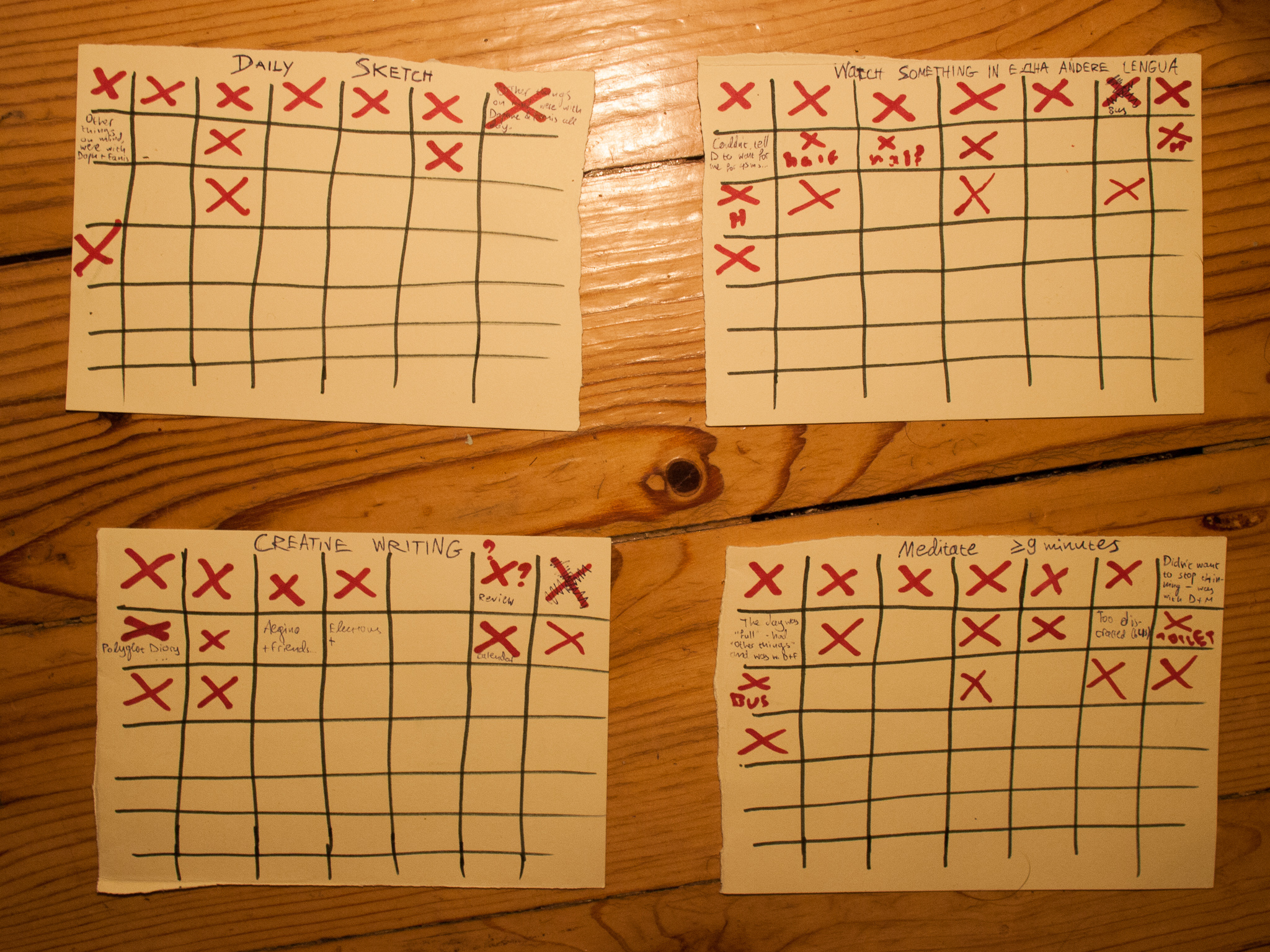
On May 8th I made not one, not two, but four cards. I thought it would be challenging, but entirely feasible.

3 weeks + 1 day later, this is the state of things:

7x7_challenge_qb

The habits I thought I wanted to make permanent in myself by using these cards are:

  • Making a daily sketch;
  • Watching something in the languages I’m studying;
  • Writing something apart from morning pages every day, be it posts, poems or working on those stories I have in my head;
  • Meditating.

Some of these daily habits were more successful in their conception than others.

The state of things right now is that, as you can probably see, it’s become pretty difficult to stick to my goal. Week 1 was more ore less smooth sailing, but since then I have been finding myself more and more in situations where I just can’t focus on my tasks, be it because of oversocialising (here in Sofia it has come to the point where there’s almost never a time when we don’t have a guest staying over – which means going out with them, spending time together etc, on top of the usual EVS chaotic experience), travelling, internet distraction…

Three weeks in, as things are now, I think I can safely say that I have bitten off more than I can chew . Two of the habits are creative, one needs me to clear my head from all the day’s little nagging things (which I’ve always found very difficult, hence I’ve found meditation to be so demanding and never really stuck to it) and the other needs me to have at least a block of undistracted 45 minutes to spare every day in front of a screen. It sounds easy enough, but my life right now is so disorganised (perhaps for good) that I’m struggling to find even the structure needed to work on structuring it!

The most trouble I’ve had with creative writing, which is just too broad a term. I combined it with writing something in the languages I’m learning at the moment, which has culminated into my polyglot diaries, but this doesn’t seem to be working out right now, since it’s already been a week since I wrote anything for them. At least today’s X has already been taken care of by me writing this post.

My progress on the rest of the challenges isn’t in much better shape: watching something in a different language has been reduced to watching Battlestar Galactica with Bulgarian subtitles – I don’t have the patience to watch anything else dubbed -, after many days, it was only yesterday that I sketched anything apart from logos or plants, and my meditations have been so full of inner noise I often come out more stressed out than I was when I went in. It’s adviseable to meditate in only certain altered states: experience says that mild-to-moderate drunkenness is not one of them.

I wanted to share my progress on this because I think it’s time I did something to make these challenges a priority. What is that which is most direcly influencing the way I spend my time, how much free time I think I have, and what I do with it? What is it that is so deeply influencing my capability of finding and creating stillness, the flow of my creative juices, my focus on my EVS and my language studying – in other words, how I use my alone time?

Review: Rocannon’s World

Rocannon's World (Hainish Cycle #1)Rocannon’s World by Ursula K. Le Guin

My rating: 3 of 5 stars

Even from this early sample of Le Guin’s writing you can tell she’s not just another science fiction writer, authors of what I suppose my father had in mind when he always kept telling me to avoid reading this kind of literature: the jobs of her characters (Rocannon is an ethnologist, similar to the protagonist of The Word for World is Forest whose field is anthropology), their dispositions towards their world, what is uttered and what is done in her stories are just one-of-a-kind.

Precisely because this is one of her earlier works, and she hadn’t yet refined this type of sci-fi storytelling many would come to love, the plot of Rocannon’s World wasn’t anything spectacular. However, if I said that I didn’t enjoy travelling through this world, complete with different day-night cycles, different cultures and different forms of life, a journey to a world I wouldn’t have made otherwise and one that made me richer, even by a little bit, I would be lying. Even what would seem like a small part of what makes this book and other books by Le Guin so engrossing, like observing the discovery of a new continent on an otherwise insignificant planet, can feel mystical to me. It makes me want to go out and become myself a surveyor and ethnographer of planets whose description is only a paragraph long in the respective Hitch-hiker’s Guide to the Galaxy.

The ending I found particularly impressive and it stuck with me, even right now when I can’t look it up from the book itself. It managed to convey so much of the ambitions of Rocannon and the tragedy, paradox and incompatibility of the big picture vs. everyday life in a single line, that I was wearing a satisfied smile for at least the rest of the bus trip from the port to Nea Smyrni.

Yet again, thanks Daphne for giving me this book!

View all my reviews

REVIEW: WRITING COMEDY: A GUIDE TO SCRIPTWRITING FOR TV, RADIO, FILM AND STAGE

Writing Comedy: A Guide to Scriptwriting for TV, Radio, Film and StageWriting Comedy: A Guide to Scriptwriting for TV, Radio, Film and Stage by Ronald Wolfe

My rating: 2 of 5 stars


Another book from the fresh batch of donated books to the English section of Sofia City Library.

This book from the early ’90s is a guide for anyone who would like to try their hand in writing scripts for comedy plays, shows, sitcoms, radio or stand-up comedy.

Most of the actors, writers and productions referenced are from that time, leaving out the comedy I’m familiar with (Monty Python and the work of their individual members; britcoms of the last 15 years), with the exceptions of Fawlty Towers, Blackadder and Alo Alo.


Some specific tips for individual formats, like the importance of the gag in the sitcom, or more general ones that can apply to all forms of comedy writing, I found particularly effective and insightful, e.g. always asking yourself what’s wrong in a given situation when writing the story, or where the conflict could come from which might produce the comedic effect. These ones I think I’ll remember down the road, in contrast to most of the rest of the book which chiefly had practical information, i.e. how to pitch your script to producers or make it in America, content which as little (?) as 20 years later seems terribly out-dated.

The relevant parts I thought made for good and motivating advice that made me want to try writing something serious even more, seeing how simple and straightforward some examples of funny writing in the book were. What I realise, however, is that it’s not a guide I need the most; it’s the dedication and motivation to sit down and just write, whatever that could be.

Still, I’ll remember the part about conflict.


View all my reviews

QUIXOTIC CALENDARS

Have you ever noticed that our calendar has some glaring faults, some design issues that would keep it from ever leaving the drawing room if it were to be made today?

How many times have you stopped to wonder if May or October have 30 or 31 days? I recall always having trouble with that when I was little… Or, how about this: if I ask you what day of the week it’s going to be precisely six months from now (November 22nd 2014), how long would it take you for you to t… – hey, put that phone down, I can see you!

I’m not sure why, but we have been handed down a weird model that might be precise but is neither efficient nor elegant, and as with many inefficient, disingenious or clunky systems – just look around you for ideas -, habit is the only factor preventing us from coming up with a better system; “why fix something which ain’t broken?”, you might ask. I don’t necessarily disagree with that, especially when it comes to practical, physical things, like having a bottle support the fluorescent lamp over the kitchen sink which would otherwise collapse, or using a table fan to cool your lidless desktop computer, but there are some things that, to me, are almost divine in the depth of the meaning they carry, they represent the foundations of human culture. We should therefore strive for optimisation, even if that means a radical restructuring of what we’ve come to know and love.

Here are two ideas for new calendars I came up with while chatting with Daphne and later built upon when I was travelling on the bus back to Sofia. By the way, being with Daphne and travelling in general are both very good for letting my creative juices flow.

The criteria these two calendars must meet are the following:

The year must have 12 months; the number is perfect because it is the lowest common denominator of several other commonly used numbers used in time-keeping, namely 2, 3, 4 and 6. That is to say, if you want to be able to precisely split the year in terms, semesters and quarters – this last one is extra important because of the four seasons – having the year split in 12 is the easiest and most intuitive choice.

So far so good – our calendar already has this feature and other calendars across many cultures and eras seem to have had it also.

Every month must have the same length; that some months have 30, some 31 and one has 28 days feels wrong and messes up the periodicality of the shortest circle, the week.

Every month of the year must start on the same day of the week; doesn’t it feel good when January 1st is a Monday? Wouldn’t it be even nicer if every month of the year started on a Monday, too? This way we could instantly and easily calculate what day of the week any day of the year would be.


Quixotic Calendar I

12 months of 28 (4×7) days each = 336 days + 29/30 days split into four weeks, one placed before each season to mark the equinoxes.

January (28 days)
February (28 days)
March (28 days)
Vernal Equinox Week (7 days)
April (28 days)
May (28 days)
June (28 days)
Summer Solstice Week (7 days)
July (28 days)
August (28 days)
September (28 days)
Autumnal Equinox Week (7 days)
October (28 days)
November (28 days)
December (28 days)
Winter Solstice Week (8 days, 9 days if leap year)

The calendar would be set in such a way that the equinoxes and solstices would be roughly placed at the end of their namesake weeks – it’s impossible to be precise because the exact days are moveable even in the calendar we’re using today. In this way, the Quixotic year could end on the Gregorian Calendar’s December 22nd/23rd (we’d have to go with one and stick with it), with the new year starting on what’s now Christmas Eve. It would be possible to adjust the calendar’s starting day so that New Year’s Day could coincide with what’s today Christmas Day, but that would mean that the equinoxes and solstices would roughly be on Day 4 or 5 of their respective weeks and not at their end, for what that’s worth.

The four spare weeks “outside the calendar” would serve as holiday periods, sets of time for getting together, enjoying nature, all that.

A strength of this calendar is that each month of the year would start on the same day, including the transition weeks, with a standardised form of procession which would make it easy to calculate what day of the week any day of any year would be: the week cycle would move one or two days from one year to the next, depending on if it’s a leap year. So, if in 2014 all of the first days of the month were Fridays, in 2015 it would be Sundays, in 2016, which is the next leap year, it would be Mondays, and in 2017 the two-day jump would make them Wednesdays.

This proposal would also solve the disagreement on when the seasons start once and for all! No more people telling you that spring has come on March 1st!

The calendar’s main problem is that the seasons have all moved forward a single month (under this system, June would squarely belong to spring and March to winter, for example), which could mess up our concepts of the seasons, but if you ask me, this is already being messed up because of climate change, so there’s not much to lose really.


Quixotic Calendar II

12 months of 30 (3×10) days each = 360 days + 5/6 days at the end of the year (similar to the Egyptian Calendar).

The main point of interest of this calendar would be the 10-day week, which would split each month into three neat parts. We would have to find new names for the days of the week; how about the names of the planets plus the sun and moon, like in romance languages, which all together make a nice round ten, but using words for the planets from different languages? It would be similar to a calendrical Calling All Dawns.

Just like in the first calendar presented here, the even months and weeks would help with periodicality. The extra five/six days would fall in at the end of the year, which is a holiday period anyway.


These suggestions don’t take lunar cycles into account but our Gregorian calendar doesn’t fare much better in that respect.

You can have a look at more proposed reforms here.

REVIEW: AN EXCURSION INTO THE PARANORMAL

An Excursion Into the ParanormalAn Excursion Into the Paranormal by George Karolyi

My rating: 4 of 5 stars

I’ve been reading a lot lately about the paranormal. The term itself is almost taboo among scientists and people who have devoted themselves, whether knowingly or not, to the High Church of Materialism, an idea and its implications beautifully explored by Rupert Sheldrake in The Science Delusion. It’s been connected with very specific things and phenomena, such as extrasensory perception, telekinesis, auras etc, which have all been discredited and/or completely rejected by what you’d call mainstream rationality; bad science, Tricks of the Mind/hallucination or outright fraud have been strongly suggested as the cause of the above phenomena and more. Nevertheless, according to the book’s definition of the word:


Paranormal phenomena do seem to occur, it’s just that the tools our current level of understanding of the world provide us with are insufficient to explain the why. Fraud, bad science etc. as explanations would constitute those phenomena normal, not paranormal, which by the way is the dominant narrative at this point in time. Perhaps things are not as clear-cut when the “definite proof” of these phenomena being normal is placed under scrutiny.

George Karolyi, in this book, did what in my opinion every scientist – or at the very least more of them – should be doing: he didn’t accept or dismiss observations based on what he assumed was true; rather, he put observations first and attempting to build a theory on the results second.

Apparently (and I’m using this word in particular because according to Google this man doesn’t exist), when Karolyi wrote the book, he was a researcher in the University of South Australia with a background in electrical engineering. This explains the absolutely rigorous methodology he seems to have followed. I’m serious: he begins the book with a Physics 101 on electricity, waves, EM fields and quantum mechanics, all of them fields of physics which were either completely unknown, very poorly understood or deemed magical/supernatural as little as 150 years ago. It even has a section on probability and statistics for readers to get a basic grasp of what significant, as opposed to chance, results mean when conducting experiments.


The book then goes through human auras, psychokinesis, Kirlian photography, ESP and survival-related phenomena (among others), describing what experiments have been done on each inquiry – some by the author himself -, often going into extreme, virtually unfollowable by the layman, technical details on the methodology thereof. What genuinely surprised me? The author, to his credit, included negative results. For example, his experiments on aura perception did not lead to anything more than chance results, yet there they were for the reader to draw his or her own conclusions on.

The majority of the rest of the phenomena, though, did in fact produce significant, sometimes even highly significant, statistical results, even when some of them generally either don’t lend themselves well to controlled laboratory experimentation due to the apparently unconscious nature of their induction, as is the case with telepathy, or proof of their existence would not be easily quantifiable, such as in the case of survival-related phenomena e.g. apparitions or reincarnation. Imagine where we could be going if we let this research guide our curiosity, instead of the misguided skeptics the world over.

On an interesting side note, I thought it was funny how at the end of the book Karolyi started making conjectures to explain the paranormal, such as the existence of parallel universes or dimensions (see 10 Dimensions Theory) which would “carry” the non-physical, conjectures which he then used as a platform for closing the book by going on a moral tangent – how people ought to live in order to make the best of their lives. It came into stark contrast with the extraordinarily detached point of view which preceded it, given the material at hand, but I thought it was more interesting than inappropriate.

The main point of all this is that it’s very unfortunate that we have limited ourselves in such a way so as to not be able to even imagine, for the most part, what we could be doing with this frankly liberating information. Maybe in 150 years people like Rupert Sheldrake, Charles Fort (whose Book of the Damned I’m in the process of reading) and even George Karolyi and other researchers whose work I’m trying to hunt down will have found their place in future History of Science books (or their equivalents) as forerunners of the coming paradigm shift, the next renaissance. We can only hope.

This review is of a copy of the book recently donated to the English section of Sofia City Library.

View all my reviews

HIGH EXISTENCE AUDIOBOOK ONE

The HE Audiobook: 26 of Our Best Articles For Your Personal Evolution

3 months ago we set out to gather the best articles we’ve ever written and transform them into an audiobook.

We compiled a huge stash of inspiring, thought-provoking, ego-breaking, magical content and re-created them with the mesmerizing voice of Simon from SpokenMatter.com.

The result is a whopping 5-hours of audio content that transforms the way you absorb our articles.

You get our best 26 articles for less than two cups of coffee.

1420341_10201880102497757_901897491_n

You can listen to them while commuting or use them to get your grandma interested in DMT 🙂

They’re also DRM free so you can share them with anyone.

This is our first attempt at supporting HE through original content. Rather than ads or affiliate links, this audiobook further empowers us to do what we love without sacrifice.

This is where I, qb, come in. I bought and download this several months ago and it was quite worth it. I uploaded it on my server for sharing with anyone who might be interested but wouldn’t know where his or her $5 would be going. This is valuable info and each one of the 26 articles-cum-sound files are wonderful partners for walking and/or running.

Get it now.

THE MYSTERY OF GO, THE ANCIENT GAME THAT COMPUTERS STILL CAN’T WIN

Go-01
Remi Coulom (left) and his computer program, Crazy Stone, take on grandmaster Norimoto Yoda in the game of Go. Photo: Takashi Osato/WIRED

Wired article on the state of things in developing a Go-playing program that will beat the grandmasters, something that apparently might not only be farther off than we thought, but also more difficult.

I was surprised to hear from programmers that the eventual success of these programs will have little to do with increased processing power. It is still the case that a Go program’s performance depends almost entirely on the quality of its code. Processing power helps some, but it can only get you so far. Indeed, the UEC lets competitors use any kind of system, and although some opt for 2048-processor-core super-computers, Crazy Stone and Zen work their magic on commercially available 64-core hardware.

[…]

Many Go players see the game as the final bastion of human dominance over computers. This view, which tacitly accepts the existence of a battle of intellects between humans and machines, is deeply misguided. In fact, computers can’t “win” at anything, not until they can experience real joy in victory and sadness in defeat, a programming challenge that makes Go look like tic-tac-toe.

Things you don’t mention when people ask you what your day was like

You absent-mindedly stick your pinky finger in your ear to scratch it, happily chilling in Slaveikov Square, when a middle-aged colleague from the library passes you by and whistles at you to catch your attention and greet you. You essentially just nod a hello back, finger still firmly lodged in your ear. You’re left thinking that she greeted you just to let you know that she was there to witness you with digging for gold with your pinky.


There is a Dutch princess – apparently the patron for libraries or something similar to that – visiting Sofia City Library’s Children’s Department to present the fresh Bulgarian translation of the children’s illustrated book she recently finished writing. You tremble at the idea of actually having to meet her, because you’re simply clueless about how it would be proper to address her: “would Your Highness be too strong?”, you think to yourself. “Would shaking her hand without, err, kissing it or something, be too… normal?” It even occurs to you that, maybe, if you greeted her in just her first name, no titles or anything attached, you would do what no-one had ever dared to do before; talk to her normally, for what she really is; just another human being. For that she would deeply admire you – just like in the movies. In the end, you don’t get within 5 metres from her.


You see in the distance the guy who met one of your roomies in a big party the previous night, with whom he stayed out for the whole night and with whom they apparently hit it off quite well. He’s probably waiting for your roomie, judging by the three red carnations in his hand. By coincidence, it’s the same spot you’re supposed to meet another, completely unrelated, friend. You pretend you don’t see him; the least you want is an awkward exchange in the spirit of :

-“Hey, how are you?”
– *obviously aware of the fact that you noticed the flowers and still at the stage of deciding whether he should address the small scarlet-coloured elephant in the room* Good… eheheheh, good. And you?”
“….”

Good. You avoided that. For half a minute or so all he can see of you is your back. You doubt he can recognise it as it being yours or, even if he can, if he would be willing to make the fact known to you. When you discreetly turn around, your roomie has already arrived and met up with the guy, is holding the flowers and is vividly exchanging with him whatever it is you’re supposed to say in such situations –  I don’t know what it is, sorry. You pass them by and greet them both; now there isn’t just a single person sitting there, it will finally be both socially appropriate and desirable by everyone for you to just say hi and continue walking with no further questions, exclamations or general interaction. You start moving towards them but not exactly; you know, in an angle from which you they can see you but you’re not actually walking in the middle of the air holding them apart.

Neither of them notice your very briefly outstretched hand somewhere in their vicinity.

You do not change your course of bipedal locomotion.


All of your groceries have run out and you’re too bored to actually buy more.  But is it really all of them or was that just a matter of speech? Not quite – you still have eggs and potatoes left. Your hate for eggs has been stuff of legends before, but you’ve somehow been forcing yourself to eat them in the past few months. It begun when you needed extra protein in order to hopefully see that exercise you’ve been putting your upper body through have some tangible results. That dream has been left in the orphanage of abandoned dreams (that was a horrible image, I’m sorry);  you don’t life your weight around at a rate where extra protein would be of any use anymore – let’s just put it like that – but the “fake it till you make it” part has paid off at least psychologically speaking and now eggs don’t sicken you as much as they used to.

The frying pan is hot. You reach for an egg but your fringers go through the shell as if it was yogurt. You curse everything that’s holy (and not so much) that made it normal for people to eat chicken menstruation. You empty the contents of the egg spilled in the carton into the pan. You check on the potatoes that you fried before and left wrapped in paper in order for it to soak the excess oil, the way you’ve always seen your mother do and you yourself do but your flatmates strangely mocked. You immediately decide it wasn’t such a good idea to use toilet paper instead of the normally used paper towels: the majority of the potatoes are now covered in filmy, greasy tree pulp. You spend the next 10 minutes removing chewy stuff from your food. The sensation of futility is comparable to peeling apples with your bare hands – no, not normal apples, that’s not so bad – maybe the candied ones you’d buy at the πανηγύρι. You resign and end up eating maybe half of them, paper and all, and throwing the rest  out, something for which you are not at all proud.

While writing these lines you’re still unconsciously picking out little pieces of paper from between your teeth with your tongue.