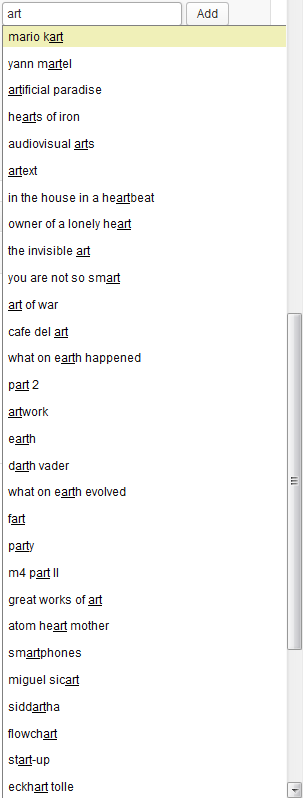
Inserting “art” in the tags of a new post gets some interesting words that contain that string…
Relevantly Irrelevant
Inserting “art” in the tags of a new post gets some interesting words that contain that string…
 Extra Lives: Why Video Games Matter by Tom Bissell
My rating: 3 of 5 stars
After reading some articles by Tom Bissell on video games, I was fully expecting this to be a revelation on the meaning of video games, with me coming out of the book convinced once and for all that video games do matter (I haven’t made up my mind yet, but then I’m like that with everything). While Extra Lives was very interesting, well-written and informative, it didn’t convince me as I thought it would. Maybe it’s because I’ve moved almost completely away from the genres Bissell prefers (shooters, open-world RPGs) and the consoles he mostly plays them on: for years I’ve shown more and more of a preference towards strategy and an erratic choice of influential, innovative and/or quirky indie games – all the realm of the PC rathen than the console. I have tried maybe half of the games he chose to unfurl his point with –Fallout 3, Mass Effect, Grand Theft Auto 4, Braid– but wouldn’t say I’m a big fan of any of them (except for maybe Braid). I can certainly say that I haven’t gone back to replay -or finish- them , for one.
I wouldn’t want to let our genre discordance influence my judgment, though. Extra Lives was a very enjoyable read and a mature, honest look at the situation of games today 3 years ago. I think Tom Bissell did a fantastic job on showing why the potential of the medium matters and how he himself is torn between realising that on the one hand and on the other “understanding why non-gamers think games are a waste of time”. It’s just that, at this point in my life, I’m leaning -however slightly- towards the latter.
The conclusion? Do games matter? Will they at some point, if they don’t now? Well, that depends on who you are and what your outlook on games is – as well as, I suppose, what your own preferred genres are.
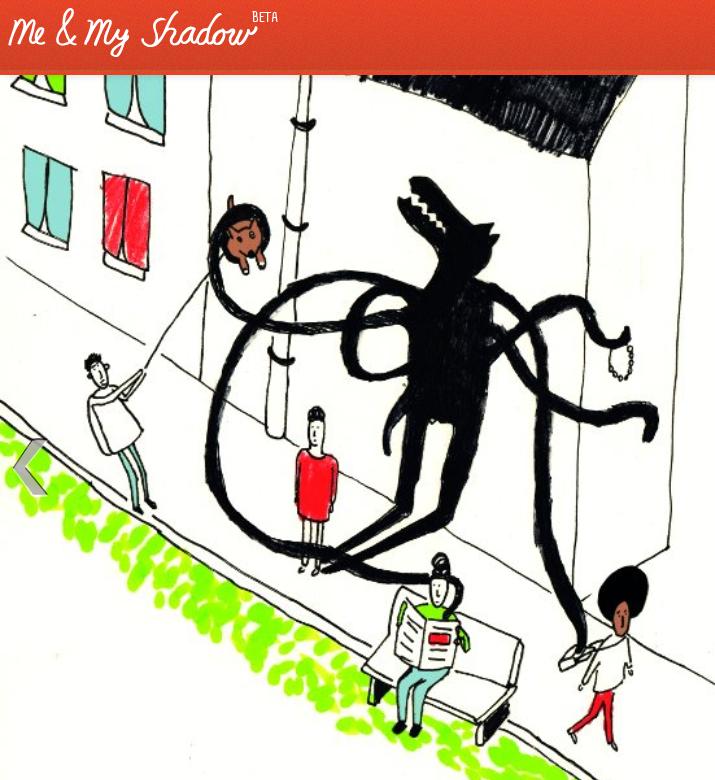
It’s a resource for the privacy policies of different large and small websites, how they enforce them, what you can expect to have surrendered knowingly or not and, perhaps most importantly, measures you can take to use the web with a little bit less transparency.
It’s an expertly, fantastically designed website that you can’t resist not using once you get there. The information and sources are also top-notch. Very informative in this cultural representational way that always makes me feel warm and cozy inside.
It’s important, very important information, too. There’s just so much being revealed about privacy online: Snowden, Greenwald, Prism, Xkeyscore (the “God terminal into the Internet“), NSA -along with every secret service in the West at the very least- and I honestly believe that even now we know next to nothing about what’s really going on. Like a lot of things, this is going to get a lot worse before it gets any better. Thankfully, people who work on projects like Me & My Shadow give me back my trust -if only just for a little while- in the power of the Internet to make the world a better place.
PS: I just found out about Data Dealer through them, an online tycoon game in which you get to be one of those data mining corporations. The objective is to collect millions of profiles to take advantage of through various websites such as “Tracebook” and “Schmoogle”. Check it out!
*obligatory awesome music that has the same name as the new month, sans the rain that just won’t come*
I’ve always had problems with keeping fit. It’s a matter of discipline and a lack of goals: in some of my older attempts I would go out and run in the Alsos, do some exercise maybe, stick to it for a few weeks but I’d quickly get bored of it or would lose motivation because there would be no actual goal – no, “getting in better shape” doesn’t count as a real, tangible goal.
Then one day about a month ago I was playing around with Garret’s iPod when my eye caught an app with a weird name: C25K. He explained that it was a program that gets you off the couch (or the desk chair, as is the case with me) and ready to run 5 kilometres in just 9 weeks by slowly adjusting the equilibrium between the jogging and recovery walking times – more of the latter in the first few weeks, almost exclusively the former in the later ones.
I can proudly announce that today I did my midway run: I have as much left as I have done already and I got me a pair of new running shoes as a reward (and an upgrade) for making it this far. Another 4 weeks to go in total. Next time it’s going to be 20 minutes of running straight. I’m pumped. Bring it on I say!
If anyone wants to get fitter (but be careful, it’s not a good way to lose weight because you tend to eat more to build up those leg muscles) and running sounds like something you might enjoy doing, get off the couch (or desk chair) and try C25K, it’s great.
For motivation: The Oatmeal: The terrible & wonderful reasons why I run long distances
 The Disaster Artist: My Life Inside The Room, the Greatest Bad Movie Ever Made by Greg Sestero
My rating: 5 of 5 stars
Now would be a perfect time for anyone who hasn’t watched The Room (2003) by Tommy Wiseau to watch it. Guys, this movie has been called “the Citizen Kane of bad movies”. There’s a game made based on the story, the following for this cult classic has been going strong for years -it’s still not very famous in Greece but I’m working to change that- and, obviously, a book about it just came out.
A book written by Mark (Greg Sestero) of “Oh, hi Mark!” fame and co-written by Tom Bissell, a person for whom my respect increases by the day. A book I could hardly put down and kept reading it standing up in the metro and in the bus and which I finished in just 3 days. I usually take long with books – sometimes because I force myself to read them rather than enjoying them. This one was different.
The Room is a special case of “WTF, how does this thing exist?!” and a lot of its charm lies on precisely that inexplicability. Who is Tommy Wiseau? Where did he find the film’s $6m budget? Why did he become the unique, strange character he is? Greg Sestero divulges a lot on how he met Tommy Wiseau, what made their relationship special, disastrous and in a way admirable, all the way up to the making of The Room, but those fundamental questions on the very essence The Room are never answered directly. He gave away enough to make me even more interested in Tommy Wiseau as a personality and what he and his ways might have to teach me (I didn’t believe there was anything I could learn from him before I read this book) but not too much, which would ruin everything. At the same time, The Disaster Artist has a certain kind of flow and style that it, as is correctly advertised on the cover, reads more like a novel – and you have to remind yourself that not only is it real life you’re reading about, but also it’s about The Room. The freakin’ ROOM!
Another reason I connected very well with the book was that Greg Sestero’s way of thinking, his reaction to some things, his relationship with Tommy and his whole demeanour reminded me of myself. I could almost imagine myself in a parallel universe in all the situations retold in the book, and that helped a great deal with my immersion in this tragicomic story.
 The Artist’s Way: A Spiritual Path to Higher Creativity by Julia Cameron
My rating: 5 of 5 stars
The Artist’s Way is one of those books that change you – one of those that are made to change you, and you buy them because you yourself want to change. It’s a course in self-discovery, acceptance and creative birth.
These are the basics: for every morning of every week for the 12-week duration of the course -one chapter for each week-, the blocked artists choosing to follow the Way have to:
1)Do three pages of free writing every morning, a daily ceremony known as the Morning Pages. This acts as a mind-clearing meditation routine, a brainstorming machine and a way of spotting trends: weeks after writing the pages the artist on the Way may analyse his or her morning pages and notice trends in his or her daily writings: unfulfilled artistic urges, changes that need to be made for the person to reach harmony and happiness, sudden ideas and other great things.
2) Take themselves out to at least one Artist’s date per week, in which they have to indulge in whatever it is they love doing but would not normally allow themselves to be lost in (remember, this book is meant for blocked artists -read: most of us-).
3) Complete tasks in personal archaeology and self-discovery, wherein they have to dig up favourite creative childhood pass-times they gave up because of humiliation, “growing up” or other creativity-killing reasons.
I completed my 12(+1 lazy one) weeks a few days ago. I can safely say that it had great effects on me. Doing morning pages has now become more of a good habit of mine, and even if I didn’t do all of the tasks, it’s one of the books you have to go through at some point again for inspiration. It says so in the end, too.
If you’re a blocked artist, believe you can’t do art because you think you’re too old to start or “can’t draw” (or are “tonedeaf” or “terrible at writing” or “have no ideas” ad nauseam), think whatever you do needs to be perfect from the beginning or don’t bother because what you would create wouldn’t appeal to the masses, you should really try following The Artist’s Way.
The only thing I would add to the course itself would be a special NoSurf task or, even better, a complete revisit to the book that takes what the world looks like in 2013 into account; I strongly feel the internet is becoming, at the same time, the most important invention and the single strongest creativity and motivation killer mankind has ever known. I mean, in the 1993 edition that I have, there’s already a no-reading week included in the course for eliminating distractions and for focusing time and energy on the creative juices within, but the internet is proving to be a distraction magnitudes greater than reading the paper or a book could ever be. We come in contact with the works of the world’s most talented and creative on a basis of addiction, almost.
What I really mean is that I’ve grown tired of and alarmed at the great artists I personally know who keep getting demotivated by seeing someone else’s graphic, photo or drawing on Tumblr or listening to that fantastic song or watching that clever video on Youtube, instead of getting inspired, as they claim they should be. It’s more “look how much others have progressed instead of me” and much less “this is possible and I could do it too.”
Or on any screen, I might add. I’m putting this HighExistence post right here to remind me in the coming days of my resolution to fight my internet addiction, and at the same time help you, dear reader, ask yourself whether you’re rockin’ in the same old boat. We have to do this together.

I have been counting my growth-killers and the distraction brought about from the internet has definitely been my No. 1 for months now, if not years – if not for far more than I dare to admit. I’ve been more than reluctant to do anything long-term to try to stop it, which proves that I really am addicted to the internet. Remember The Shallows? It’s no accident I pursued to read that book and praised it so much in my review.
A few resources in case you’re about to take this as seriously as I am:
Step 1: Do some reading: NoSurf, in the vain of NoPoo or NoFap. Will help motivate you and make you see that it’s not just you…
Step 2: Treat it like a real addiction.You have to take measures to distance yourself from your poison. HabitRPG (I’m a sucker for gamification, baby), Chains.cc, Freedom, Leechblock, RescueTime are good starting points.
Note that I haven’t implemented all the above yet but I’m making this open call for everyone interested to start together, inspired by some people who opted to stay away from the internet for 30 days and one who even made a blog to document the process.
In the year 1930, John Maynard Keynes predicted that, by century’s end, technology would have advanced sufficiently that countries like Great Britain or the United States would have achieved a 15-hour work week. There’s every reason to believe he was right. In technological terms, we are quite capable of this. And yet it didn’t happen. Instead, technology has been marshaled, if anything, to figure out ways to make us all work more. In order to achieve this, jobs have had to be created that are, effectively, pointless. Huge swathes of people, in Europe and North America in particular, spend their entire working lives performing tasks they secretly believe do not really need to be performed. The moral and spiritual damage that comes from this situation is profound. It is a scar across our collective soul. Yet virtually no one talks about it…
Excellent article by David Graeber that had been sitting on my tab stack for a few months now waiting for me to post it here. It confirms my suspicion that we don’t need to work as much as we do and that much of what people are paid to do is purposefully not useful.
Of course, it could also be that I’m looking for further evidence and support to ground my avoidance of these bullshit jobs, what has made me prefer unemployment to -in my idealistic, INFP eyes- ridding my life of meaning. Some people would call such behaviour laziness, but I suspect those people probably wouldn’t agree with the article anyway.
 The Etymologicon: A Circular Stroll through the Hidden Connections of the English Language by Mark Forsyth
My rating: 5 of 5 stars
I could quote almost any page of this book to demonstrate its awesomeness and healthy doses of “aha!” it can induce on the reader but that wouldn’t do The Etymologicon justice; Mark Forsyth does such an awesome job of linking one word to the next with such -delighfully British- humorous descriptions and eloquence that simply picking and choosing doesn’t feel right.
This book is an ode to the history and connectedness of languages, one delicious word -or group of words- after the other. You can get a taste of Forsyth’s etymology- and origin-of-language-related work in his blog Inky Fool, which worked as his groundwork for The Etymologicon. If you find any of it interesting at all, chances are you’ll fall in love with this book just like Daphne and I both did.
On an unrelated note, I think it’d be interesting to share with you that the previous owner of my copy felt the need to correct grammar and syntax mistakes, such as having “But” and “And” at the beginning of sentences, with her (I’m assuming it’s a bitchy, uptight, female 60 -year-old-virgin English teacher) black marker; at other places she noted “Daft!” or underlined mistakes obviously intended for humour. To give you a little example at some point the book reads: “What the proofreader gets is a proof copy, which he pores over trying to fnid misspellings and unnecessary apostrophe’s.” She went ahead and deleted that last apostrophe. She really did. “…they who are so exact for the letter shall be dealty with by the Lexicon, and the Etymologicon too if they please…” The book begins with this quote by the apparently very prolific John Milton; the lady would have done well to have taken this piece of advice to heart.