REVIEW: MAN’S SEARCH FOR MEANING

Man's Search for MeaningMan’s Search for Meaning by Viktor E. Frankl

My rating: 2 of 5 stars

Read this on my Kindle.

The first part is about this psychiatrist’s time in a number of concentration camps. That was the fascinating, horrifying part of the book and I truly enjoyed it. It put everything else I was doing while reading the book into perspective.

The second part I found confusing and not much from it has stuck with me. Logos, apart from meaning or the ability to think and reason also means speech in Greek and logotherapía means speech therapy, the kind you would get if you couldn’t pronounce r, g or s (and sometimes what I think I need when I realise just how badly and hastily I pronounce some words). I kept subconsciously thinking there was some kind of connection between Frankl’s logotherapy and logotherapía, which isn’t the case at all.

In the end I didn’t come out having understood what this book was about. If you ask me what Dr. Frankl’s logotherapy is, I wouldn’t be able to accurately tell you. However, I don’t think that it’s the book’s fault; on the contrary, it was well structured and argued. Perhaps I just wasn’t so interested. The first part though… that was intense.

View all my reviews

REVIEW: THE WIZARD OF OZ

The Wizard of Oz (Aladdin Classics)The Wizard of Oz by L. Frank Baum

My rating: 4 of 5 stars

Refreshing in its simplicity and messages. I was genuinely taken aback by the occasional brutality: limbs casually getting chopped off, animals dying by the hundreds, perhaps as a punishment for choosing the wrong side, and characters facing terrible prospects but somehow remaining amazingly, contagiously, cheerful. That’s what fairy tales were like in the past, I suppose.

This is a story told many times which remains more than a century after it was written very strange and counter-intuitive. Reading it actually felt like a meta-trip to Kansas for me—“how can a fairy tale be so strange? From the pacing to the characters to everything! What would it feel like listening to this story as a child? What would have made the most impression on me? What would I need most, a heart, brains, courage, or a ticket back to Kansas? Actually, wait, wh-what happened? I’m 25 years old!”

View all my reviews

REVIEW: THE HOBBIT

The Hobbit, or There and Back AgainThe Hobbit, or There and Back Again by J.R.R. Tolkien

My rating: 3 of 5 stars

Finally, after three years of idling, finish it I did! I was stuck since 2011 (dunno why) at the part right before the party got into the mountain. Then I watched the first and third films and disliked them, so I got very close to never actually finishing The Hobbit. However, since this is book-a-week year (just finishing books counts too!) I couldn’t resist the temptation…

I have to say I quite enjoyed Tolkien’s writing, at least in The Hobbit. I think it was the perfect balance between complex descriptions and enjoyable dialogues, and I’m saying that having read LOTR in Greek many years ago and knowing what kind of an experience having the scale lean towards the descriptions and the story of everybody, their friends and their friends’ friends’ dog’s grandmothers side is.

In a few words: The Hobbit in book format was more enjoyable than the films, while in LOTR’s case the reverse was true for me. But books such as Tolkien’s are difficult to criticise because they are so deeply influential and part of everybody’s “discovering the realm of high fantasy” phase, somewhere between the ages of 11 and 14.

Is The Hobbit the post-war Harry Potter? Will teens enjoy Harry Potter 50 years from now the way I did growing up? Will Harry Potter eventually spawn a universe of influences unforeseeable to us today? Did Tolkien ever imagine what kind of worlds he would inspire in the imaginations of others?

View all my reviews

EARWORM GARDEN // CHRISTOPHER TIN — HAF GENGR HRIÐUM

Also from Christopher Tin, also from The Drop That Contained The Sea. I told you that my favourite songs/earworms off albums tend to cycle. This one is in Old Norse:

lyrics
The sea, storm-driven,
Seeks heaven itself,
O’er the earth it flows,
the air grows sterile;
Then follows the snows,
and the furious winds
For the gods are doomed,
and the end is death.

Haf gengr hríðum
við himin sjalfan,
líðr lǫnd yfir,
en loft bilar;
þaðan koma snjóvar
ok snarir vindar;
þá er í ráði,
at rǫgn of þrjóti.

I can imagine this playing while the drakkars were crossing the Northern Atlantic for new shores… Brings chills up my spine.

Also reminds me of Liberi Fatali from FFVIII:

REVIEW: ΑΪΒΑΛΙ

ΑϊβαλίΑϊβαλί by Soloúp

My rating: 5 of 5 stars

Το αγόρασα για τη μάνα μου· το διάβασα πριν προλάβει να το ανοίξει μεν, αλλά άφησα και αρκετό χρόνο στο μεταξύ για να μην φαίνεται ότι της το αγόρασα κυρίως για να το διαβάσω εγώ δε! Καλό αυτό με τους γονείς!

Ας ξεκινήσω λέγοντας ότι είχα γνωρίσει μέσω της Πολιτισμικής Τεχνολογίας τον Soloúp από κοντά πριν αρκετά χρόνια—πάνε έξι σίγουρα—στην Μυτιλήνη την οποία περιγράφει στην αρχή του βιβλίου. Ήταν για την παρουσίαση του «Είναι κανείς εγώ;». Είχα εντυπωσιαστεί από την απλότητα του, με την καλή έννοια πάντα, και από την συμπάθεια που μου ενέπνευσε, κι από τότε τον διάβαζα περιστασιακά και απολάμβανα τις εύστοχες γελοιογραφίες του με θέμα την επικαιρότητα. So, I’m biased! Πίσω στην Μυτιλήνη: έχοντας κι εγώ μια πολύ ιδιαίτερη σχέση με αυτή την πόλη, έχοντας ζήσει εκεί πέντε απ’τα καλύτερα μου χρόνια, ένιωσα αμέσως τι ήθελε να πει ο ποιητής.

Γιατί κι εγώ πέρασα Απέναντι όσο ήμουν εκεί. Τρεις φορές επισκέφθηκα το Αϊβαλί όσο έμενα στην Μυτιλήνη, και μια φορά πήγα στην Τζούντα/Μοσχονήσι. Και η δική μου οικογένεια, μέρος της τουλάχιστον, διώχθηκε από τη Σμύρνη, και από εδώ που βρίσκομαι τώρα, από τη Νέα Σμύρνη, αναρωτιέμαι και μαζί με την μητέρα μου το παρελθόν των συγγενών από έναν άλλο κόσμο. Πριν 2 χρόνια ανοίξαμε για πρώτη φορά ένα γράμμα  που το είχε γράψει ο θείος απλά για να καταγραφούν κάπως όσα έζησε τις ημέρες της Μικρασιατικής Καταστροφής. Η μάνα μου δεν το είχε ανοίξει ποτέ επειδή ήξερε ότι θα συγκινήθει.

Τώρα που το σκέφτομαι, όλη μου η οικογένεια, απ’όλες τις μπάντες, έχει το στοιχείο του ξεριζωμού: η αυστραλέζικη οικογένεια του πατέρα μου δεν ήταν πάντα αυστραλέζικη· ξεριζώθηκαν από διαφορετικά μέρη της Βρετανίας για να μεταναστεύσουν για τους δικούς τους λόγους στην άλλη άκρη της Γης. Ο πατέρας μου, με τη σειρά του, εγκατέλειψε τον Νέο Κόσμο για να έρθει στον Παλιό, στον πολύ Παλιό. Ο έλληνας παππούς μου ήταν από την Κλειτορία Αχαΐας, όμως στον πόλεμο το χωριό του καταστράφηκε από τους Γερμανούς (και μετά δούλευε για τη Siemens και η μάνα μου έγινε καθηγήτρια Γερμανικών… αυτό κι αν θα πει έλλειψη προκαταλήψεων!) και έπρεπε να έρθει στην Αθήνα, όπου βέβαια γνώρισε τη γιαγιά μου στη Νέα Σμύρνη. Όλη μου η πρόσφατη οικογενειακή ιστορία είναι μια διαρκής μετανάστευση, γι’αυτό το Αϊβαλί μου μίλησε βαθιά.

Και δεν είναι τι μου είπε. Είναι πώς το είπε. Με τόση ευαισθησία, σεβασμό στην ακρίβεια στην πηγή αλλά και διαφορετική ερμηνεία και παραλλαγή όπου χρειαζόταν· αρμονία· όμορφα σχέδια, με βάθος, όχι τεχνικό απαραίτητα, αλλά αλληγορικό, αυτό το intuitive αντί του sensing. Επίσης είχε, και φάνηκε πολύ, απεριόριστη αγάπη γι’αυτό το κομμάτι της ιστορίας το οποίο τόσο πολύ έχουμε ξεχάσει τόσο σύντομα, για την ιστορία της ειρηνικής συνύπαρξης που διακόπηκε από τους πολέμους και την Ανταλλαγή. Αλλά έτσι λένε, πως οι τρίτης γενιάς και μετά επιθυμούν πραγματικά να ψάξουν τις ρίζες τους μετά από τέτοια τραυματικά γεγονότα σε επίπεδο εθνών.

Υπάρχει αυτές τις μέρες, όπως φαίνεται και από την ίδια την κυκλοφορία αυτού του βιβλίου και την αναζήτηση που την ενέπνευσε, νέο ενδιαφέρον για τις ιστορίες αυτής της άλλης τόσο συγκινητικής εποχής. Ο Soloúp γράφει στο τέλος του βιβλίου ότι ήθελε να χρησιμοποιήσει το υλικό που ερεύνησε ώστε να κινήσει το ενδιαφέρον στους αναγνώστες για τις πραγματικές πηγές και τα πραγματικά βιβλία που μίλησαν για ό,τι συνέβη. Για μένα πάντως το κατάφερε 100%, και γρήγορα ανακάλυψα πως η μάνα μου ήδη έχει μεγάλο μέρος της λίστας των προτεινόμενων. Σας έρχομαι!

Τέλος, πολύ σημαντικό για μένα, ήταν και η θέαση της άλλης μεριάς, πώς η Καταστροφή ήρθε και ως απάντηση σε μια σειρά ελληνικών φρικωδιών στην Μικρασιατική Εκστρατεία αλλά και πώς οι Τούρκοι βίωσαν την ανταλλαγή και τα πριν και μετά στην Κρήτη. Κι εγώ θυμάμαι αυτόν τον χάρτη της Κρήτης στο τουριστικό πρακτορείο, αν δεν κάνω λάθος, με το που βγαίνεις από το τελωνείο στο Αϊβαλί.

(ο Soloúp είναι στην Τζούντα, στα παλιά ελληνικά σπίτια, με έναν τούρκο επισκέπτη που ξέρει κρητικά γιατί η γιαγιά του ήταν από την Κρήτη πριν πάει με την Ανταλλαγή στο Τσεσμέ)

Mehmet: Ακριβώς ετουτανά τα σπίθια θανά ‘πρεπε να μας μονιταρίζουνε (ενώνουνε).

Soloúp: Ποια; Τα σπίτια κάποιων ελλήνων νοικοκυραίων που άφησαν τα κόκαλα τους στις γύρω ρεματιές και τώρα μέσα σε αυτά ζούνε τούρκοι;

Mehmet: Ναισκέ, αλλά δε ζήσανε μέσα τούρκοι που εσκλαβώσανε, αλλά τούρκοι πρόσφυγκες «μπομπαντελήδες» (απ’την Ανταλλαγή). «Γκιαουρόσποροι», όπως εβρίζανε και την εδική μου νενέ οι Γερλήδες στον Τσεσμέ. Ετουτανά τα σπίθια βαστούνε δύο ζωές. Μια ρωμαιική και μια τουρκική. Εζήσανε μέσα ντως άνθρωποι με άλλη λαλιά και πίστη. Αλλιώς ονειρευόντανε τη ζωή ντως οι ρωμιοί που τα χτίσανε, αλλιώς οι τούρκοι που τα καμπιτήρανε. Αν είχανε λαλιά τα σπίθια, δε θά ‘χανε να πούνε τόσα για ρωμιούς και τούρκους, όσο για των ανθρώπω τα βάσανα. Ο πόνος είναι ίδιος όποια γλώσσα και να μιλείς. Αν είχανε οι τοίχοι λαλιά, θά ‘χανε πολλά να πούνε για τη βαρβαράδα των ανθρώπω. Για τον κατατρεγμό. Όμως ο καθείς μας στην εδική του μπάντα, μαθαίνει πως τα βάσανα είναι μόνο εδικά του. Η βαρβαράδα πάντα των «αλλωνών». Ετόσας ο πόνος, λέει η Αϊσέ, πως θαν’ εμπορείε να μας μονιταρίσει. Το σπίτι πού ‘φηκε ο παππούς σου στον Τσεσμέ και που το δώκανε στη νενέ μου την κρητικιά.

Soloúp: Να πεις στην Αϊσέ, με τόσο πόνο στις φαμελιές μας, στο τέλος θα βρεθούμε και συγγενείς.

Mehmet: Για να το σκεφτείς… είμαστε και οι δύο εγγόνια της Λοζάνης!
Και οι δύο: Χα, χα, χα!

Ο καθείς αγαπά την πατρίδα του και τον τόπο των παππούδω του. Σε μας μόνο στσοι μπάσταρδους τση Λοζάνης, ετούτηνα η αγάπη είναι πιο μπερδεμένη.

Μεγάλο έργο. Ευχαριστώ.

View all my reviews
EARWORM GARDEN // THE PERFUME OST — THE CROWD EMBRACE

Haunting music. The scene where it plays during the film does give off masterfully the otherworldliness, the raw hit to the senses that are Grenouille’s perfumes. Here it is — it’s very close to the end of the film, so spoilers, obviously.

Tom Tykwer directed the film and he was in the composing team for the OST. Talk about a man of many talents. Between this and Lola Rennt, he’s made two of the films that rank very high in my list of favourites—as well as worked on their soundtracks.

Also, here’s my review for the book. If I had to choose between the book and the movie, I’d say “who’s to say we can’t enjoy them both?” As is the case with Game of Thrones, it’s one of these cases where book and visual representation each stands on its own merits. I haven’t actually read the GoT books because they’re stupidly long, I already know the main plot and people have told me that the series follows the books closely, but I’m sure that, in a parallel universe where I had read them, I wouldn’t regret it a bit and I’d try to convince my present-universe self to take the plunge. Still, I don’t feel inclined. Does that make sense?

EARWORM GARDEN // CHRISTOPHER TIN — TEMEN OBLAK

Christopher Tin. He’s the guy who composed Calling All Dawns, one of my favourite albums of all time and whose first track is Baba Yetu from Civilization IV, the song that was Tin’s claim to fame.

I was looking for an older post where I must have written something about Calling All Dawns but I could find nothing. Now’s the time then! What I adore about Tin’s music and what makes it unique is that every song is sung in a different language and has a different style. At the same time, however, it’s all miraculously held together by something as straightforward as a classical symphonic orchestra. I find this blend quite fresh and satisfying.

His new album, The Drop That Contained The Sea, another concept album of classical music mixed with ethnic, adds another level of metaphor by bringing in the circle of water. There are songs in Ancient Greek, Old Norse, Brazilian and other languages in there, some of which I don’t recognize. It’s quite good, almost as good as Calling All Dawns.

From the whole album, Темен Облак stands out for me (at least for now, because my favourite songs from individual albums tend to go through circles). It’s in Bulgarian which is a heavy bonus, but anyway I find it incredibly powerful! Lots of choir or vocal-heavy songs are dominating my earworm garden  lately.

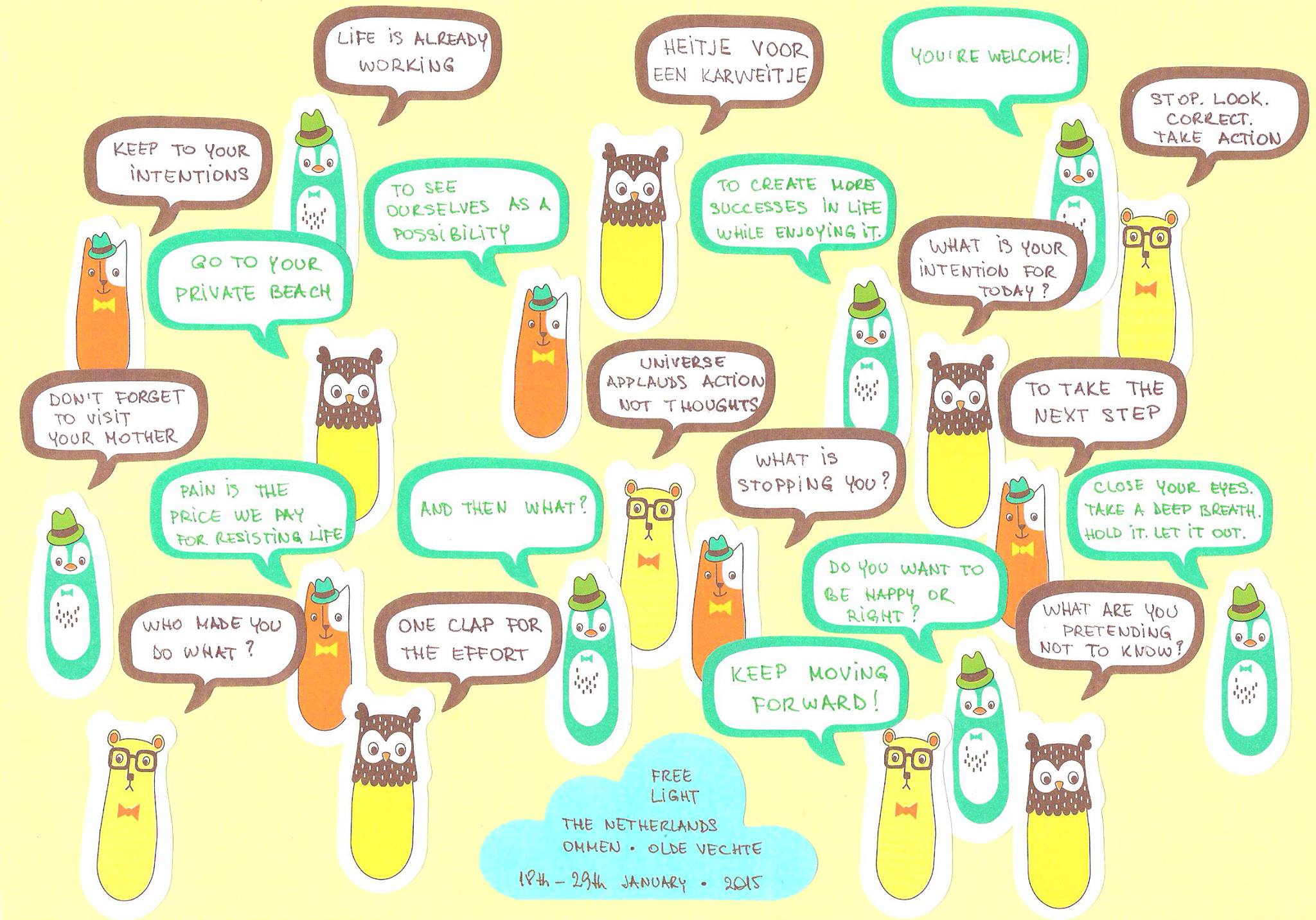
FREE LIGHT

free_light_01_2015
Made by Agnese with the glasses. We didn’t talk almost at all but this doesn’t change the fact that she made something pretty.

This picture is a little token and memento of what took place in Olde Vechte in The Netherlands the past few weeks. That Olde Vechte. It’s become out of the blue a significant part of my life and if all goes well it’s going to become more important still in the months to come.

I’m posting this here because somehow everything I put on here gets reinforced in my head, it becomes more tangible. It works. Synapses and shit (I haven’t taken advantage of this enough, by the way—never too late to start).

People and how we work are weird… no no no. Sorry. I do this a lot: I talk about the general we when I mean to talk about myself and what I do. Let’s try this again: I’m weird. Remember, gotta accept accountability.

So I’m writing this post purely for my own benefit and not because I think it might be interesting to anybody apart from those with whom I shared the experience—kinda similar to how you post songs on Facebook and the only people who like your post are the people who already know and like the song and very few others actually listen to it, usually people who have a crush on you. That’s how talking and writing about youth exchanges and trainings is, including EVS, including Erasmus, all those sexy international things that have been taking a great deal of my time and energy the past few years. The feelings they have created in me are difficult to convey, offline as well as online, so I’m not going to go into the boring details of a purely experiential thing that’s as useful and interesting to read about as listening to people talk about the dreams they had last night. What I am going to say is do yourself a favour and participate in such programs. If you want to learn how, I can help you and direct you, and, who knows, one day even train you.

Sudden spontaneous insightful realisation time. The above paragraph starts with “So I’m writing this post purely for my own benefit” and ends with me urging you dear reader to give it a shot. What can I say, contradicting myself seems to be my new favourite hobby.

Scratch that, it’s not new at all.

Since I’m writing this, have a look at some of my older, more thorough posts about these experiences. Are you intrigued by what you read? Honest question. I’m really curious, because in real life most people express indifference when I talk about these projects.  This might explain why I felt the need to write the way I wrote this post.

I SEE GREEN (1st time in Olde Vechte)
HETEROTOPIE (France)
Creative Photography in the Finnish Wilderness
Danish Diaries
EVS in Sofia

EARWORM GARDEN // IN THE HALLS OF THE USURPER — SHOVEL KNIGHT

Yes, Shovel Knight is every single bit as good as it’s said to be—all eight of them. The little detail that makes me feel all cozy and warm inside? You can change the language in-game.

REVIEW: FISH WHO ANSWER THE TELEPHONE AND OTHER BIZARRE BOOKS

Fish Who Answer the Telephone and Other Bizarre BooksFish Who Answer the Telephone and Other Bizarre Books by Brian Lake

My rating: 4 of 5 stars

This book is a blithe and glorious (yes) collection of such amazing, curious and sidesplitting book titles as:

(double entendres)
Drummer Dick’s Discharge, Beatrix M. De Burgh, Ernest Nister, 1902
Penetrating Wagner’s Ring, John Louis DiGaetani, Rutherford, NJ: Fairleigh Dickinson University Press, 1978
Boobs as Seen by John Henry, George Vere Hobart, New York: G. W. Dillingham, 1914
Memorable Balls, James Laver, Derek Verschoyle, 1954
Invisible Dick, Frank Topham, D. C. Thomson & Co., 1926

“Jeehosophat! What a disgraceful scene!” said Dick Brett, doing a series of physical jerks behind a bush, as he began to grow into visibility.”

(authors–right or wrong)
The Ethics of Peace and War, I. Atack, Edinburgh: Edinburgh University Press, 2005
Motorcycling for Beginners, Geoff Carless, East Ardsley: EP Publishing, 1980
Industrial Social Security in the South, Robin Hood, Chapel Hill, NC: The University of North Carolina Press, 1936
Obesity: Causes, Consequences, and Treatment, Louis Lasagna, New York: Medcom Press, 1974
Metabolic Changes Induced by Alcohol, G. A. Martini, Berlin: Springer Verlag, 1971
Frozen Future: The Arctic, the Antarctic and the Survival of the Planet, Daniel Snowman, Toronto: Random House of Canada, 1993
There Are No Problem Horses, Only Problem Riders, Mary Twelveponies, Boston, MA: Houghton Mifflin, 1982

etc etc, going through a wealth of subjects and book types. I feel weirdly proud of owning this book. Apart from being a little treasure all of its own, it reminds me how anybody can publish a book and indeed how many different tiles have been published through the centuries, that we’ll never know about no less. Time to start writing now then!

BTW: I’m not including this to the 2015 reading challenge because I read 95% of it in 2014. In fact it was a gift from my mother. Spot-on, wasn’t it?

View all my reviews