Unexciting, unedited and entirely too long presentation of our EVS residence and flat in Sofia.
Zanda, Vicente, Maria and me behind the camera.
Relevantly Irrelevant
Unexciting, unedited and entirely too long presentation of our EVS residence and flat in Sofia.
Zanda, Vicente, Maria and me behind the camera.
A lot and not so much has changed in the 96 hours since my last post from the EVS front. Vicente and then Zanda arrived and joined the party and my first impressions of them are quite positive. For our first night together, which was two nights ago, I made some risotto with mushrooms but it wasn’t very good because I threw in too much rosemary. The Greek salad wasn’t very good either because the tomatoes I bought were (obviously) out of season and for that reason they were pretty bland. Maria made some pancakes for dessert and those came out great – turns out you can even eat them right out of the fridge just fine!
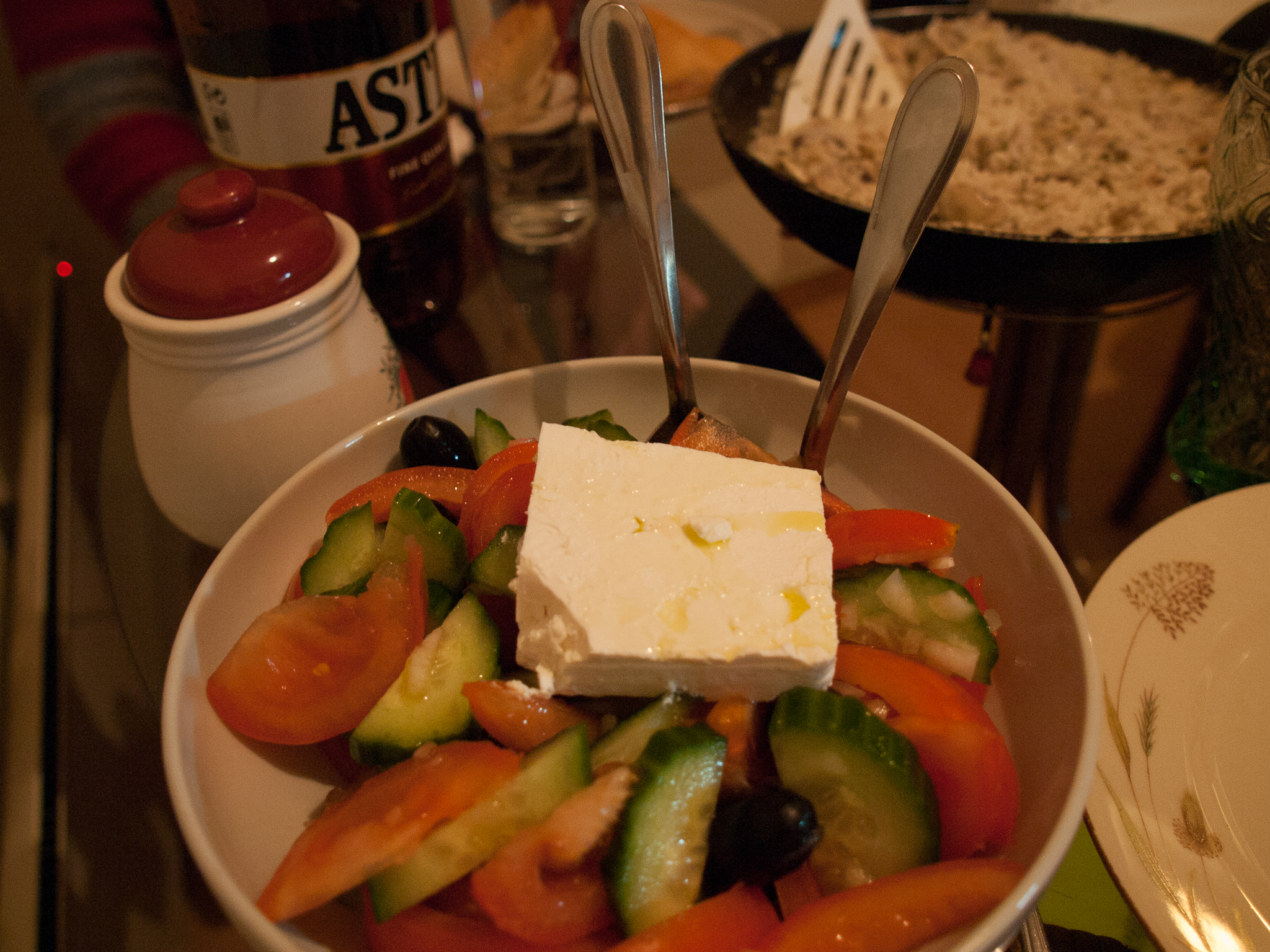
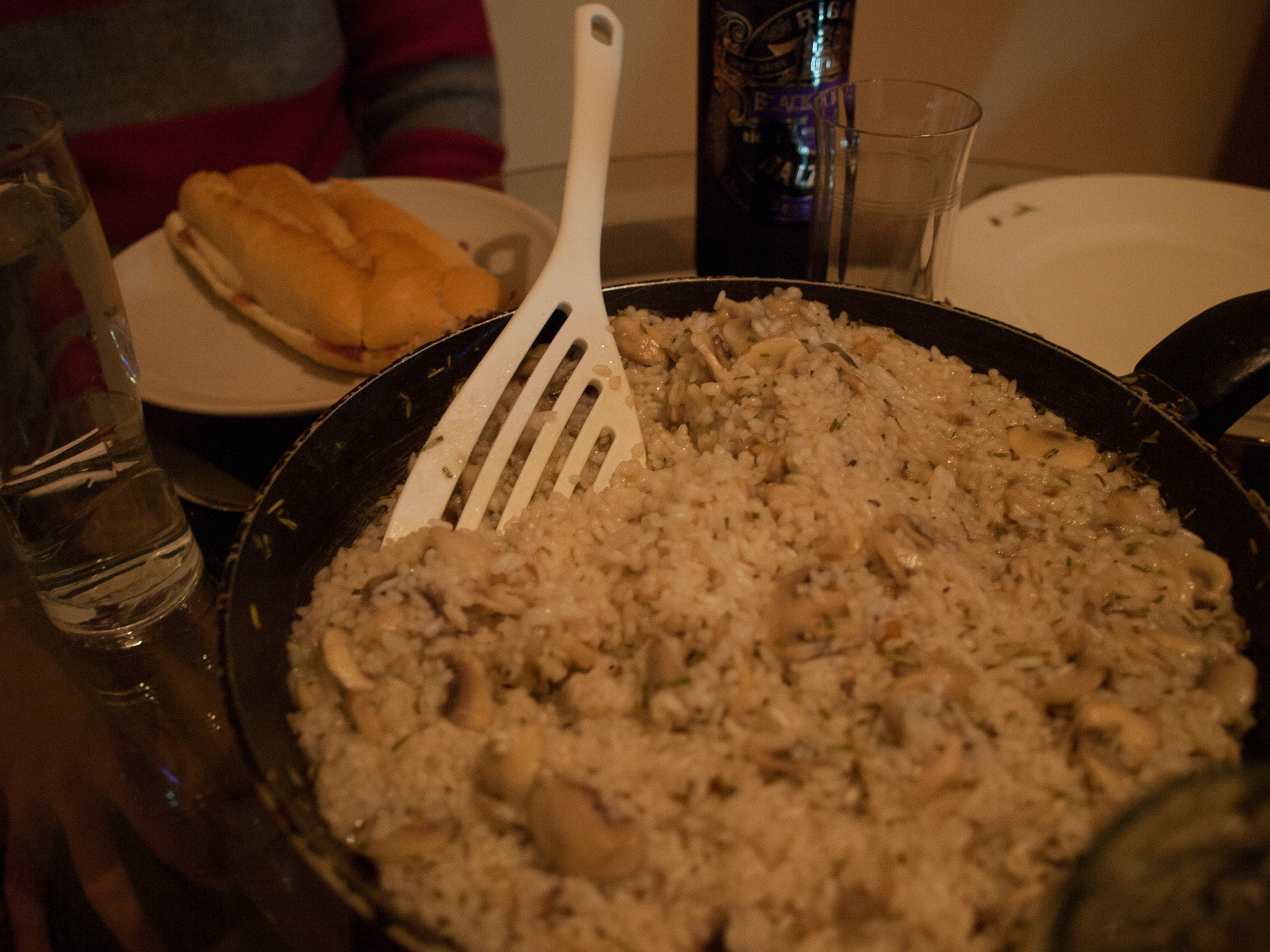
Tonight Zanda made some absolutely delicious cheese soup with mushrooms and vegetables.
Soon I’ll take a proper video for presenting the guys and the flat. This is just a… taste.
But enough with the food. Yesterday the fog finally crept away and the sun at long last flooded the sky and land.
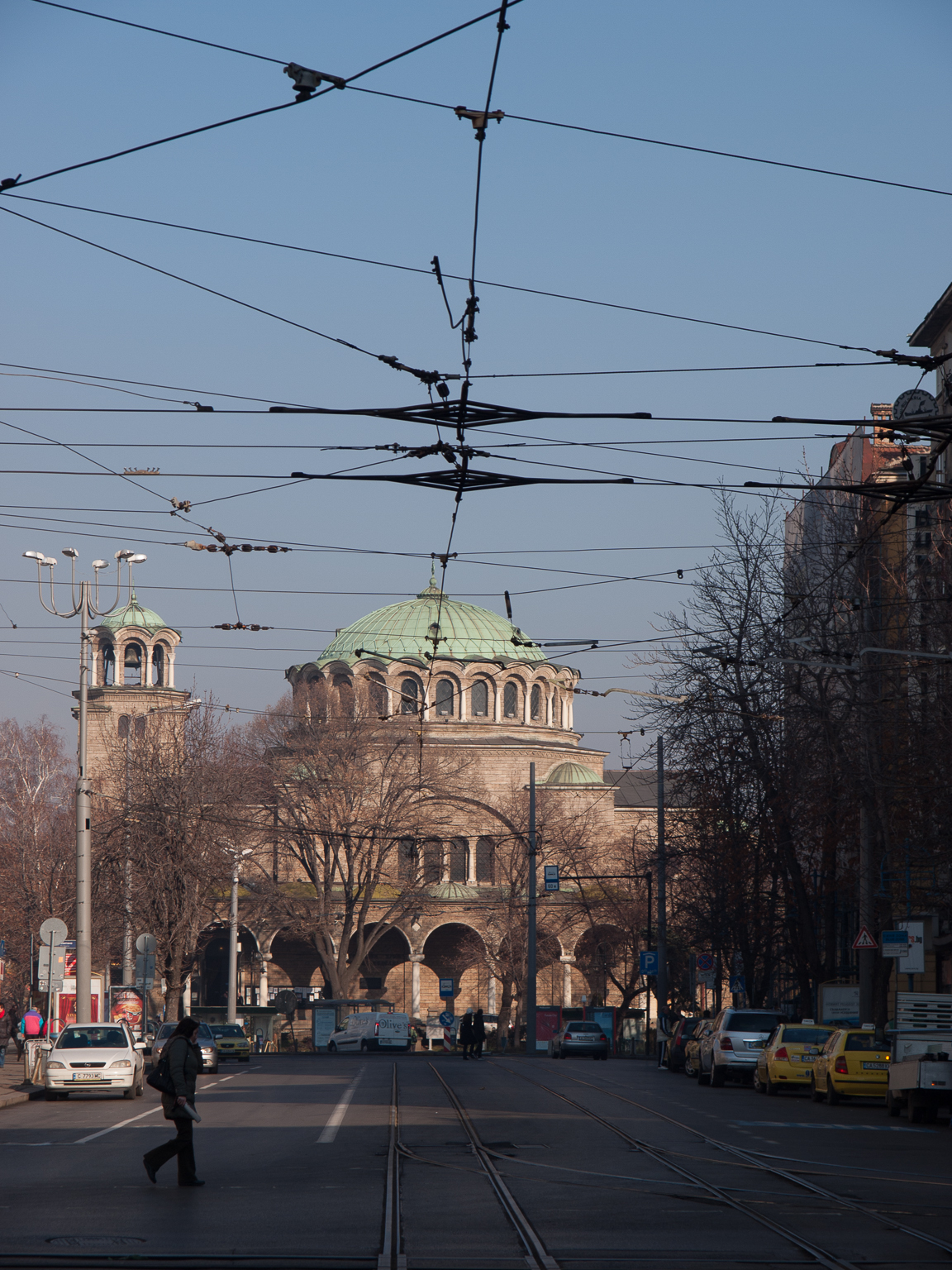
We met some other EVSers in the library from a different project and went for tea together in a very cozy place somewhere in Sofia (I suppose saying “in the centre” won’t help you find it…) Tomorrow we’re having our first Bulgarian class all in the same group and I’m super-excited: another new language and more new people!
It was also a few days ago that Vicente, Maria and I tried riding the tram to the library for the first time just for a change. We thought that the metro ticket, which is valid for one hour, would also be valid for the entire mass transit network of Sofia as is the case e.g. in Athens. Well, the conductors who appeared out of nowhere didn’t think so. We failed to present the yellow paper we suddenly noticed that everybody else around us was holding, and the conductors took us off the tram where we were welcomed by a fine of 20 leva (10€) for each one of us. Honestly, I was pleasantly surprised; older encounters with conductors out to kill in Athens had proved much more painful to my wallet than this. Of course, I wasn’t happy we were stopped like that but eh, lesson learned, no pain no gain! And, at any rate, later that day we went with Boryana to have our cards issued. Take that, conductors!
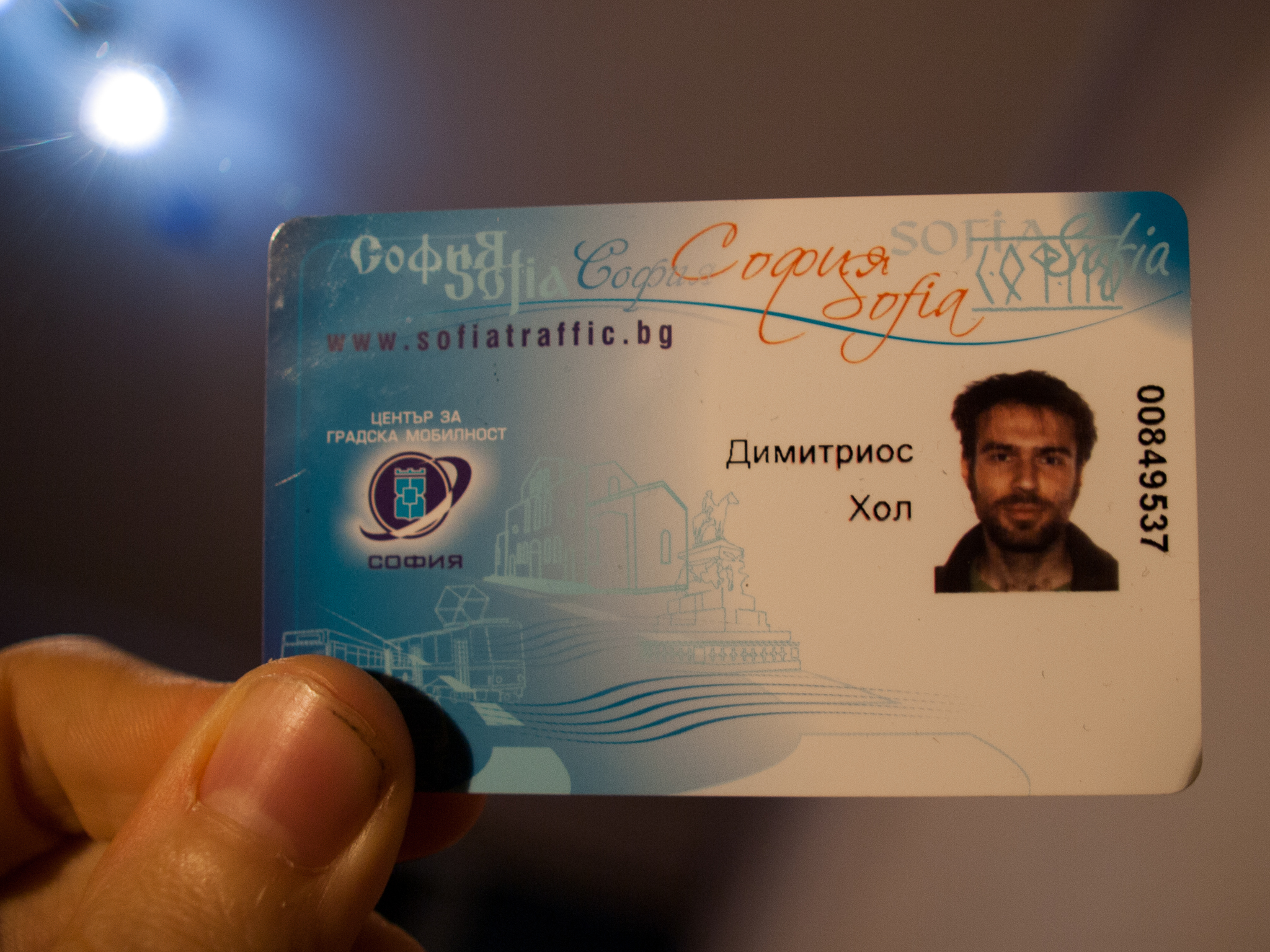
The very same day I used my freshly printed card to go to Zapaden Park for a run, the closest piece of open land to our apartment – about 15-20 minutes by metro or tram. It’s one of the biggest parks I’ve ever been to; in fact it’s more like a forest! Unfortunately, the winter browns and grays don’t allow it to be as beautiful as I imagine it to be in the warmer seasons but still the sight of the winter forest and Sofians of all ages out to enjoy it makes my heart a little brighter and keeps me company while I’m out for my run. Can’t wait to see the park turn blinding white, which will hopefully happen sooner rather than later.
Our last tidbit for today: yesterday we went to the cinema; we live very close to the Mall of Sofia, which includes a multiplex. Even for a Saturday it was super cheap, only 9 leva (4,5€), and on Thursdays it’s down to 6! The movie we watched was The Wolf of Wall St; three-hour film and I didn’t want it to end, so entertaining and well-made was it. It had, most probably, the best depiction of an overdose I’ve ever seen on film (okay now I have to watch Fear and Loathing in Las Vegas just to check). Leonardo Di Caprio has come a long way… Needless to say, this will most definitely not be the last time we go to the cinema while we’re living here in Sofia!
Gotta go to bed now or I’ll be like a Greek zombie (ζόμπι; νεκροζωντανός;) at the lesson tomorrow. Leka nosht!
Departure time for Tourist Service’s bus from Athens to Sofia was 8:00 in the morning sharp. I caught it after a full day of melancholy of leaving behind things, situations and, most importantly, people that I love (the long-needed party at my place the day before with all the lovely faces didn’t help). You know who you are, I hope.
I get these very short but intense feelings of regret and of not having appreciated everything and everyone enough before and during every big journey of mine. Does everyone get these same feelings? I wonder about this a lot. Sometimes I think that everyone’s like me, but it is much more often that I feel I’m alone in too many things to count. It is a dangerous and untrustworthy feeling.
Athens to Sofia was an 11-and-a-half-hour ride. It wasn’t so tiring for me: I’m used to these long trips owing to my experience of catching ships to and from Mytilini and waiting for hours in European airports for frugality’s sake. I began reading Carlos Castaneda’s The Art of Dreaming which Daphne lovingly gifted to me before I left. It’s a great book and it made for a more… dreamy journey. Closer to the destination I started watching Skyfall but we arrived before I could finish it.
The first I saw of Sofia, I didn’t really see much of it. It’s been almost completely covered in fog since yesterday. I would expect that to be a normal thing for this city (it feels like the right kind of city to be foggy as a natural state, you know?) but even the locals were taken by surprise.
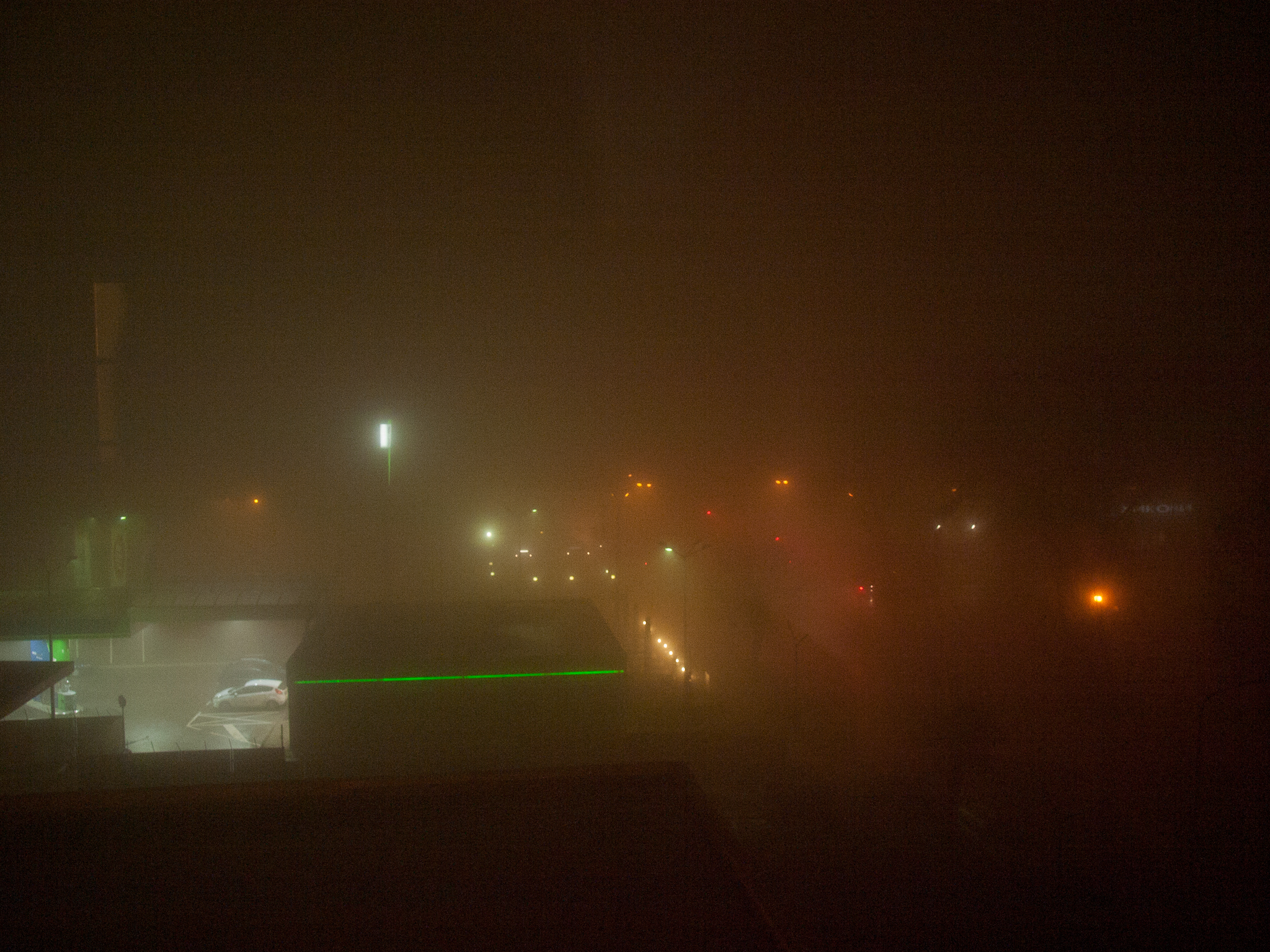
I was welcomed and taken to the flat by the very friendly Valentina, an employee of the Sofia City Library. The flat is on the 4th floor and guess what? There’s no elevator (or lift, if you’re American!), which might sound like a problem, but it’s in situations like this that a running schedule really comes in handy! Of my three fellow volunteers, only one had arrived yesterday and that’s Maria, the Danish girl. The other two will be coming tomorrow and the day after. This is the last fateful night I’ll have the boys’ room for my own. I shudder at the idea of having to share it for nine months! Let’s hope everything turns out alright and I don’t find sharing my private space for so long a little bit too overbearing!
I didn’t see much of Sofia today apart from the area close to the library, but I already find it an interesting city. It might look gloomy and run down in a lot of places (nothing I didn’t expect before I came here) but I can sense a history and character waiting for me to discover.
The library itself has a similar air: it’s an old building in obvious need of repairs and renovation, but the people working in it, such as Valentina and Boryana who are involved with the EVS project, but also the rest of the employees that we got to meet today, are full of life and joy. To give you an example, every Wednesday they have an English speaking group practice session for every library employee willing to join, and today they invited us newcomers as well. Everybody was delighted to meet us and Valentina also brought a bottle of fine red wine to welcome us with. I sense we’re going to work very well together and that they’ll take good care of us – they already do.
Not only that: their selection of books makes me want to just stay in the library and never leave – it doesn’t help that there are whole sections and rooms dedicated to books in languages that I’ve been meaning to practice on (German and Spanish) and many many books in English to choose from. Who knows what other treasures I might find in the meantime!
A funny little episode from today: I went to Billa to shop for some pasta (got some by Stella; surprisingly many Greek brands here) and stuff to make a Greek salad with, plus beers and a strange Bulgarian beverage I haven’t tried yet. I took everything to the cashier and it all amounted to exactly 10,00 leva – a little more than 5€. I thought this was amusing and so did the cashier. For some reason I don’t like speaking English when I’m in a foreign country; it feels uncomfortable, like I should know the language otherwise I’m little more than a product of globalisation and cultural domination. Like “what the fuck is a Greek and a Bulgarian doing speaking English in the Balkans?!” There I was though, having a fun little moment with a Bulgarian cashier – in English.
Sometimes I feel really messed up with my strange self-limiting ideals.
Anyhow, the salad and the pasta were delicious and today was a great day in general. Here’s to a good start of our 9-month EVS project, and here’s a link to the library’s existing blog that we’re going to be taking over soon.
 Lord of the Flies by William Golding
My rating: 3 of 5 stars
Listened to this in audiobook format read by the superb Martin Jarvis. I kind of regretted it because the book is rich with detailed descriptions a lot of which I missed because I’d sometimes get distracted while listening. Maybe I’m not accustomed to audiobooks with more difficult language, or perhaps it’s just that I need to train my concentration skills.
All that said, I liked the book but, you know, not that much. I wonder whether its message is absolutely pro-civilization; if it’s really saying what it seems to be saying, that if you remove civilized society from humanity, all that’s left is savagery. I don’t like this take and would like to have more knowledge of anthropology to back my feelings with research that humans are better than that.
Then again, there’s this… Rather, I hold true that neither the “noble savage” nor the “civilization über alles!” tropes are absolute truths and that a whole lot of varying parameters will influence whether a community will destroy itself or flourish to form a different culture.
As a final note, I think reading this properly could get it to 3.5 stars. Its subtle, sometimes tender descriptions sat well with me.
Το πρώτο πραγματικό επεισόδιο του quixotic baboon’s dangling phonetics είναι γεγονός. Πριν με ρωτήσει κανείς, το quixotic baboon το υιοθετώ σιγά-σιγά καθώς μου ταιριάζει πολύ σαν αντίστροφη ερμηνεία του qb (cubi). Αααχ, μια μέρα θα την πω και την ιστορία του ονόματος. Ίσως είναι ένα καλό θέμα για ένα μελλοντικό επεισόδιο! Yes, that’s it!
Notes in Spanish
The Partially Examined Life
The Higherside Chats
A History of the World in 100 Objects
Get Lucid
Hardcore History // Common Sense
You Are Not So Smart
Kyle’s Cult
Three Moves Ahead
Podrunner
 The Legend of Zelda: Hyrule Historia by Shigeru Miyamoto
My rating: 4 of 5 stars
When I first heard of the existence of Hyrule Historia and its inevitable translation and release in Western markets I was as ecstatic as any fan could be. To give you an idea, scanlations from the original Japanese edition were unleashed to the thirsty hordes of Zelda enthusiasts within a matter of hours after release in Nipponia. Finally! A Zelda tribute to end Zelda tributes; a book strictly for the fans; an official behind-the-scenes, anthology, retrospective, together with the manga prelude to Skyward Sword, all presented with high quality illustrations, colour and printing and, perhaps most importantly, THE TIMELINE!
Now that eyebrows have had the time to be lowered and discussion on the three timeline theory, which like it or not is now obviously canon, has subsided, it’s time for the admission part: the part where I look into the cold, hard facts of being a maturing Zelda fan. I hope you’re ready.
In the last pages of the book there’s a Thank You note from Eiji Aonuma, director and designer of many of the most recent additions to the series and to many the visionary and overseer of the Zelda franchise as a whole ever since Majora’s Mask was released. This is part of what he had to say:
“The History of Hyrule” allows players to determine where each Zelda game is positioned in the chronology of the series. One thing to bear in mind, however, is that the question the developers of the Legend of Zelda series asked themselves before starting on a game was, “What kind of game play should we focus on?” rather than “What kind of story should we write?” For example, the theme of Ocarina of Time , the first Zelda game I was involved with, was, “What kind of responsive game play will we be able to create in a 3-D environment? […]
“Because the games were developed in such a manner, it could be said that Zelda‘s story lines were afterthoughts. As a result, I feel that even the story of “The Legend Begins” in Skyward Sword was something that simply came about by chance.
“Flipping through the pages of “The History of Hyrule“, you may even find a few inconsistencies. However, peoples such as the Mogma tribe and items such as the Beetle that appear in Skyward Sword may show up again in other eras. Thus, it is my hope that the fans will be broad minded enough to take into consideration that this is simply how Zelda is made.”
I remember reading years ago that the official timeline of the series was a confidential document kept deep inside the Nintendo headquarters in Kyoto… As the years passed and new titles that made little sense when put in the big picture were added to the chronology, such as Twilight Princess, the connecting story started looking like either a lie too disappointing to reveal, or if it really was there, just a little bit too simplistic, i.e. is the great overarching story of the Legend of Zelda just a tale of many Links, many Zeldas, many Ganons and a terribly uninteresting tale of a prophecy never fulfilled? I slowly joined the disappointed doubters, those that questioned the relevancy of the timeline or even the very existence of it.
This confirmation by Aonuma sealed the deal: it was Nintendo’s way of saying “you wanted it so badly, so here it is, but you’re looking too much into it; go out more would you, you buncha nerds!” and I think it would indeed be sound advice for people still arguing on forums whether the official timeline is in fact real or not, suggesting that their own version of the timeline makes a lot more sense! The denial there is in the world…
I must admit that expecting a big closure from Skyward Sword, the “aha!” moment that would put every little piece of the puzzle in its place and it never really coming but instead getting the much-advertised prelude to Ocarina of Time with more unresolved new directions, brand new deities (as if there weren’t enough already), characters and hint-dropping, left me with a sour taste in my mouth. It is obvious that if you really want to enjoy Zelda and avoid such disappointments it would be a good idea to be “broad-minded enough” as Aonuma-san suggested, to turn your thinking brain off and take it as Nintendo delivers it. Willing as I am, I just can’t do that. I can’t create connection between the stories when the connective links (get it?) are so vague, each time raise more questions than they answer–for sequels’ sake– and often feel as arbitrary as Star Wars Episode III.
As Zelda games are changing to cater for new audience and are at least trying to get with the times, I feel more and more that they’re just not for me, that Nintendo has long stopped trying to cater for my ilk and that in reality they can’t even do it anymore. I can already see with my mind’s eye Nintendo fanboys who never broke away listing the “hardcore” games Nintendo has released in recent years that would supposedly dispute my argument. What they don’t realise themselves is that Nintendo of old, the Nintendo that dominated my childhood, was revolutionary, it wasn’t just the franchises and the games. It was innovative, it created demand, it didn’t just respond to fans. Now it’s like Fidel Castro or Chavez – only the blind and misled still see revolution where there’s nothing left but allusion to and revering of the good ole days.
Maybe it’s the gaming culture I’ve grown out of, or even a gaming culture I can’t grow into anymore. Maybe it’s just the simple fact that people change, or, as I’ve observed time and time again, that people heavily tend to single out the Zelda title they first played as the pinnacle of the series that can never be bested, and what of course follows is unrealistic expectations of newer games that they will finally be the ones that emulate the feelings they had when they played their first Zelda when they were 9. Is it possible that when a game becomes an enduring legend, the greatest enemy it has to face is its own legacy? Newer players seem to love games such as Spirit Tracks or the new Link Between Worlds, games I really can’t see myself getting into for the simple reason that I just grew up differently. It’s a pity, but so is the nature of the world: as series reach their maturity and endure for more than 25 years in a field which is barely older than that itself, so do players. Funny how people don’t have similar expectations from other media, such as fairytales or children’s animation movies.
Nevertheless, Hyrule Historia is safe from all the above because it’s made for my own personal nostalgia, it only exists in the past. It’s like a photo album with pictures from your childhood: it remains valuable no matter what. Apart from the older ones like me, I can also see the young ones taking an interest in it, those who love Spirit Tracks and Wind Waker HD and who never had the chance to grow up with the older games (same with me and the original NES Zelda) but are still interested in the series as a whole and think I’m a snob hipster 20-something gamer elitist, the very same feelings I had for those who thought Ocarina of Time was crap because according to them Link to the Past was the best. Don’t worry kids, you’re up next.
Yesterday I rolled up my sleeves and decided it was time for a new theme. I started up the Weaver II customiser but nothing I could come up with was better than, or even comparable to, the -also customised- theme I had before.
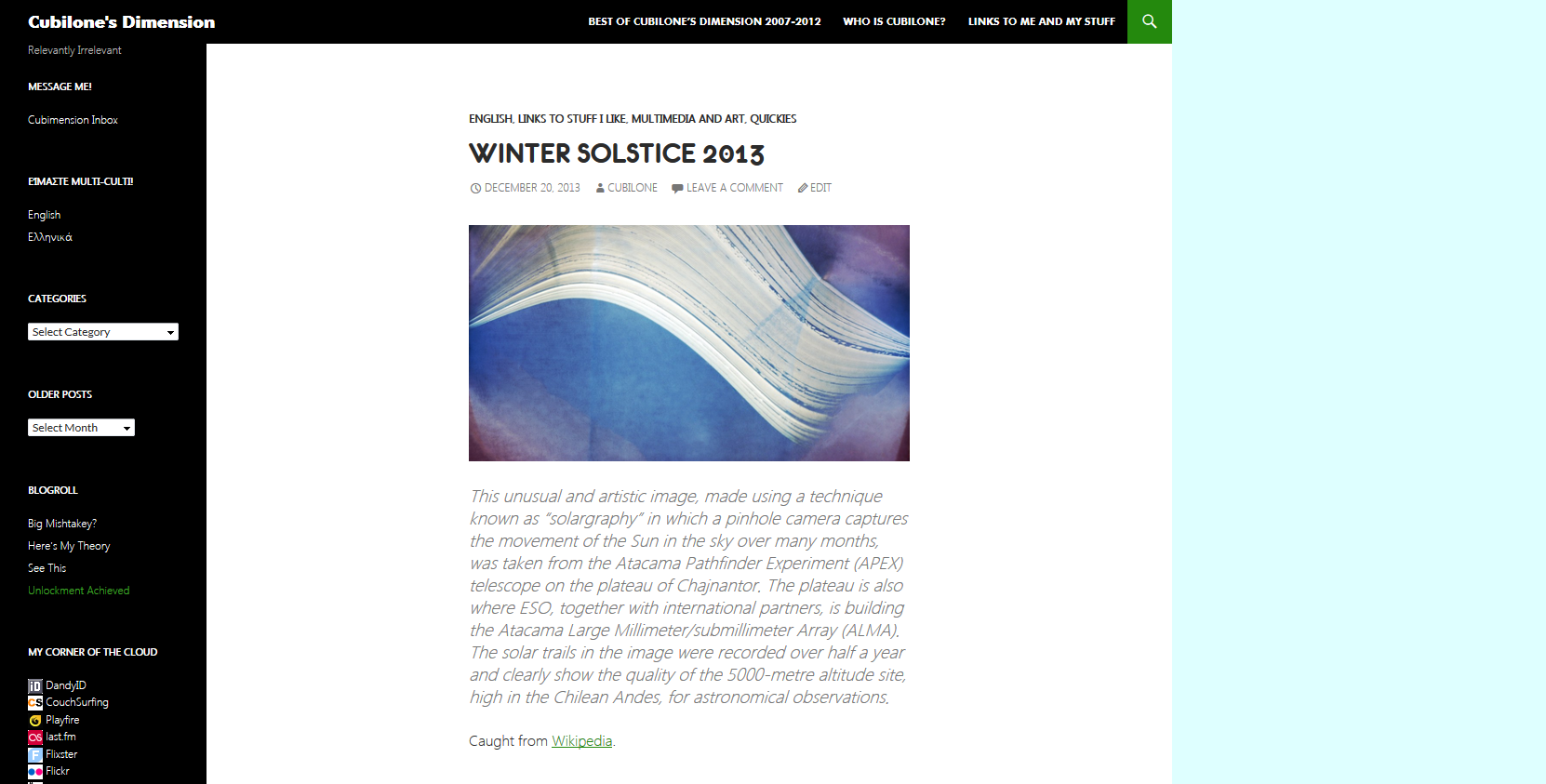
Then I realised that there was this new theme Twenty Fourteen WordPress had put up with their new release of the platform, as has become tradition. It’s the theme you can see right now plus a few tweaks I made which mainly have to do with Greek font support, different fonts for headlines, content width and the awesome “background” to the right I made in Photoshop.
It isn’t obvious -even I forget what this place used to look like in all its different itterations- but this theme is the fifth one I’ve used since Cubilone’s Dimension first came to be back in 2007. Today I wanted to remember what the site used to look like, how it’s changed and evolved throughout all these years. I played around with the themes still in my virtual dresser for a little while but then found another, much better way of looking back.
Enter The Wayback Machine, an unfathomable web archive that screenshots pages at random intervals from all across the Internet and uses them to create a historical archive for the ever-changing face of the digital world. Fortunately, this here too site didn’t escape the vortex, so allow me to take you for a short ride through Cubilone’s Dimension’s modest history.
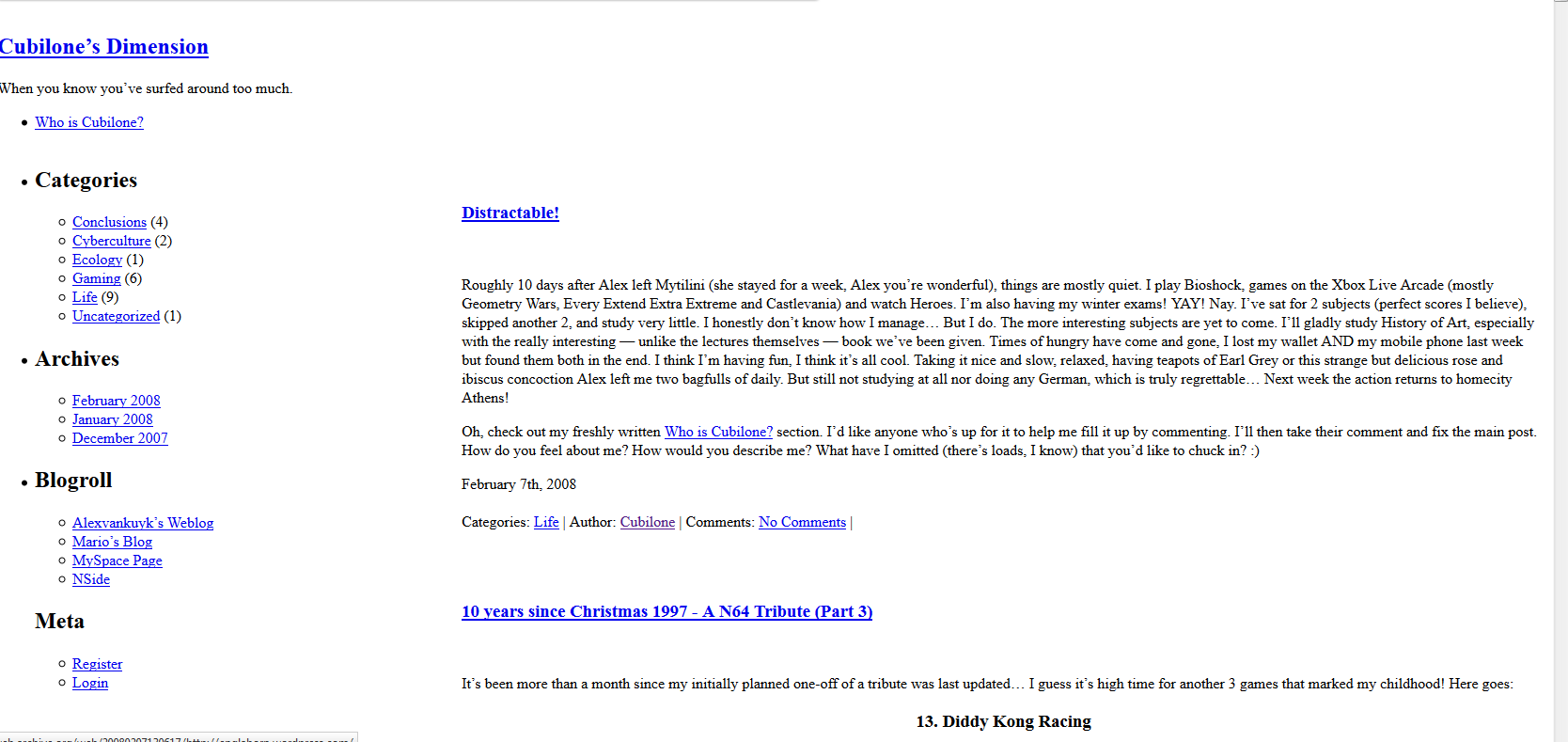
Version of the site from early 2008. Back then the blog’s URL was simply http://cubimension.net. The references haven’t changed in the archived html and so the saved img src’s and href’s pointing to the background and CSS files are now pointing to nowhere; screenshots after ’09 don’t have this problem as that is when I created the main hub and corkboard and moved the blog to its current directory (/blog). The theme and background remained the same throughout 2007, ’08 and ’09, the same as the one in the following picture.
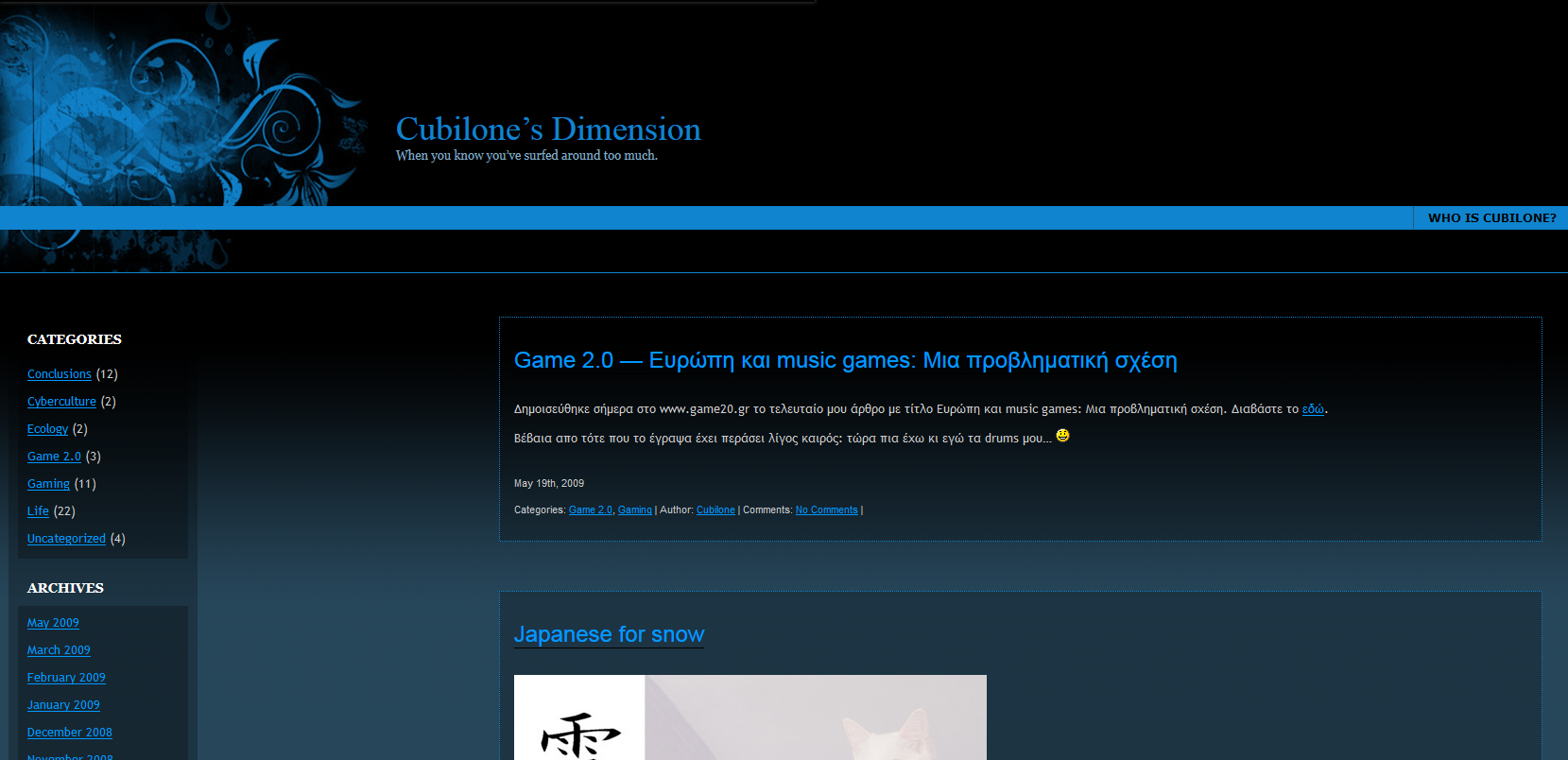
June 1st 2009 – first screenshot from after I had moved the blog to /blog because of my work on this, a primitive portfolio site but mostly an exercise on CSS (I made it for uni). Eesh, I can’t even look at that… thing!
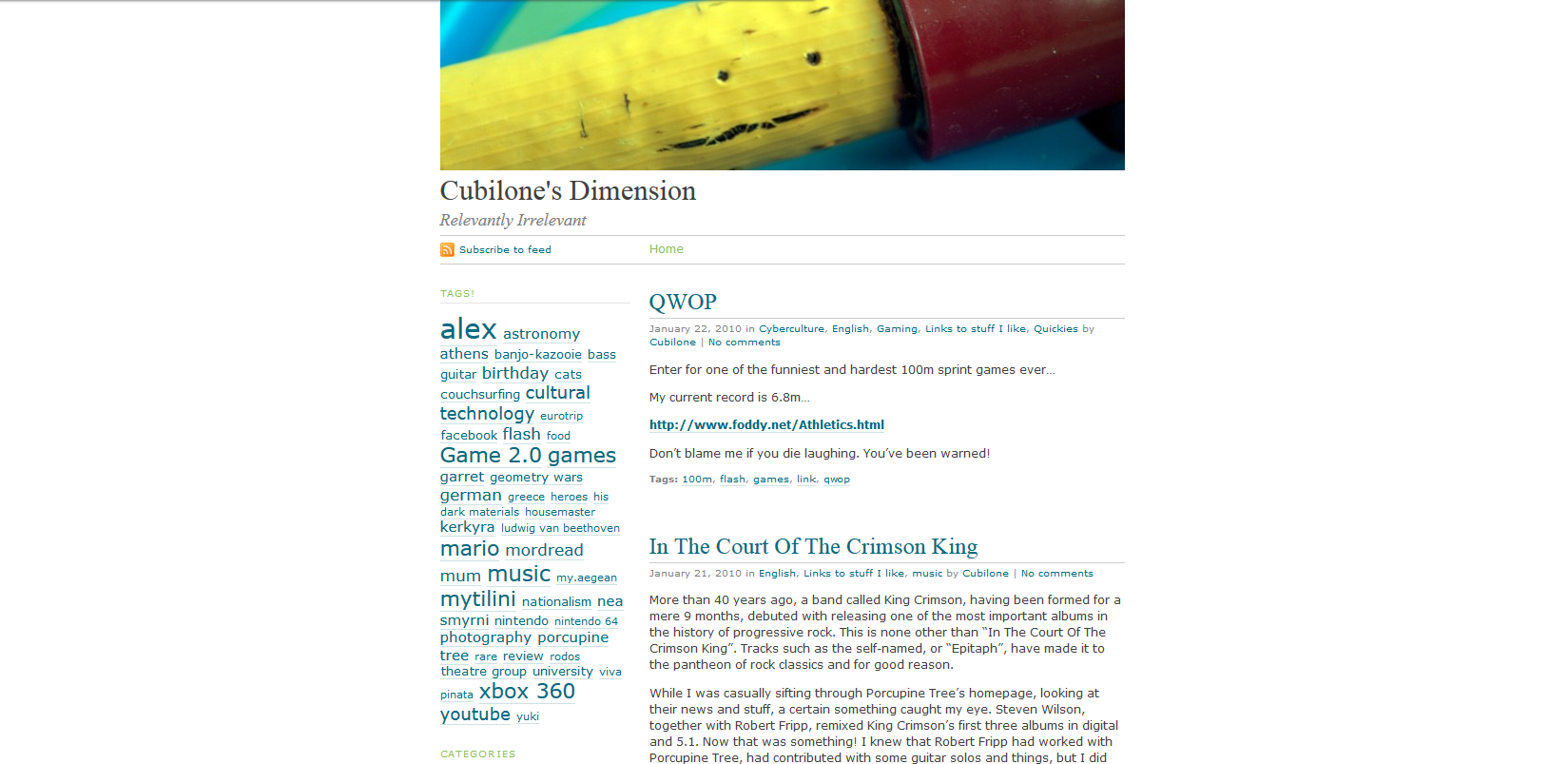
January 22nd 2010 – Tired of all the dark blues and blacks, I opted for something a little bit brighter. I like the photogallery at the bottom of the sidebar to the left, back when I uploaded lots of my photograms. That’s also roughly the period when I started posting more, trying to fend myself off Facebook by replacing status updates with posts.

January 9th 2011. I went for a standard theme here to freshen things up a bit and streamline the blog experience, just as I did 3 years later (now). This theme was very transient because a few days later I custom-designed this:
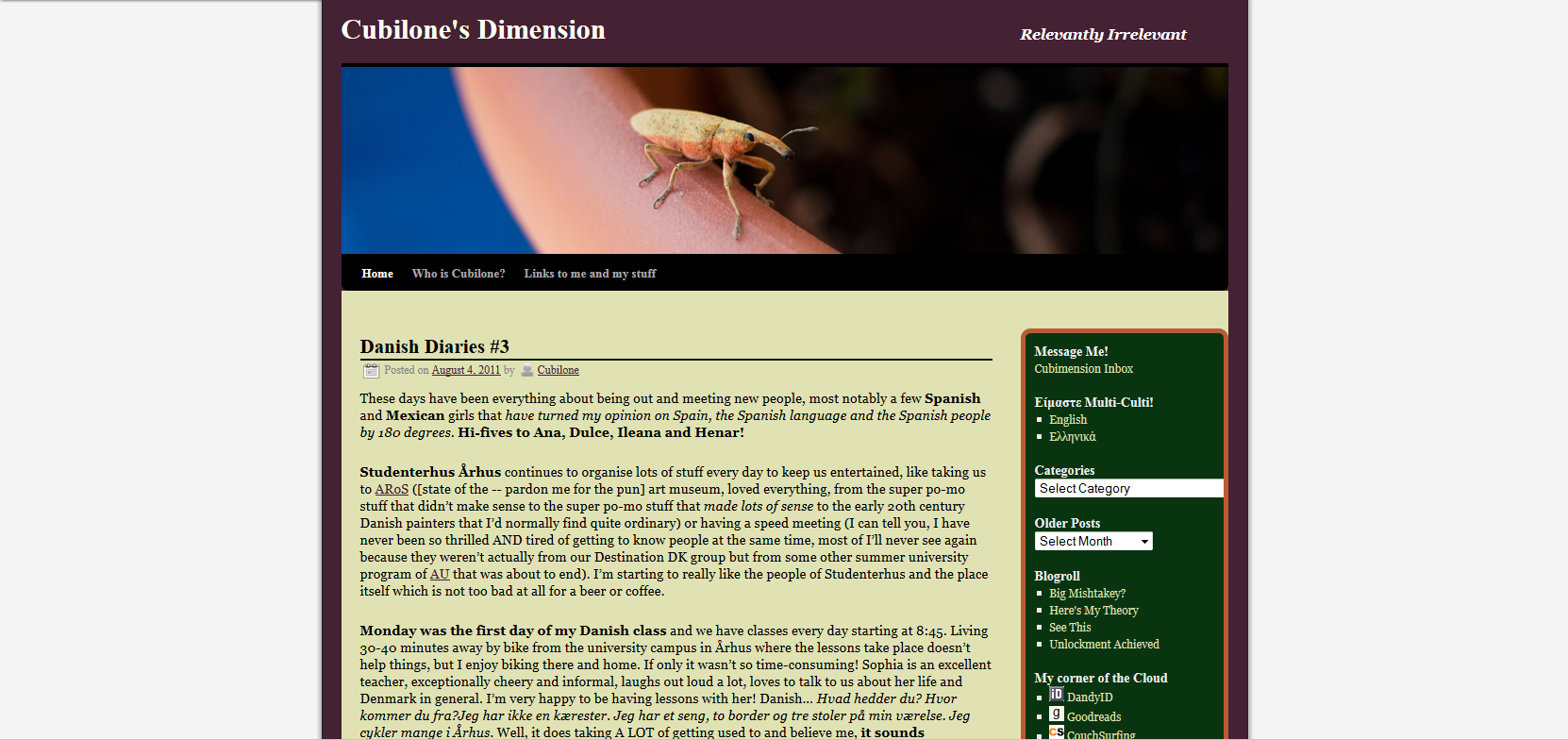
August 7th, 2011. I was in Denmark then but the theme had been online for some time already. I can’t remember where I was when I was designing it – memories of me being in Mytilini and Athens at the same time both seem false, but the gist is that it was somewhere in the first quarter of the year, a lonely time in general, a time when I had all the time to fine-tune the theme to suit my taste. There was also a tiled floorboard background then which has since been replaced by the background that came next and so doesn’t appear on the Wayback Machine.
And here we are today. At some point mid-2012 I replaced the header and the background to better suit the mood I had then.
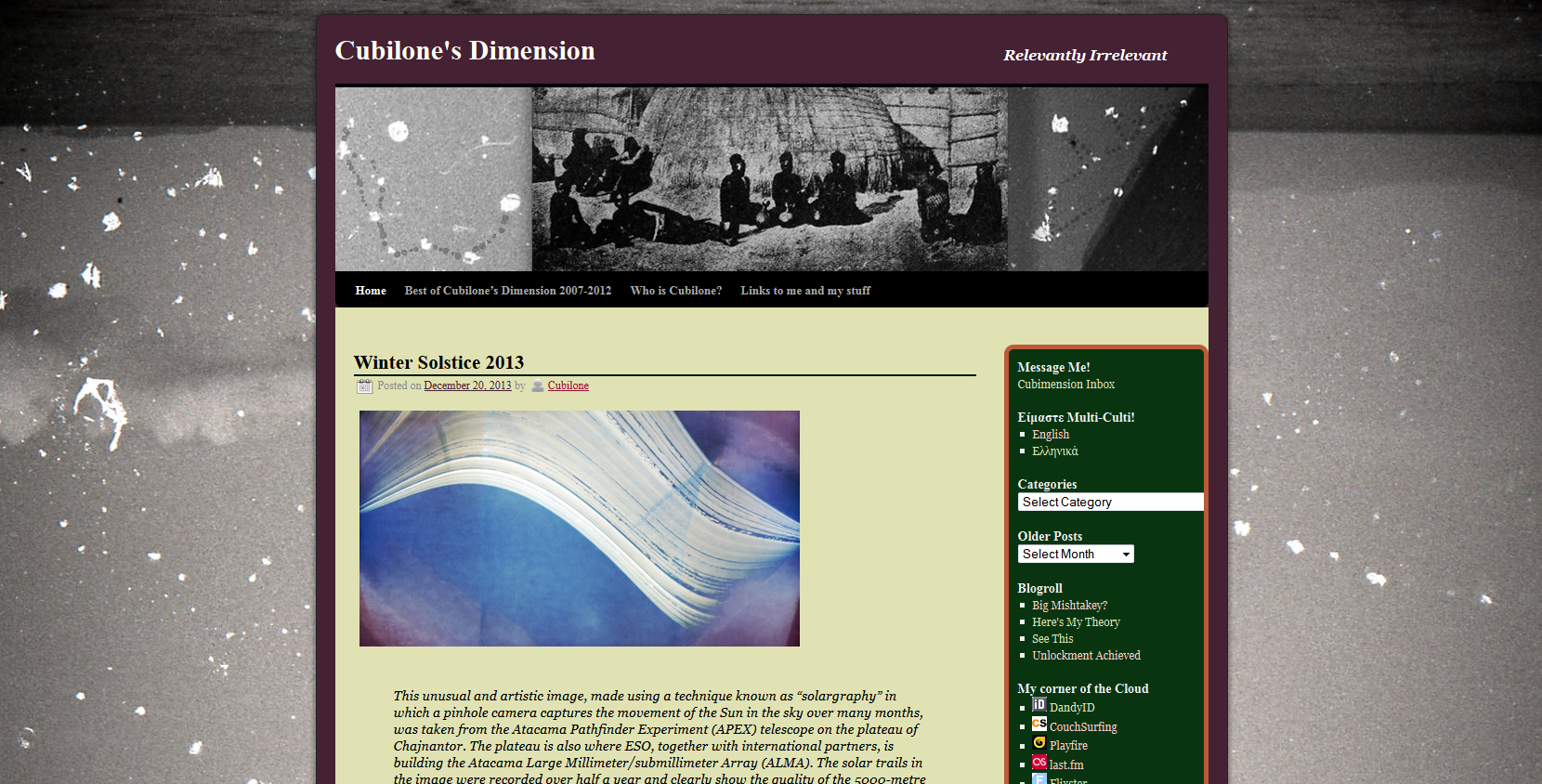
I had been using the same theme until yesterday, when I finally made the change from this custom theme I had grown to love but which I had never realised I hadn’t changed for more than 2.5 years to the one I’m using now. For historical purposes (who knows what the future might bring?) I’m also leaving a screencap of the brand spankin’ new one right here:
Thank you for this short tour, have a nice evening or day!

This unusual and artistic image, made using a technique known as “solargraphy” in which a pinhole camera captures the movement of the Sun in the sky over many months, was taken from the Atacama Pathfinder Experiment (APEX) telescope on the plateau of Chajnantor. The plateau is also where ESO, together with international partners, is building the Atacama Large Millimeter/submillimeter Array (ALMA). The solar trails in the image were recorded over half a year and clearly show the quality of the 5000-metre altitude site, high in the Chilean Andes, for astronomical observations.
Caught from Wikipedia.
If you can speak Greek (chances are, if you’re reading this, you can) you may read my original takes on Civilization V and the first expansion Gods and Kings. I reviewed them for Game 2.0 when they came out, the good people from whoever-the-distributor-of-Take-Two-in-Greece-is being kind enough to provide me with a review copy as happens of course with almost all games I write articles for. This year though, while they did send me a preview copy, they somehow neglected to allow me to play a launch version of one of the best entries in the Civ series -at the very least as far as expansions are concerned- and so I had to wait for a Steam Sale to come to snatch it up for 10€.
• cultural victory is now a blast! Being “peaceful” never was so fun before, artifacts, exhibitions, tourism and all;
• archaeology blew me away with its ingenuity and the feelings it gave me of being part of a real world and at the head of a truly timeless civilization;
• banning and unbanning luxuries reminded me of the 1961 Single Act on Narcotic Drugs, as far as legitimacy and complete arbitrariness is concerned. Oh the ways games can show you how the real world works…
•liberating Ethiopia from the bloody hands of Carthage and then having them vote for me for World Leader, together with the -mostly bribed- loyalty of the world’s city-states, was very satisfying;
•playing as Venice and Byzantium meant playing two different games and I loved that (I became stinking rich in both though because of trade routes, love them!);
• haven’t tried the scenarios yet, most probably never will;
• I try to install a simple alarm clock through the mod menu and you go and disable achievements? Seriously?
• feeling the urge to spend so many hours on it during a time when minutes, days and hours feel more valuable than ever;
• archaeological sites spawning in ice; what the fuck’s up with that?
• online multiplayer as clunky as always; still want to play;
• those other civs being just a tiny bit quicker than me and completing wonders a single turn before I would and doing that 4-5 times in a row; there’s only so much a hippie can take;
•AI still a bit wonky at times, marked improvement over vanilla and expansion 1 nevertheless;
• missionaries are a complete waste of time!
• playing together with Daphne for the first time. Doesn’t count as a comment on Brave New World in particular, but that they included the option for playing hotseat is commendable;
• reloading again and again as Venice to finally get the cultural victory I wanted! All bowed to my superior Venetian works of art eventually and the victory was all the sweeter after I had chosen Autocracy as my Ideology. Strength Through Joy, the achievement read;
• I was itching to try the Zulus for my hand at a Domination Victory before I started writing this and I’ve been playing Civilization on and off for most of my life; I’d do it now if I wasn’t ready to go to bed;
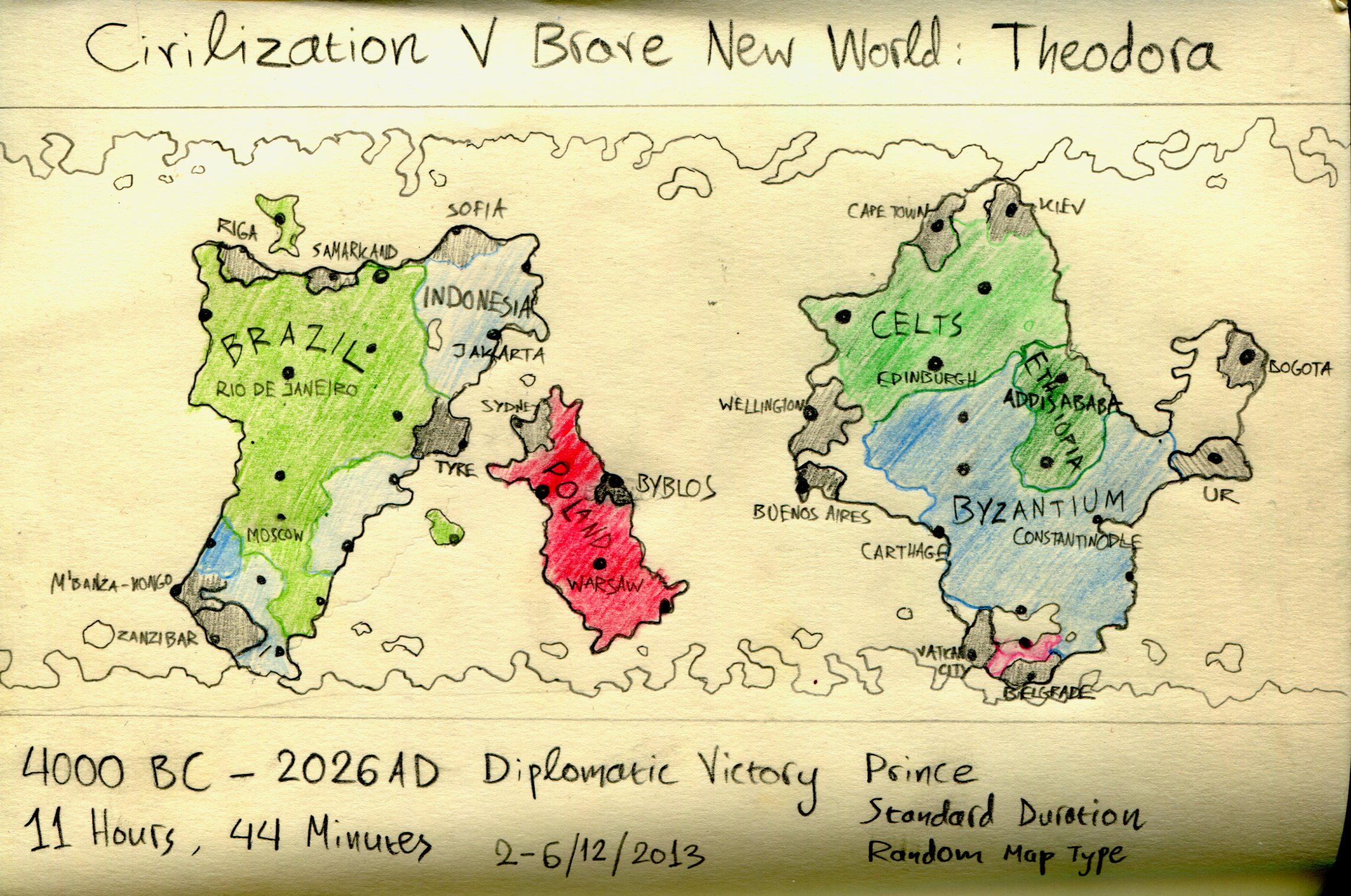
• becoming inspired enough to draw the final maps of my two games in my notebook (also influenced by On The Map);
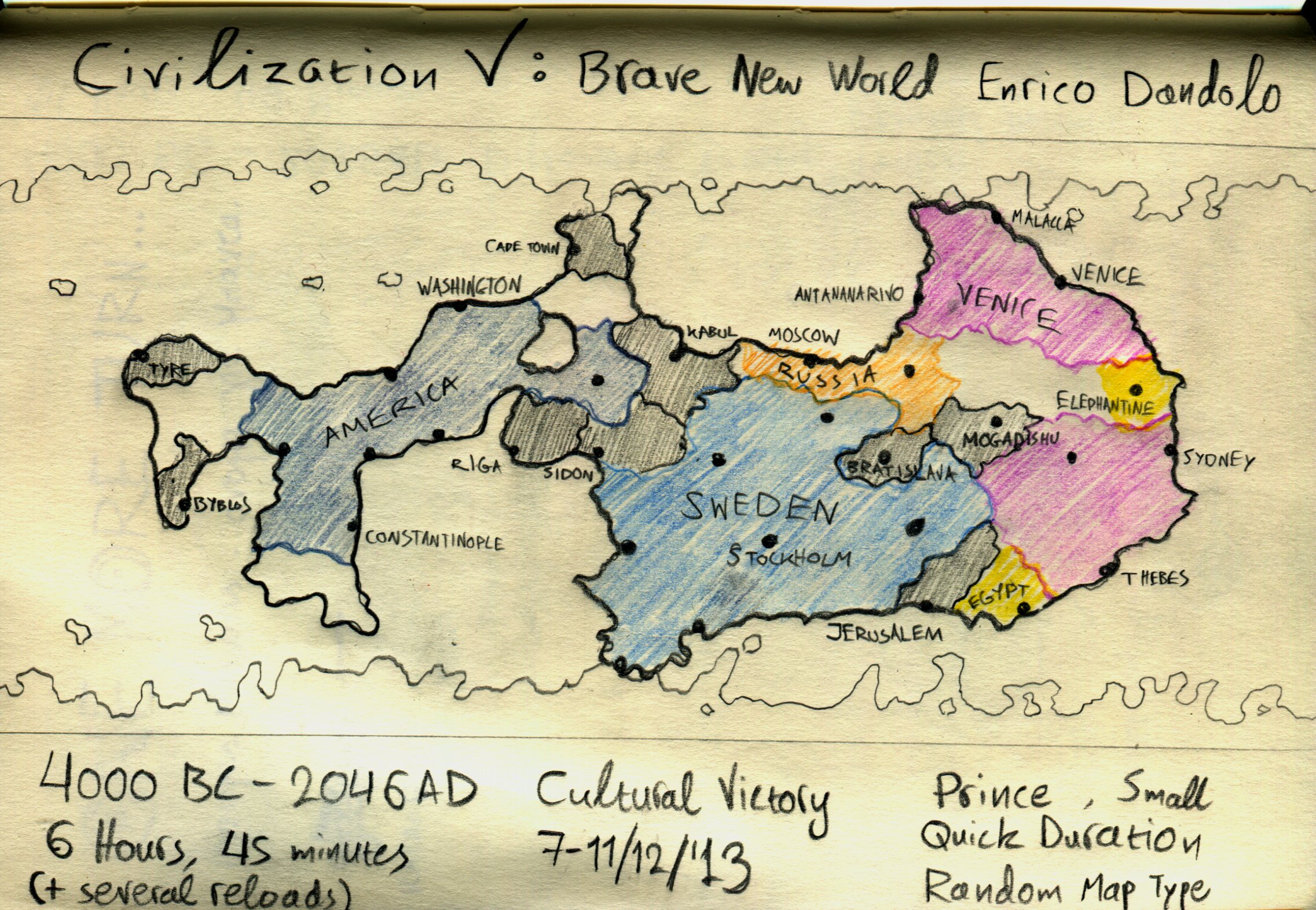
• doesn’t think this could be their thing. Some people believe they need to know or understand history and/or strategical thinking in order to play, but it’s remarkable how many different kinds of gamers I’ve met or read about that like Civilization but don’t necessarily enjoy other strategy games;
• is looking for a way to “kill” time; just ask Daphne: when Civilization becomes a priority over even Breaking Bad, you know you’re onto something;
• likes classical music; this game has a lot of it and it’s good;
• thinks fantasising about artillery, battle plans, taking over cities and teaching those Swedes the lesson they deserve -while at the same time appearing/pretending to be working- sounds like a fun day.
Happy birthday! 🙂 Check last year’s celebration if you’re looking for something special, I didn’t have the time had too many other priorities to prepare anything for this year. I wanted to change the theme, freshen up the place a little bit. Soon…