Category: English
Review: Tricks of the Mind
 Tricks Of The Mind by Derren Brown
My rating: 4 of 5 stars
In this book, Derren Brown, famous British “illusionist, mentalist, trickster, hypnotist, painter, writer, and sceptic”, sets out to reveal the secrets of his work and actually tell people “I have no real powers, and I hope this settles it!”. We get to see all of the above sides of his: amazing breakdowns of his work and shows and spectacular analyses of what parts of human psychology and neurology he manipulates and why. Most of all, however, we see his sceptical side.
Derren Brown dedicates the majority of his book and prose on an excellent and thorough debunking of things like parapsychology, homeopathy and alternate medicine. He goes through them with an aura of “I would like these things to exist but they cannot, and here’s why”. The idea is that they’re all a mix of delusions, confirmation bias, psychological tricks and many other “flaws” of the human psyche he actually explains are the reason he can trick people.
Now, my personal opinion still is that the scientific method is far from perfect and that a lot of what we see that works in these fields but shouldn’t, based on what we can know and understand about the world, is not necessarily less real than what can be proven; conversely, the scientific dogma is trying to concvince us that if it can’t be proven, it shouldn’t work. However, anecdotal evidence from countless sources (which Mr. Brown rejects based on the fact that they cannot be integrated into a greater theory, but how could they ever be?) tells us a different story.
Repeatabiliy, correlations between cause and effect and the need for evidence are concepts inseparable from the scientific method, but the scientific method is only one way of looking at things. You might say it is the one that works more reliably, but that doesn’t mean that it always works or even that reliability should be our end-all-be-all criterion when creating our world theories. For example, how does reliability and repeatability fit in with the double slit experiment? Or how about the decline effect (excellent article by the New Yorker), which questions the whole idea that once something is proven, it should be able to be repeatedly proven anew? What if it fails to? Is it a problem of the experiment or an incompatibility of the nature of things with the idea that, given the same known and unknown conditions, A should always lead to B? Maybe Douglas Adams had it right all along:
“There is a theory which states that if ever anyone discovers exactly what the Universe is for and why it is here, it will instantly disappear and be replaced by something even more bizarre and inexplicable.
There is another theory which states that this has already happened.”
In short: if Derren Brown is an open-minded sceptic, I choose to be the unorthodox researcher, the explorer of the fringes, the one who looks for the truth that slips between the seams, what gets misunderstood by the scientists of its time, ridiculed, rejected by the dominant paradigm, including the rhetoric of this book of course. “I have the rational intelligence to be a scientist, but it’s not in my personality to fill in cracks in established mental models. I seek anomalies that open cracks.” ~Ran Prieur (there’s more from him coming up)
I believe that the author’s bias towards positivism is a resulf of him, as discussed in the book, being religious at a young age and at some point changing sides completely. Since then he seems to have kept insisting that the paranormal or parapsychology must have the same psychological root as religious belief. This is a bias which can also be seen in the studies he chooses to cite to prove his points, as well as the books he recommends at the end of the book for further reading; most of them are, predictably, reinforcing what he already talked about in the book – more scepticism in line with The God Delusion (which I’m curious to read). Is he making the same mistake of maintaining reverse cognitive and confirmation biases, the very same thing he set out to point out to us that everyone is doing?
All that said, even if I disagree with his scope and can see the limitations of his argument (which could be a cognitive bias of my own, mind you), I did enjoy his argumentation and have to commend his style. He didn’t insult people who fall into the cognitive mistakes he outlines and who believe in these irrational behaviours he has taken advantage of to become who he is now; he didn’t try to hold the scepticist view just to prove a point or win the argument, as too many people to count are used to doing, themselves becoming the very zealots they swore to destroy; he was gentle and careful with his explanations and approached the topics with an genuinely, not just a supposedly, open mind; his whole style gave off the impression that he is actually interested in the truth, that he has the real spirit of a researcher and isn’t just the pretention of one. If we disagree in scope and -naturally- look at things from different perspectives… So be it. All I know is that I gained something from his healthy scepticism and his book is now serving as a platform for further investigation of mine in all directions.
An excellent example: from the books section of Ran Prieur’s website:
Charles Fort was the first paranormal investigator, and he’s my favorite natural philosopher. He spent 27 years in libraries collecting notices of physical phenomena unexplainable by science, and put them together into four books in the 1920’s. You don’t have to be into weird stuff to appreciate his style of thinking: that all our attempts to make sense of the world only seem true by excluding stuff at the edges that doesn’t fit, and we can keep updating and revolutionizing our models to fit new observations, but there is no end to this process. This should not make us feel troubled, but awe-struck and amused. The Book of the Damned is Fort’s first and best book, and his one-volume Complete Books are still in print. Here’s another source of Fort online.
[…]
I’ve been into paranormal and new age writing for most of my life. My advice is not to exclude it completely or your mind will become cramped and inflexible. It’s safe to dip your toes into it, but if you go into it deeply, you have to commit to going all the way through. Because you’ll reach a point where your mind cracks open and you’ll think you suddenly Know the Truth, and you’ll be tempted to stop and set up camp. You must not stop, but keep looking at different perspectives. Then you’ll think, wait, now this is the Truth, and now this… Hold on here! It’s looking like reality itself is so packed and multifaceted that it’s easy to make any nutty system of thought seem like the Truth — including the dominant paradigm itself. Now you’re getting it!
The smartest and most thorough book on the “paranormal” is The Trickster and the Paranormal by George P. Hansen. Even though his writing style is aggressively clear, it’s still hard to read because the ideas are so difficult. He covers anthropology, literary theory, shamanism, stage magic, UFO hoaxes, psychic research, and more, and the general idea is that it’s the very nature of these phenomena to only exist on the fringes. How can this work? The answer is simple but sounds so crazy that even Hansen only hints at it. Another big idea is that real unexplained phenomena and hoaxes are not opposites, but blend together.
I love the books of Fortean paranormal researcher John Keel. They’re all great, but my two favories are The Mothman Prophecies and The Complete Guide to Mysterious Beings. Like Keel, I think UFO’s are an occult phenomenon (which means something very hard to explain), and an even smarter author who thinks like this is Jacques Vallee, whose most important book is Passport to Magonia.
A great source for all kinds of fringe books is Adventures Unlimited.
Some books that try to merge woo-woo stuff with hard science: The Holographic Universe by Michael Talbot, The Field by Lynne McTaggart, and The Self-Aware Universe by Amit Goswami. And for a critique of the untested assumptions that underlie science as we know it, check out The End of Materialism by Charles Tart or The Science Delusion by Rupert Sheldrake.
[…]
So when Wilhelm Reich developed physical tools to work with the esoteric energy he called “orgone”, or when Royal Rife cured serious diseases with precise frequency generators, or when Louis Kervran found biological creatures transmuting chemical elements (his book is Biological Transmutations), or for that matter, when ordinary people experience UFO abductions or miraculous healings, these are not hoaxes or delusions. They are honest and accurate observations that fail to be integrated into consensus reality… so far!
*deep breath* Okay. I’ve written this much already and I haven’t even mentioned any of the more practical things covered. Mr. Brown included tricks for improving one’s memory and memorising things (like the incredible Method of Loci), techniques for spotting lies and deception, and others shared with the foundation of NLP for disconnecting with bad memories and reinforcing positive visualisations. You can even find the fundamentals of hypnosis in there, but it’s a topic which, to be honest, he muddled through, unable to tell us precisely or convincingly what it is but very keen on telling us what it isn’t. Now all I’m left with is “what’s hypnosis finally?”
Yes. This review is too long. If you skipped to the end, let me tell you that this book is worth it. It will make you think and it will make you look into real techniques that are both impressive and useful, if only you can just sit down and practice them (which it’s doubtful I will, not because of lack of interest but because of lack of dedication – for now).
To think I haven’t even watched his shows…
qbdp episode #4: Being employed in the 21st Century
Download here.
Is employment still relevant today? What is there left than needs doing? What’s going to happen to the world’s unemployed? What does automation have to do with all this? Is there an alternative? This and more in this episode of qbdp.
In addition, I mention this episode of The Cracked Podcast (it’s called “What America can’t admit about the Millennial generation” – trust me, it applies even more to the European South). You really need to give it a listen, it’s a must if you’d like to hear more about what unemployment means today, what more it could mean in the following years and why you shouldn’t be listening to your parents when they’re telling you that when they were your age they had already gone through 14 jobs or so. You should check out the rest of their episodes too, they’re doing a fantastic job.
Review: Dolphin Music
 Dolphin Music by Antoinette Moses
My rating: 4 of 5 stars
“The year is 2051. CONTROL, the government of Europe, keeps everyone happy in a virtual reality. This is a world where it is too hot to go out, and where wonderful music made by dolphins gives everyone pleasure. It’s a world which is changed forever when music critic Saul Grant discovers what makes dolphins sing and sets out to free them.”
Wouldn’t this back-cover tidbit catch your attention immediately if you stumbled upon it while browsing through used books? I know it caught mine. It was in the open-air book market in front of Sofia City Library, where I’m doing my EVS. If anything with either 1) dolphins, 2) the Web or 3) dystopian sci-fi is easy enough to pique my interest on its own, imagine my face seeing them combined.
The book itself is only 96 pages long and, regardless of the simple language because the book was written specifically for EFL students of around FCE level, I found it to be quite enjoyable and engaging; not pretentious yet interesting; simplified in language but not messages, and quite relevant ones, too.
To tell you the truth, I find telling a story in the easiest words possible quite charming. Something in the style just makes my heart softer, like ice cream with warm cookies. It’s like watching children’s cartoons and being able to appreciate the simple beauty of it just because you’re an adult. If a universal truth were spoken, I’m sure it would be closer to such language than to the kind reserved for high philosophy. They say that life is complicated; that’s true, but it’s also fantastically simple.
For what it is, Dolphin Music is really good. I started off by giving this book three stars but writing about it made me happier. I can’t see what should stop me from giving it four.
EVS in Sofia City Library Blog: Veliko Tarnovo
Repost from EVS in Sofia City Library Blog.
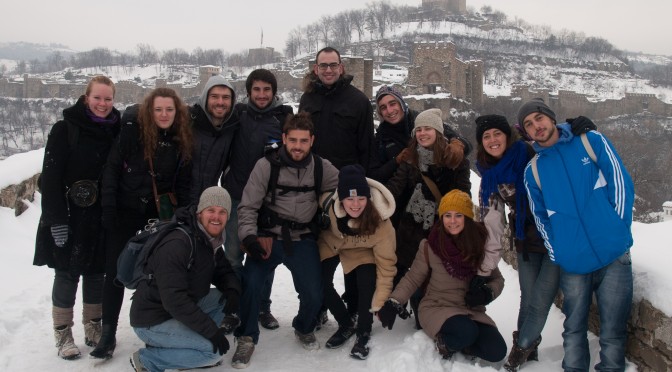
The first time I heard about Veliko Tarnovo was a few months ago at a Youth in Action exchange in Greece. Two Croatian girls, Lily and Iva, were talking about this Bulgarian city, “the old Bulgarian capital”, in which they had done their Erasmus. I knew even then, before I knew whether or not I’d be coming to Sofia for certain, that if I did, Veliko Tarnovo would not be a place I’d want to miss. The pictures sealed the deal.
And so it happened. Two EVS projects, ours and that of Smart Foundation, the people of which, incidentally, we have our Bulgarian classes together with, we decided all together to head out to Veliko (Bulgarian for great) Tarnovo for the weekend – 4 hours from Sofia by train and 25lv each for the return ticket.
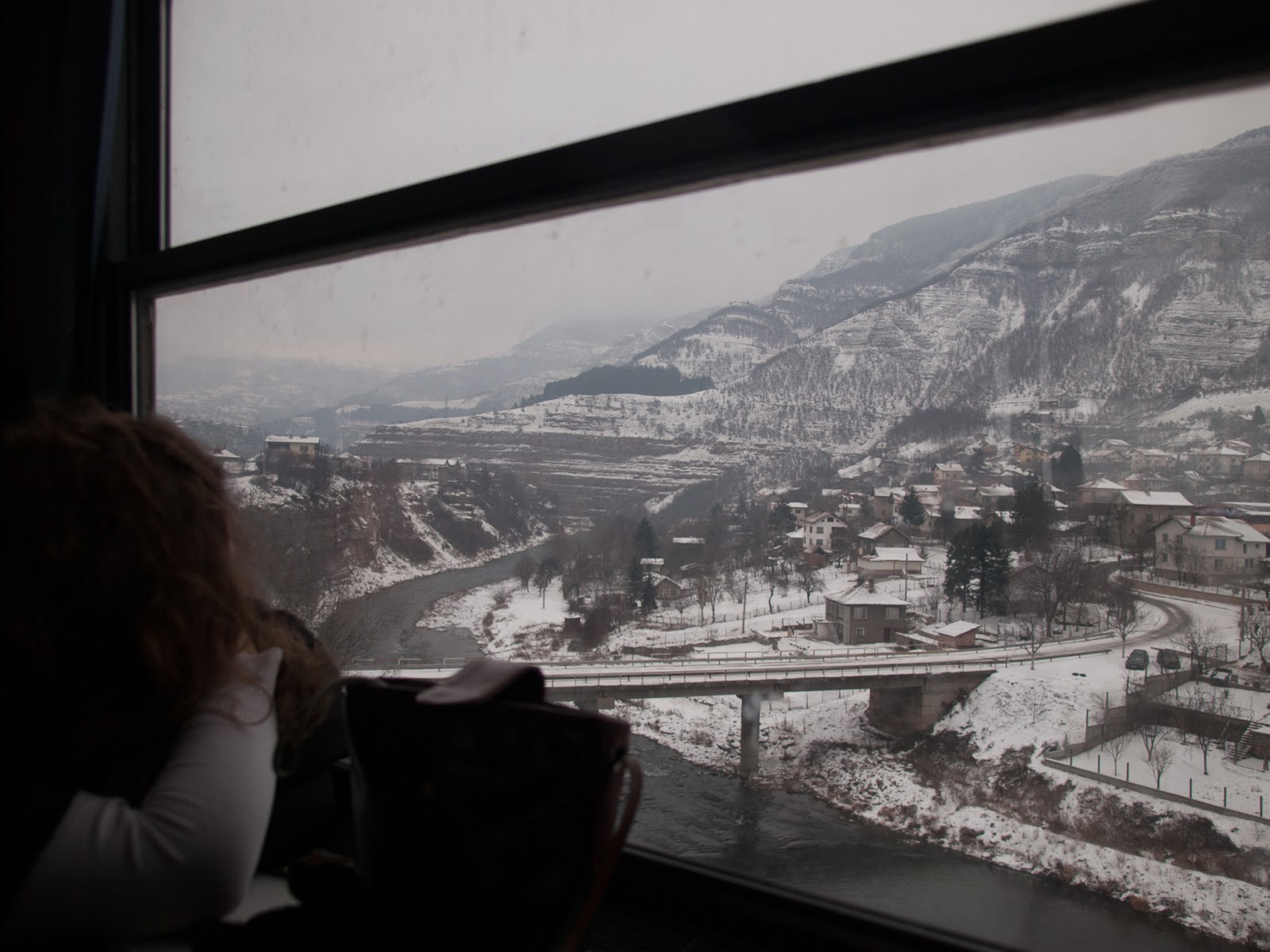 |
| Everybody was sleeping and missed the fantastic winter viewoutside the train window. Well, not exactly everyone… |
It’s very difficult to describe this city’s beauty. Imagine a river having created a canyon, and that canyon having its ridges built with fortresses, walls, churches and other old buildings generally accepted to be impressive and grand.
 |
The problem with these stunning locations is that it’s almost impossible to convey with pictures the feelings of awe they inspire you with their multiple layers, bridges connecting their sides, how impressive the fact seems that they even exist. The above picture might look good, but the view to other side looked just as good, not to mention what there was to the side of that and even directly behind me. All I’m trying to say is that I could definitely see why someone would want to build on this spot in particular and then call it his castle and capital. It awoke something ancestral in me, something like the pride of being king of the hill, master of my domain and watcher of all.
We spent Saturday night in Hostel Mostel which turned out to be a fantastic choice: 20lv each for a shared bedroom + light dinner (a kind of curry rice) + a free beer and breakfast. But that’s not all. What really made it stand out for us was the very cheap local beers they had in the fridge in the common area, free for all to pick at will and pay for at check-out for the very low price of 1,30lv per bottle. Let me just say that some of us took better advantage of this deal than others.
 |
| Hostel Mostel. Innocent enough during the day… |
 |
| …but a haven for evil drinking games at night! |
 |
| Raditsa’s baba’s surprise pickled vegetables -great for beer munchies. |
In the hostel we met other travellers from around the world who happened to be in Veliko Tarnovo at the same time as us. If we were a multinational group before, all of a sudden we became truly intercontinental: our group of three Spaniards, a Greek, a Latvian, a Dane, an Italian, a German and two Bulgarians was joined by two Argentinians (who had met earlier in their travels and decided to stick together) and an American from New York. We spent the rest of the night together, went out together and didn’t separate until when we had to say goodbye the next day, probably never to see eachother again. Those are the bittersweet moments of the world of travelling by staying in hostels, but also doing youth work and being involved in youth projects, I would add…
The highlights of our two days and a night in Veliko Tarnovo would be:
• Visiting the City Library, home to many old publications and books and staffed by people really keen to show us around:

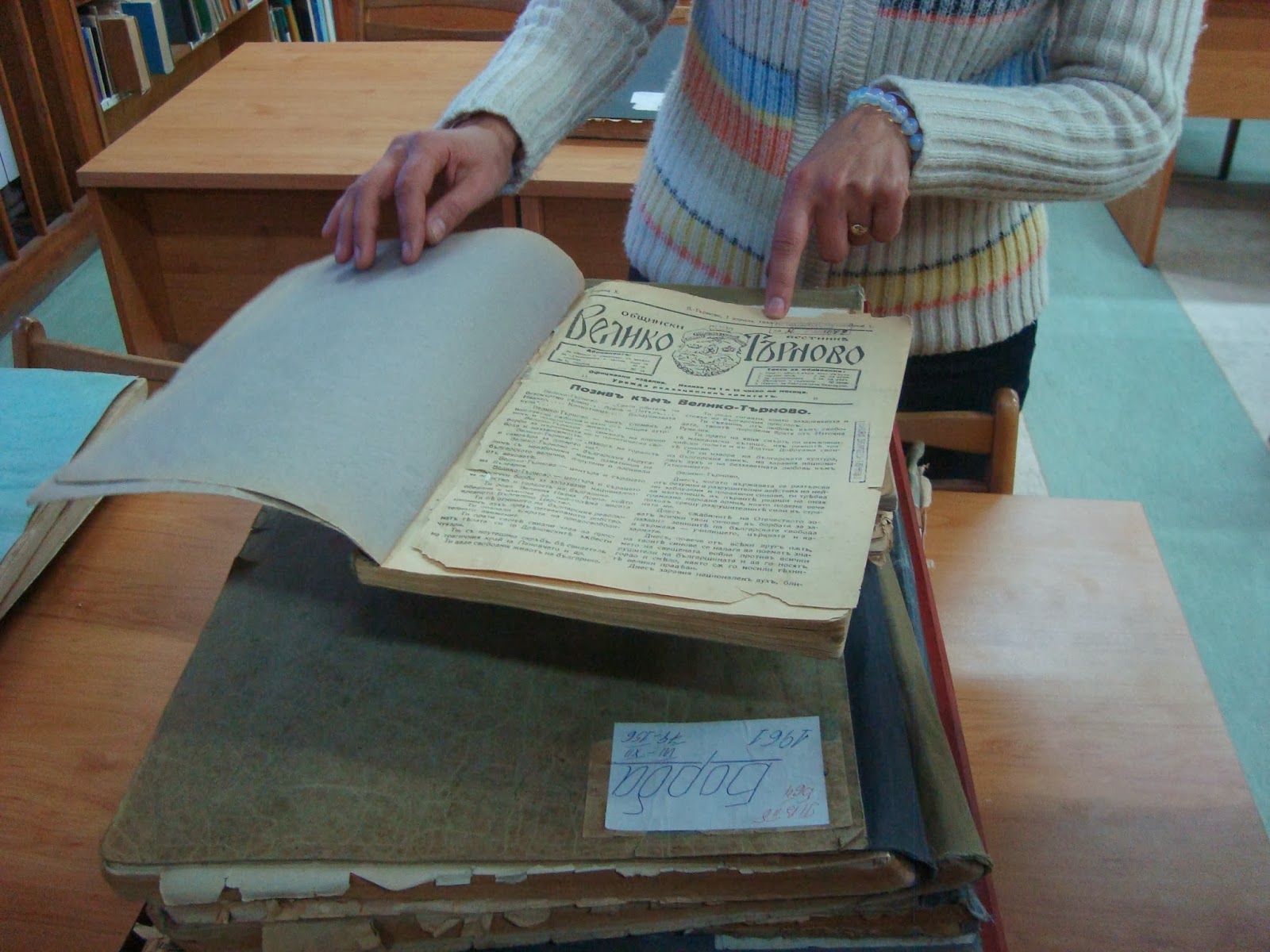 |
| April 1st, 1933 |
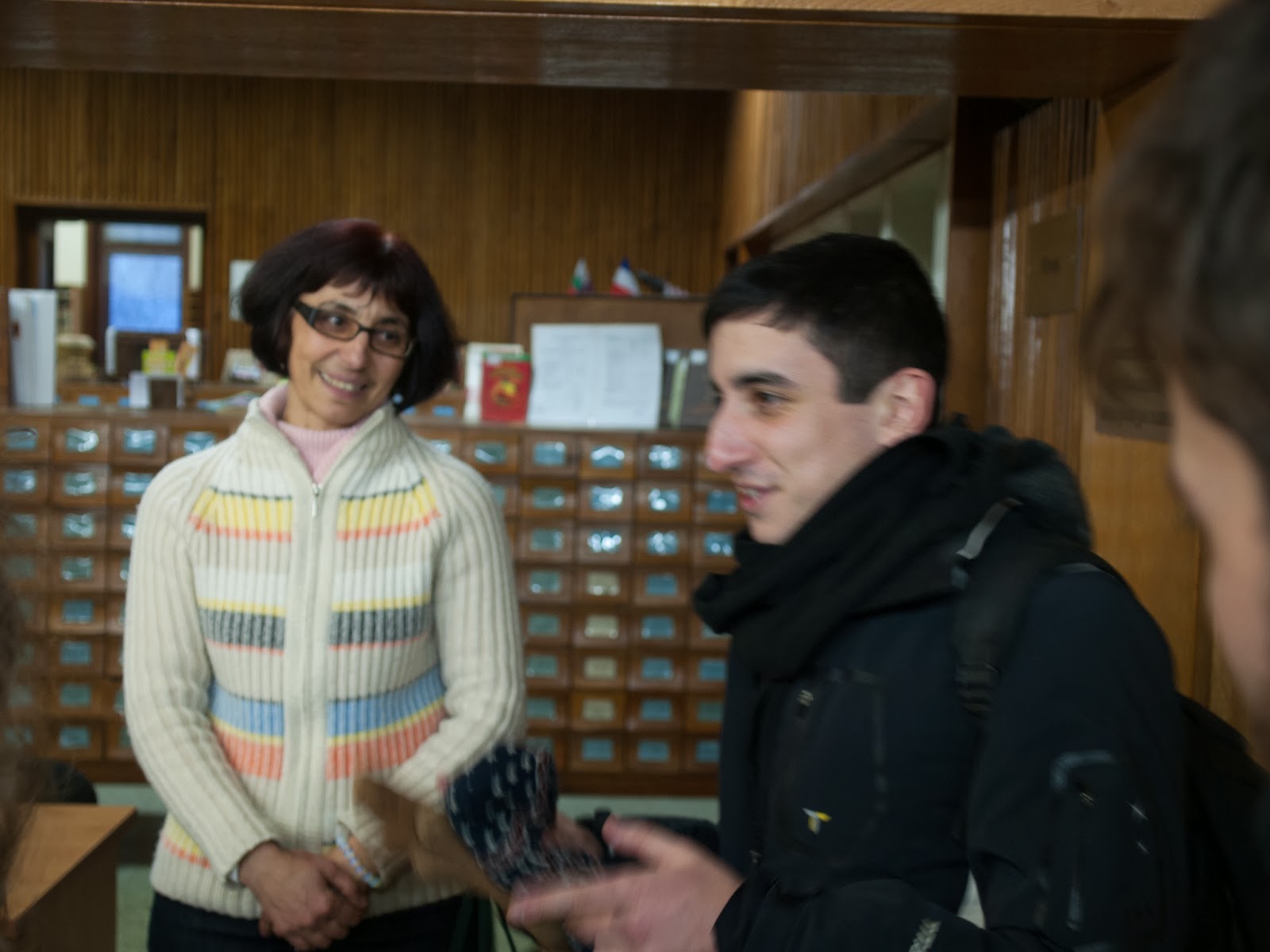 |
| Our mentor and trip manager Boris with the kind and helpful employee of the library. |
 |
| The library doubles as a museum. |
•The train from Sofia doesn’t stop directly inside the city so you have to take either a bus or a taxi from the station of Gorna Oriahovitsa for about a 10-minute ride to reach Veliko (the railroad going through the city connects Plovdiv to Ruse and is a different line from the Sofia – Varna one). In the station we saw something no-one else in our group had ever seen before but which all of us found very amusing: a free call-a-taxi service embedded into a coffee vending machine. We’re living in the future!
 |
•Visiting a restaurant recommended to us by the very sweet people of Hostel Mostel, a spot called The Artchitects’ Club. While in summer it might be nice and cozy sitting in the terrace outside as advertised in that embedded link, visiting it at this time of year made it necessary to order more rakiya than we would have otherwise. We filled our grumbling traveller bellies with Chiushi biurek (stuffed peppers pané), parzhieni kartofel c kashkaval (french fries/chips with grated cheese), various forms of meat in giuvetsh, kavarma and kebab forms and other if we left freezing our socks off, at least we left satisfied! The greatest moment of the afternoon? The ringtone of the owner/waitress that served us was The Imperial March.

•Tsarevets, the old fortress of Veliko Tarnovo and probably its most iconic symbol.


Again, the pictures don’t do the place justice, so here’s my suggestion: you go there as soon as possible and experience “the city of Tsars” for yourself. We know we will; just imagine all the above in brilliant green!
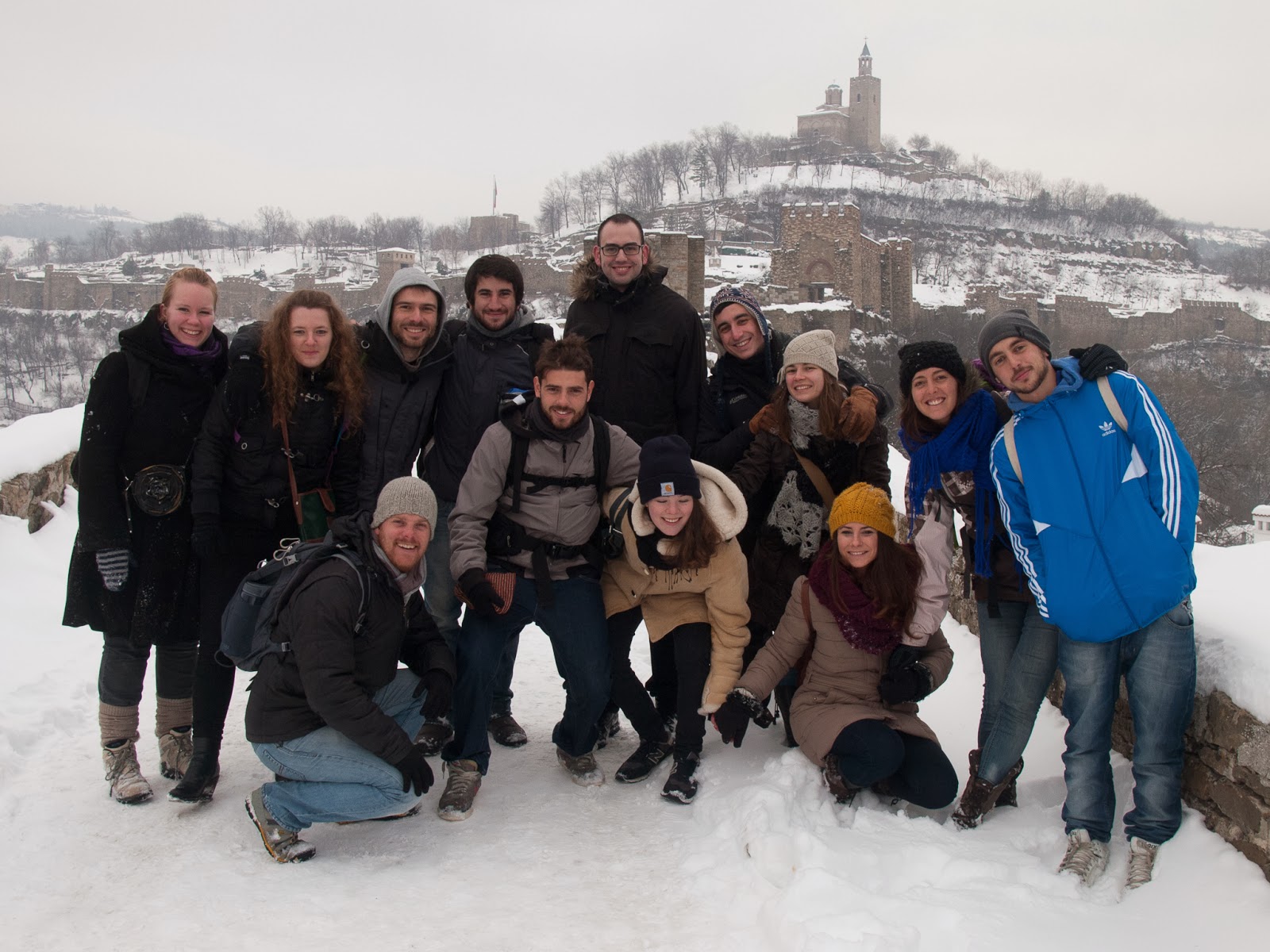 |
| A truly international party. |
EVS in Sofia City Library Blog: сняг!

Repost from the EVS in Sofia City Library Blog – I wrote that post about a week ago. More now did come, but now even that has melted. The novelty has worn off, okay, but the thought that we could have more any day still excites me.
Snyag; snow in Bulgarian!
Exactly one week ago we were eating ice cream in Vitosha Blvd and didn’t believe it when Boryana told us that it would be snowing soon. All for the better: the surprise was bigger!
Vicente and I thought that Maria and Zanda would have had enough snow for a lifetime, them being from northern countries and all, but then we realised that that would be like saying that we Mediterranean types have grown bored of our beautiful beaches, after so many summers of enjoying the sea and lying in the sun!
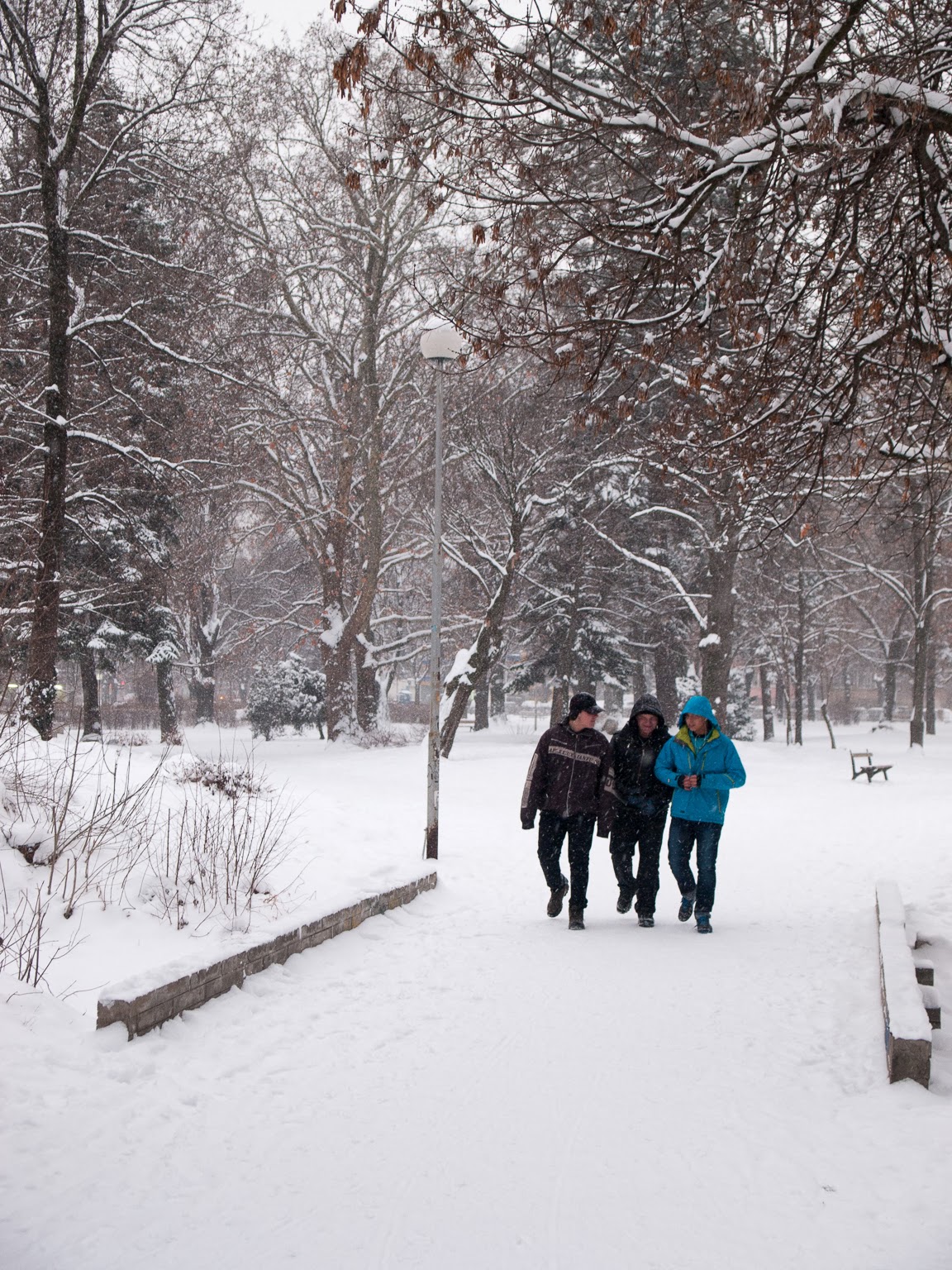
One of the things I like the best about snow is how everything is equalised under its blanket; the paths in the park disappear and the roads have to be cleaned if civilization is to keep doing its thing.Walking in the streets next to our apartment before the snow bulldozers -or whatever their names are- had really gone to work was quite a feeling; this whiteness that literally freezes reality visible, overwhelming, in all directions, including above and below.
I almost didn’t go out for my usual run because of the snow but my sense of duty prevailed in the end and it was a good decision (Vicente remarked that I was very disciplined!) The biggest park near our flat where I usually go to when I don’t want to go too far – Sveta Troitsa – gave me an opportunity to witness how, indeed, regardless of how many times you see snow in your life, every time is almost like the first.
 |
| “Gay” some things never change, no matter in which part of the world you are! |
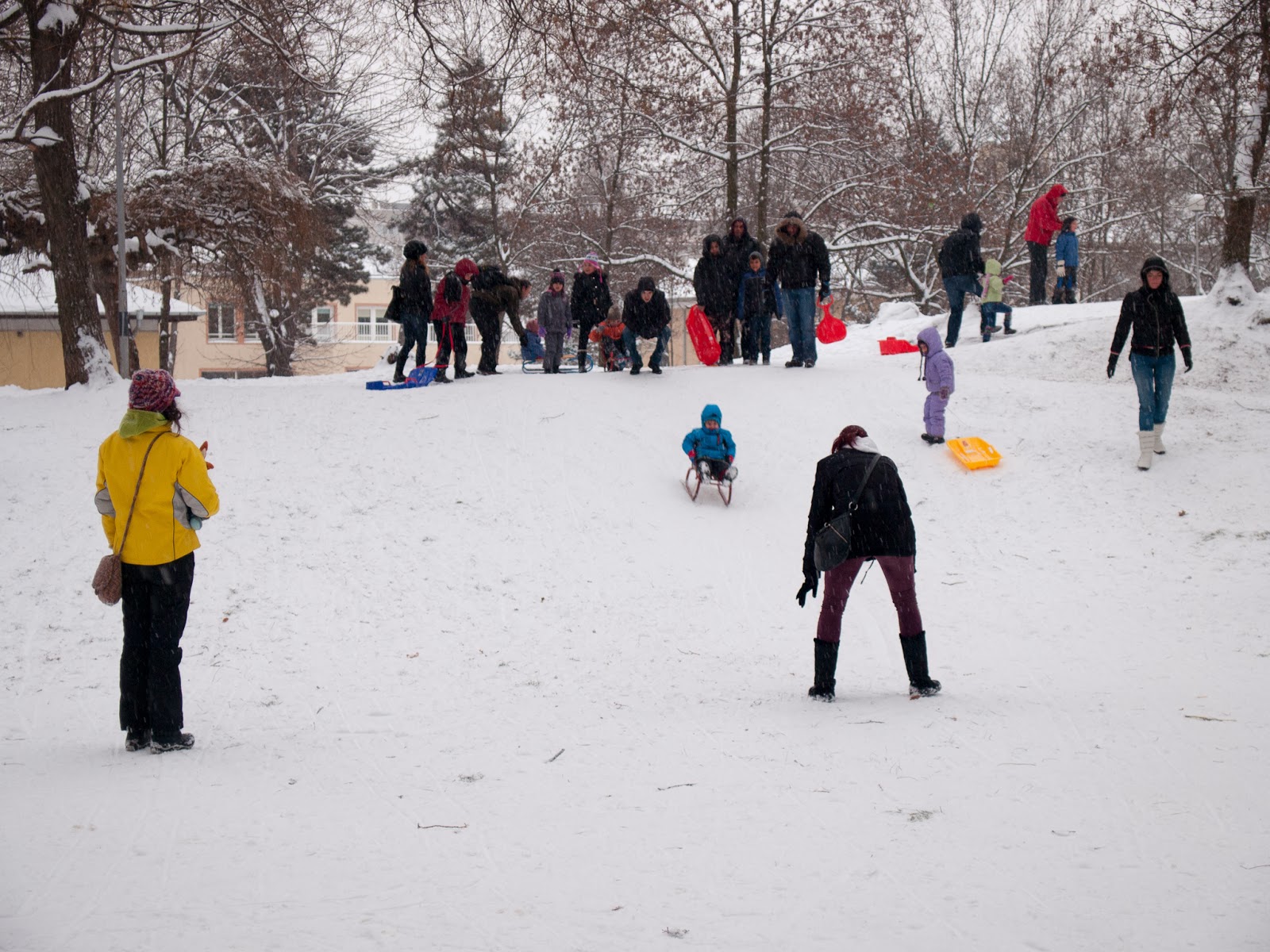 |
| Sofians went to Sveta Troitsa Park to enjoy the snow with their children. |
 |
| I miss my sled… |
 |
| Is an invisible path still a path? |
 |
| My hands were trembling too much in the cold outside of the warmth of the gloves for this picture to be any good. |
Snow never stays around as much as I’d like it to, however, and today the white stuff of happiness started melting under the winter sun, even though it was still the coldest day we’ve been here by far! By this morning all of the roads were already full of the dirty slush that the snow leaves behind and makes it unpopular to those who see a lot of it every winter. In light of this, our mentor Boris told us of a Bulgarian poet, Smirnenski was his name if I recall correctly, who made the parallel in one of his works between the urbanisation of Bulgaria -the rural families moving to the city to find work- and how the pure, innocent snow quickly becomes dirty in the city streets… I would love to find this poem and post it here actually.
Fortunately we heard that there’s going to be more snow coming in just a few days; the circle of rural innocence which turns to dirty urbanisation will not stop turning! What would the macroscopic, social equivalent of the dirty slush finally evaporating and returning to the sky be, though?
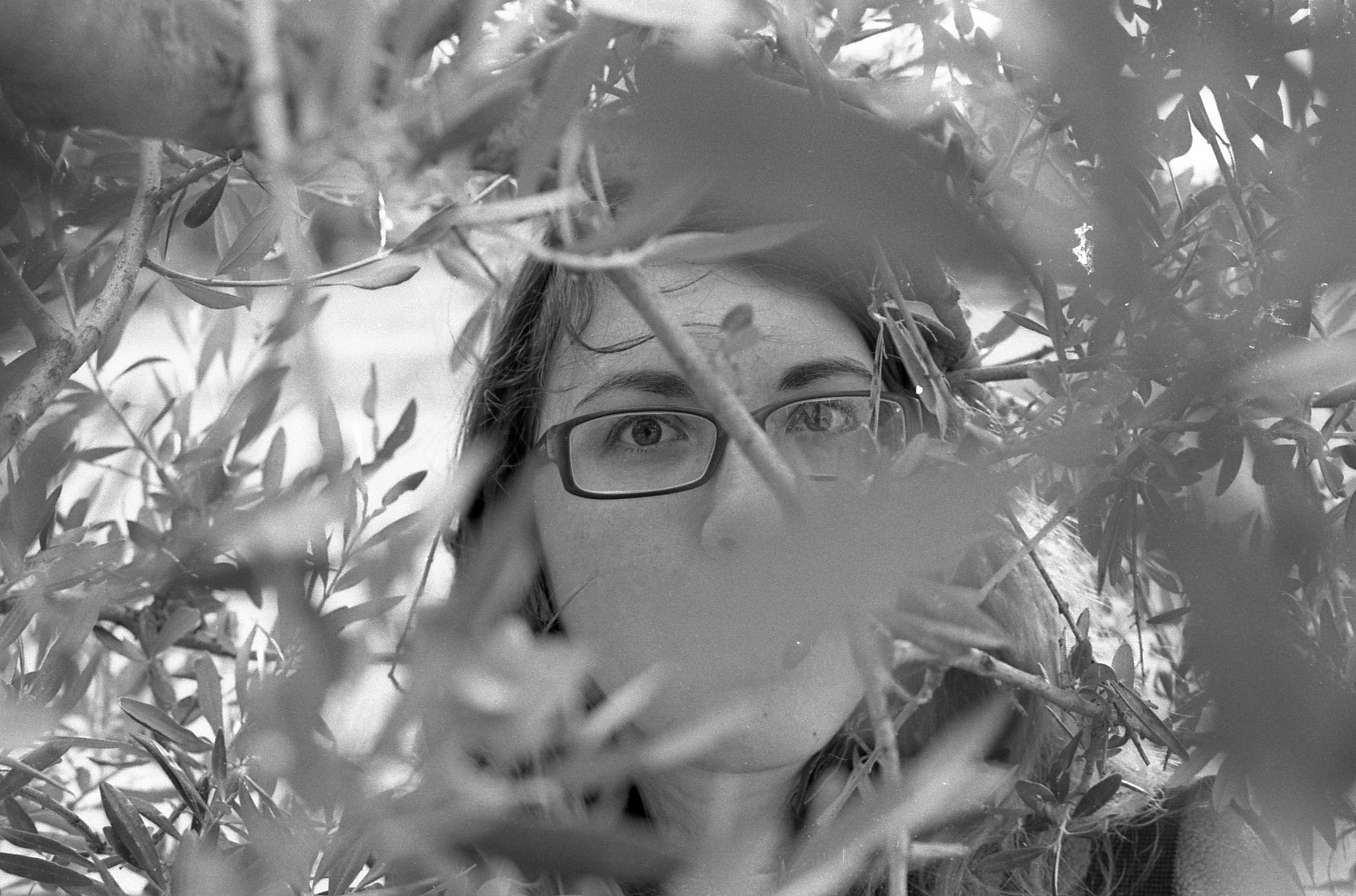
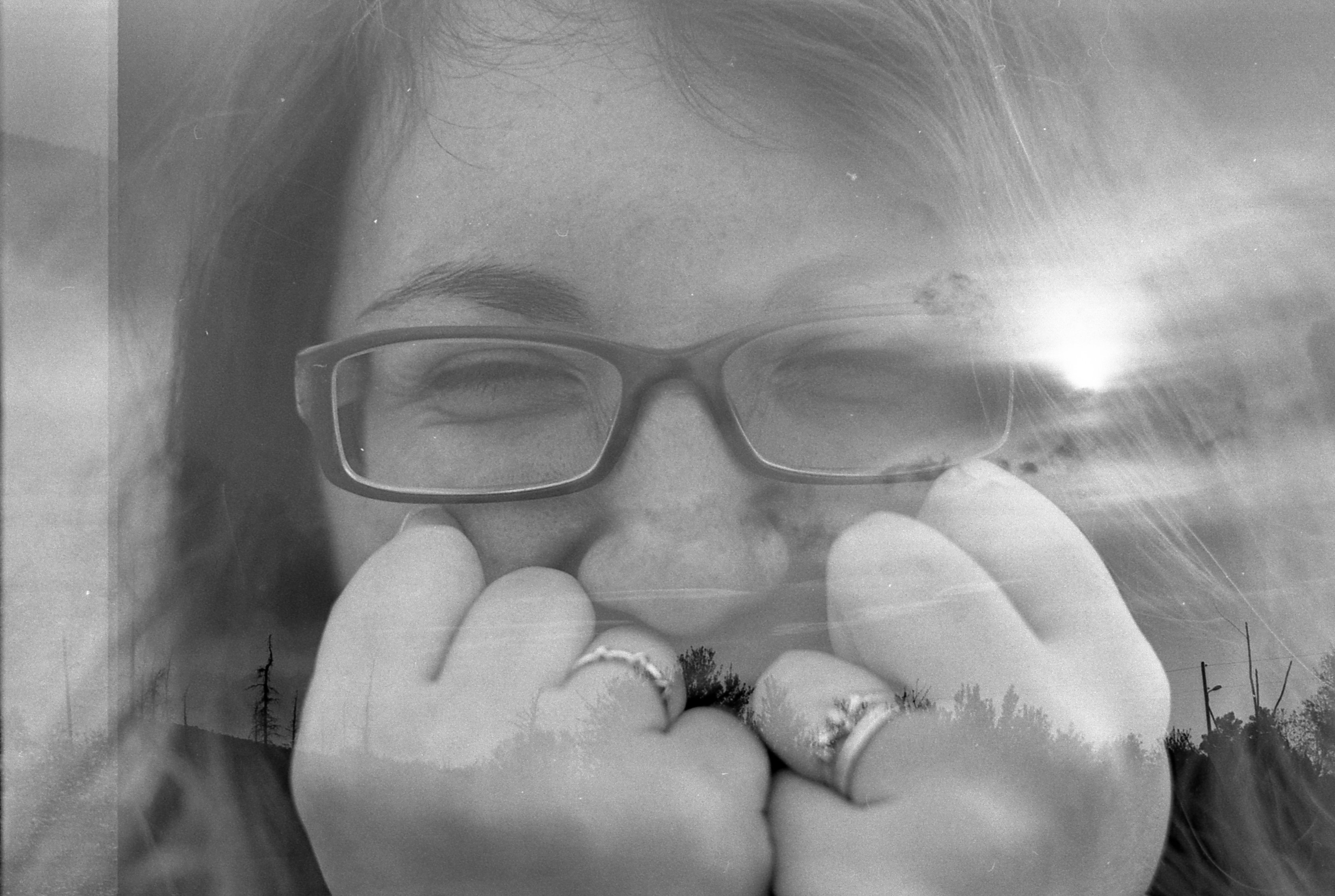
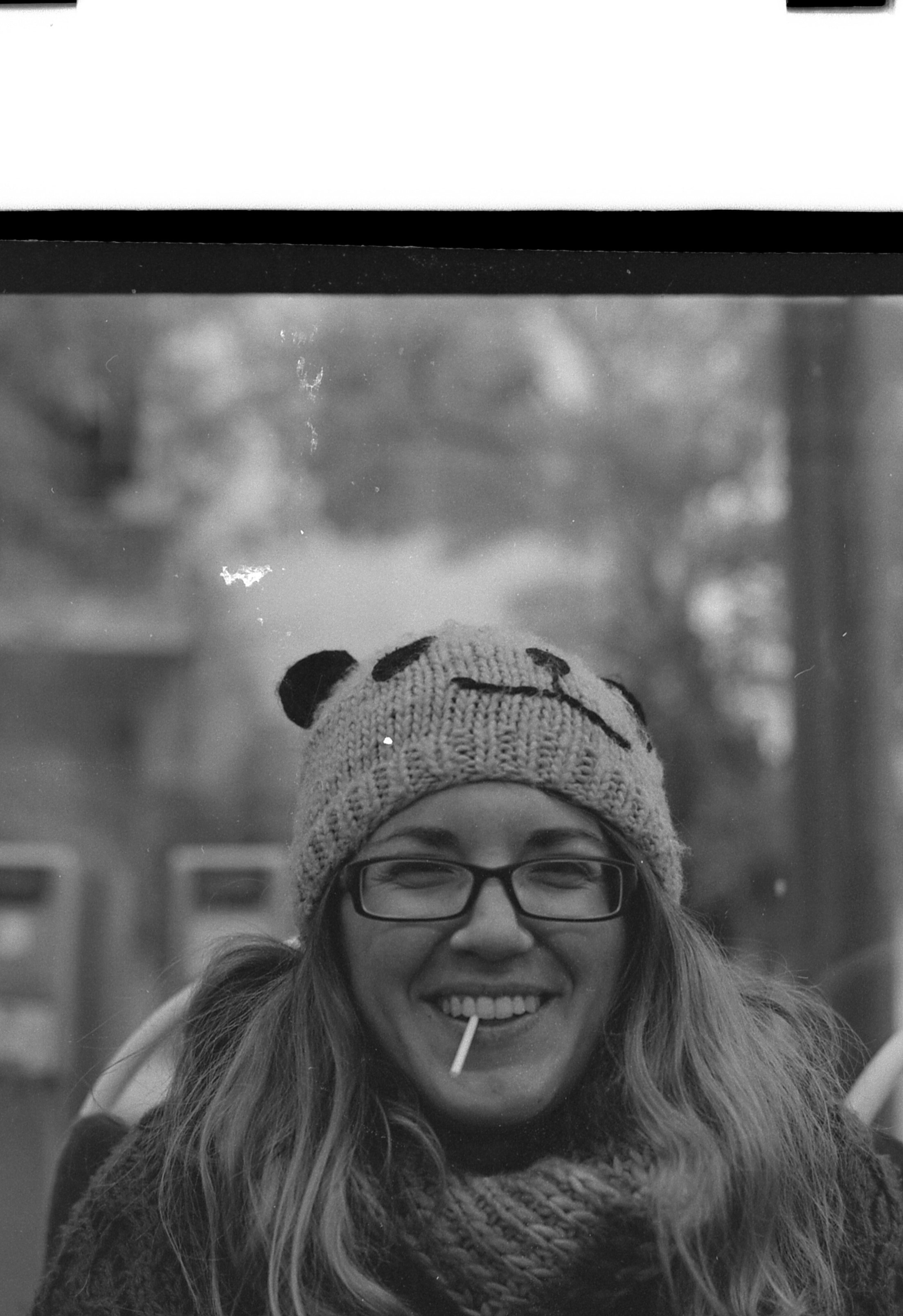
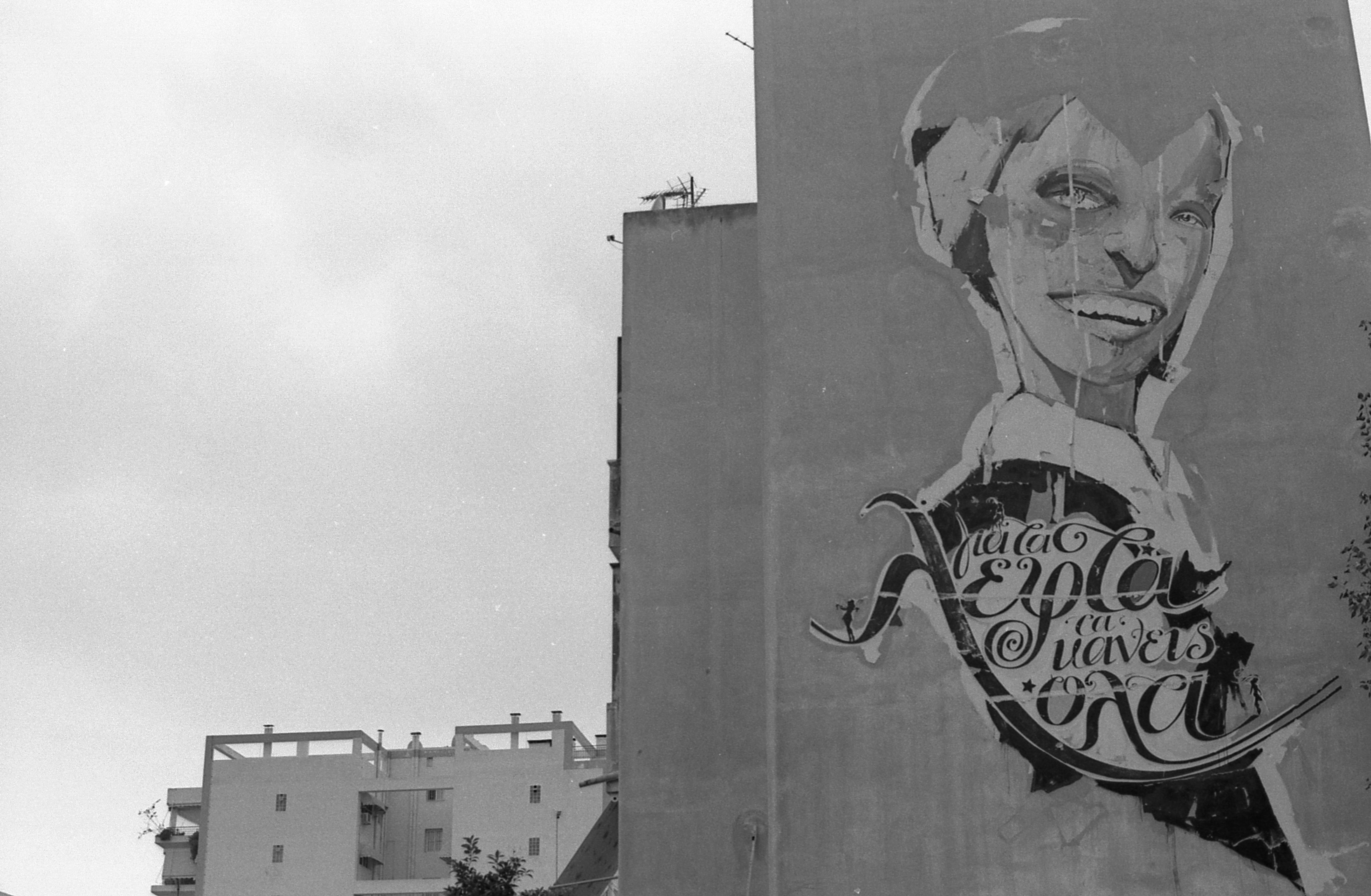
December B&W Film

A month and a half or so ago I bought two T-Max 400 black & white photography films, one for myself and one for Daphne. The idea was to use them together and develop them together as well. We did exactly that three days before I left for Sofia. I had the dumb idea to use the ergaleiaki to record the process in the darkness of my bathroom in Nea Smyrni, which ended up very very very dimly illuminating the whole affair with its red little recording confirmation LED. We knew we had made a mistake but we didn’t turn back. Thankfully it didn’t ruin the rolls.
We used T-Max developer which had expired a year or so before. Tip: don’t trust expiration dates – neither for developer nor for food. Use common sense.
All in all I’m very satisfied with this roll and so decided to upload pretty much all of it. Enjoy. Thanks go to my trusty OM2-n (40 years and still going – can you say that about your DSLR?), my scanner and of course Rapsooneli.
Rapsooneli: I invite you to upload your own roll and then we can share our creations online like some sort of artist duo! :O EDIT: She did. She went ahead and did it. Isn’t she just awesome?
Picture order randomised. If you refresh the page it will change. Go on, try it.



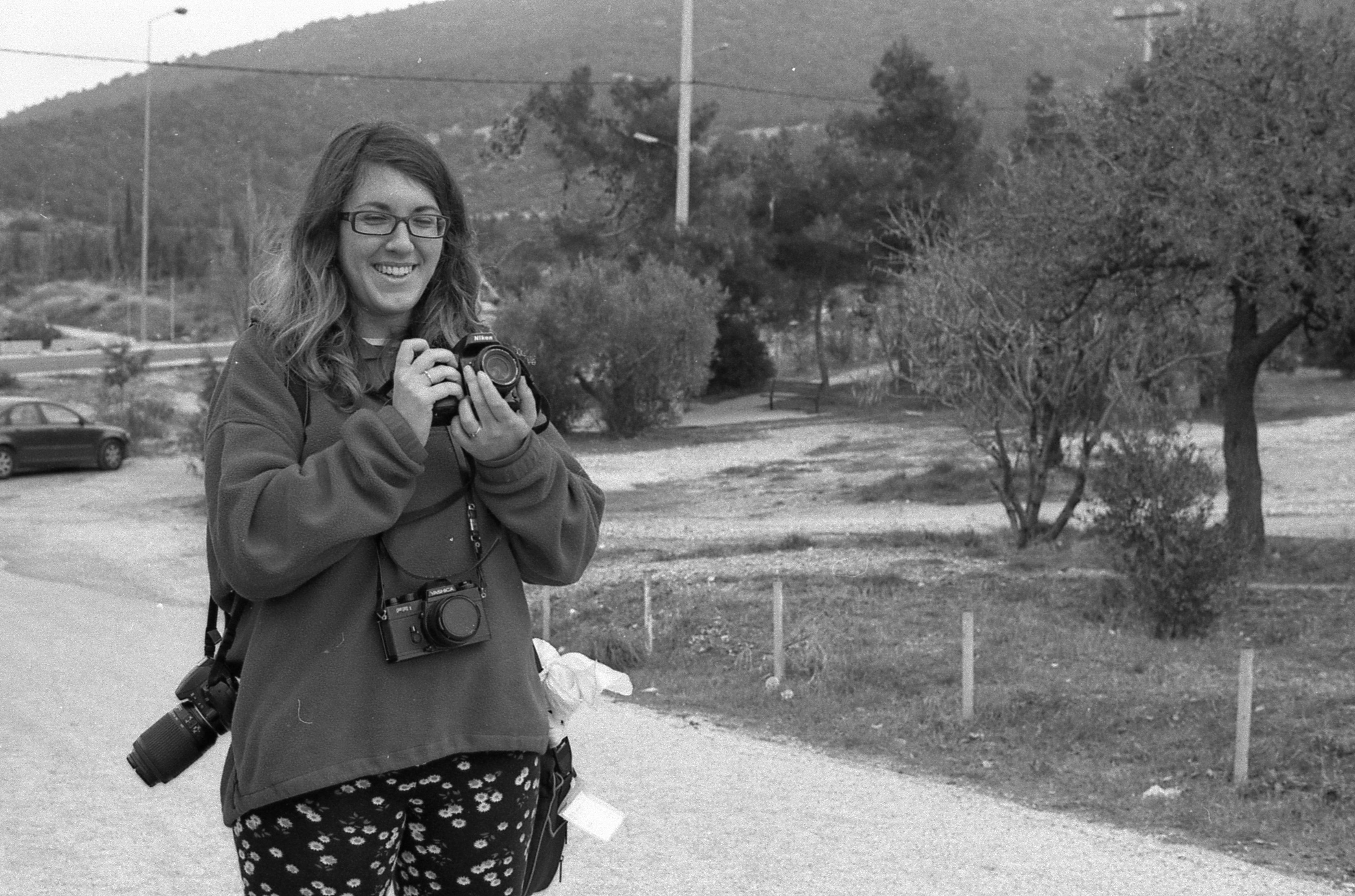
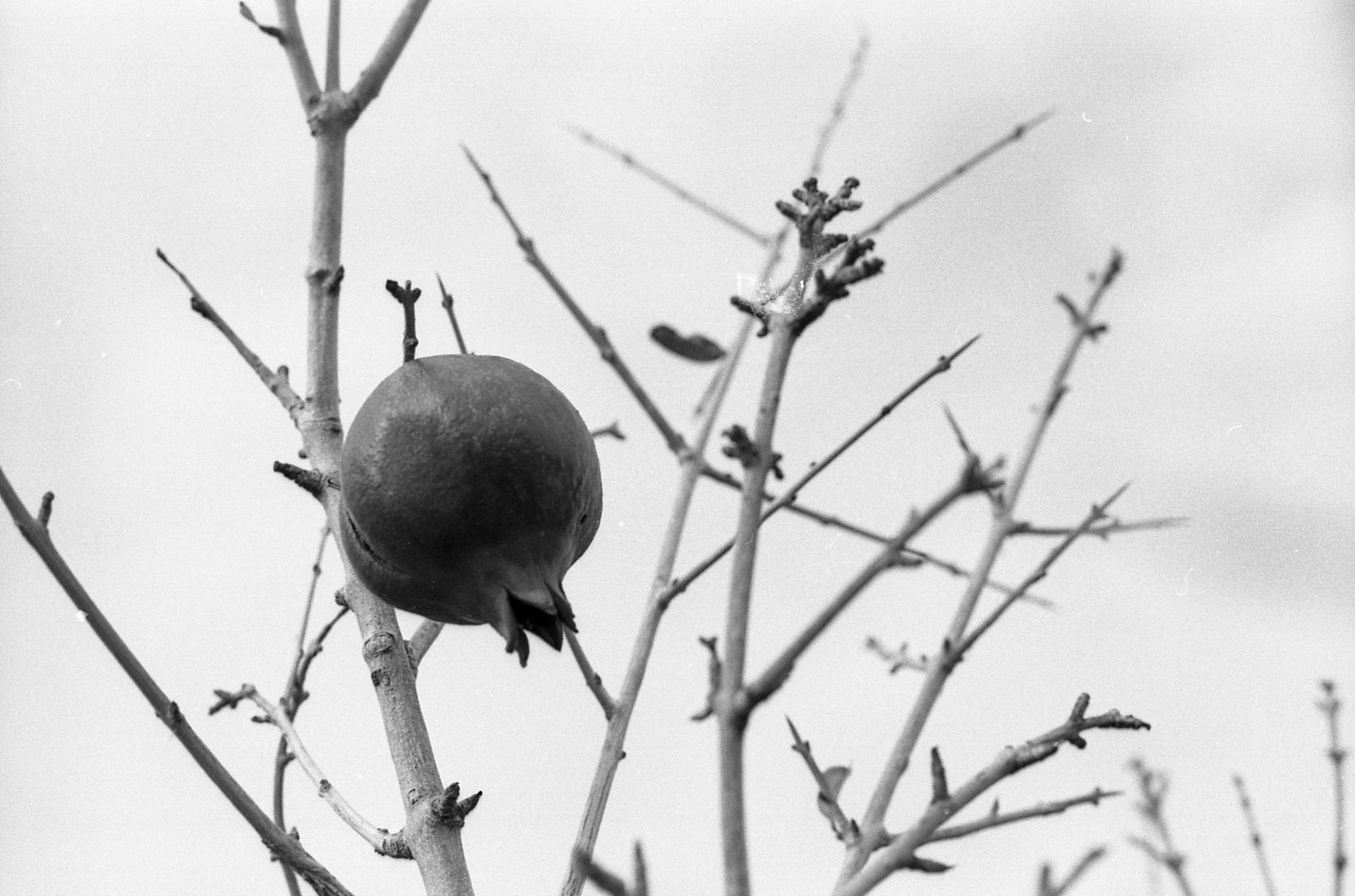
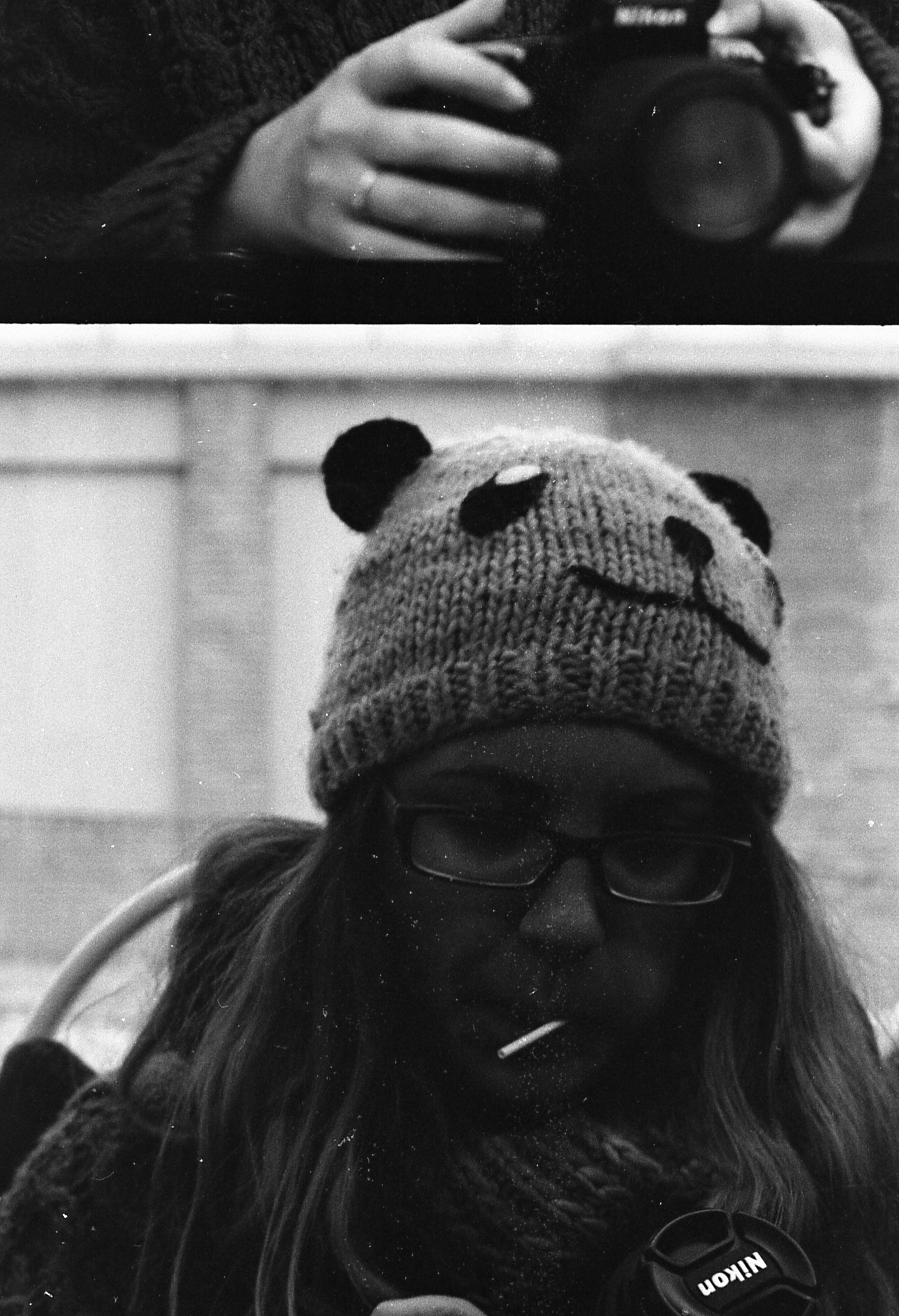


EVS in Sofia City Library Blog: Introducing! Second batch of fresh volunteers in Sofia
Repost from the Sofia City Library Blog on which I started posting today.
Dimitris from Greece; Maria from Denmark; Vicente from Spain and Zanda from Latvia. The four of us are the fresh batch of EVSers for the Sofia City Library. Our project started in the second week of January 2014 and will end in October of the same year. That’s right: we’ll be living in Sofia together for a full nine months – in fact it’s already been two weeks we’ve lived together. This blog will serve as our medium of communication with the world, our platform for sharing all that we do here in Bulgaria, our work at the library, our experiences as EVS volunteers and lots more. We’re picking it up from where the previous volunteers left it off. Thank you Jose Manuel, Agne, Sarah and Ricardo; we promise we’ll make you guys proud.
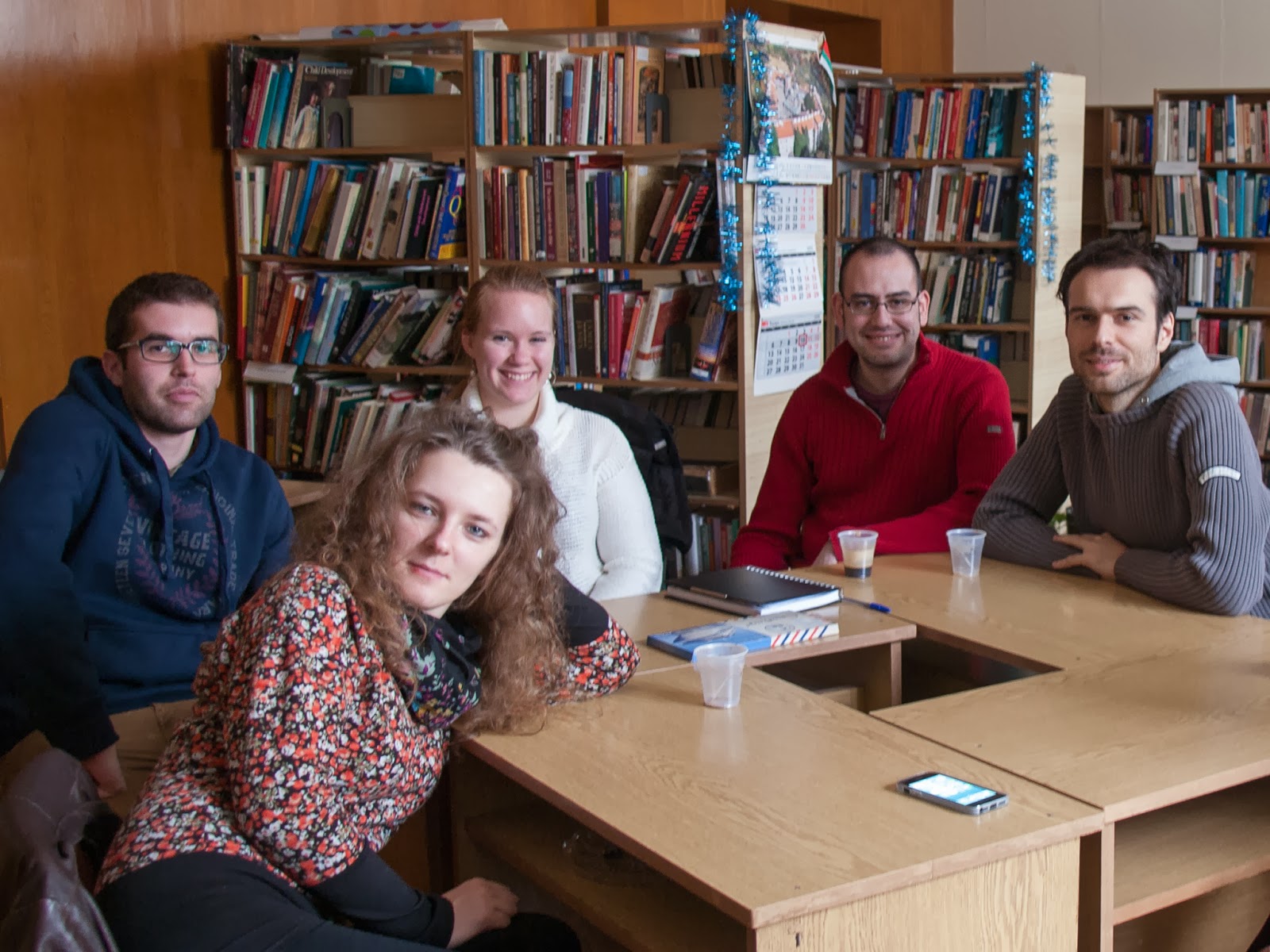 |
| Left to right: Ricardo (the veteran), Zanda, Maria, Vicente, Dimitris.Picture by Valentina. |
And for those of you just dying to know a little more about us, fear not: we wrote little texts for introducing ourselves, exclusively for this post – for your eyes only!
Zanda:
This is a very special place I want to tell you about. A place where the cows are blue and skys are orange. In this place lives a grandmother with white hair who is called Baltic Sea. If you listen carefully you can hear how she whispers old stories about Baltic countries. This place is made from grass, rivers, forests, trees and flowers. In this place live people, who don’t talk, but they are singing. Their flesh is the earth and their blood is the water. This place is LATVIA.
In Lavia there is a girl with messy hair and mind full of birds. She loves books, music, dancing, colors and she also likes meeting people from different cultures. This girl is me – ZANDA PILATE.
Vicente:
Let’s talk about me. 29 year old unemployed Spanish male. That sounds like very average. Let’s be more personal. I am a daydreamer who is always making other plans while life happens, like Lennon said. I would like to have time to live in dozens of countries at the same time, and this is the first time I’m living abroad. When I was younger I wanted to be a great journalist, help to save the world working as a war correspondent of the BBC or something like that. Then life happened. I was working in a rutinary job for almost five years. Now is the first time that I am in the place that I want to be in a long period and that makes me very happy.
I come to Sofia, a city called like my Grandma, to live with Dimitrios, who is called like my Grandpa. Feels good to be grounded by cultural junks like me, something that never happened to me even when I studied journalism.As a Spanish I don’t see myself as a regular countrymen, not the type of “Como España en ningún lao”. Even if it has some good points I feel very disappointed with it, and another thing that makes me happy about staying in Bulgaria is that I’m not working for a shitty payment, not consuming there, not paying taxes to the traitors in the government who put the payment of the debt constitutionally before public healthcare.My family is very conventional, so for me is always a shock to know other costumes, living with vegetarians, for example. My mother is probably checking my weight when I come back to Spain.I’m writing this with my fingers burned by a fucking frying pan so I expect that Dimitri appreciates my sacrifice.
Dimitris:
Soon I will be celebrating the completion of my 25th revolution around our Host Star, forever travelling together with the Pale Blue Dot, on the Pale Blue Dot, like a flea on a dog chasing its tail. Most of this time I had lived in the region of this Pale Blue Dot called Greece, where I was also born; a place famed by others of my species for its history, culture, good food and fantastic weather, “a cozy little spot”, as I imagine Douglas Adams would call it. However, something beckoned me to move for a while a little bit to the North to this neighbouring region called Bulgaria. Putting that “something” into words is very difficult, so I suppose just saying “it felt like the best next step” should do nicely. Would the word “serendipity” sound too pretentious?
I have these second thoughts a lot, you know: one of my typical characteristics is second-guessing and analysing everything I feel, think and do, in order to follow more closely my ethical compass, a weird, imaginary but perfectly mundane object that would look like what you would get if you put together timeless growth, soundless laughter and mindless wonder, and clicked “reconcile” on your 3D printer that somehow ran on yogurt – preferably vegan (yes, there exists such a thing! Crazy, isn’t it?!) I’d be a textbook INFP, if such a thing as a typology textbook existed (it does in my secret world, where the above Dimitrian object is a platonic ideal).
In case you hadn’t realised by now, I greatly enjoy writing (not talking) about myself. I also tend to unnecessarily convolute things. To spare you with the nonsense, as I’m sure you want to learn more about me and not just read things I somehow believe look clever on a screen, I’m interested in media, the natural world, (alternate) human culture, history and languages, and, even though my writing style obviously doesn’t show it, I believe in and value simplicity. I studied Cultural Technology media and culture and I think this project at the Sofia City Library, as well as the whole philosophy of informal education behind EVS and YiA programs, suits my current professional and personal ambitions like a glove. Would it be too cheesy if I put another “serendipity” here?
Maria:
I’m Maria from Denmark, Mimi the Baby at the Sofia City Library and the glitter loving DustyFairy at tumblr.
I’m the baby of the project because I’m 21 and the youngest, even though I’m the most responsible and Zanda thinks I’m acting like a mother. I’m only doing this as a cover for whom I really am, and I learnt from the very best; Wendy. She was the greatest mother Peter and the boys could ever have wished for even though she made me a bit jealous when she gave Peter the “thimble”.
I am a creative, glitter loving, crazy fairy.. Oh! I mean person, of course! A creative but responsible young girl who is a passionate complainer about everything and nothing, and who in the end still hasn’t figured out how the thing about being a grown-up is done correctly. I have, for some time been looking for my pot with “adultness” and I have started to wonder if I might have forgotten it at home, next to my fairy dust, when I was visiting princess Tiger Lily, Peter and the Boys in Neverland, the Netherlands I mean, last month before I got here.
Hmm.. Anything I forgot to tell…? Oh yes!
My biggest weakness is my fear towards onions. They are evil! They make you cry for no reason and when they do, they infect you with “The Onion Syndrome”, which, for me personally, means that I act even crazier than normal and that I even get a little mean. I’m convinced that some onions deep down in some of their inner most layers are nice onions and that they make us, fairies, ehh humans, cry because they are forced to by Captain Hook and his pirates that threaten them to walk the plank if they should ever consider stopping their cooperation. It is easier for Hook and his pirates to catch and kidnap us when our eyes are too swollen from crying and it also makes us more convince-able under the influence of “The Onion Syndrome” to cooperate.
There is so much to tell!! But I have got to go now.. Mitco is destroying things in the kitchen.. AGAIN!
Have a continued sparkling day!
“The many reasons (32 so far) why we DON’T succeed in learning languages, and retorts for why we can”
Daphne had been insisting that I leave the inn in HabitRPG I had so cozily settled in the past few weeks; thatTrapper Santa boss would certainly not kill itself! I actually did, but actually I hadn’t. By some mistake I didn’t really click on the button which makes you leave the inn (or the flipping site/my laptop/our internet was being unresponsive) and thus missed my opportunity to join the party and fight the boss. This made me very angry indeed. I started fidgeting around the site trying to find a way to undo this when I clicked on “Challenges“.
One of the top ones was “Learn a Foreign Language“. I was intrigued of course and swiftly followed a link sending me to an article titled the same as the title of this post on a site called Fluent in 3 Months.
While the author is plugging himself in more ways I considered possible, it’s a very encouraging and thorough read for someone like me whose ambition is to become a polyglot, but it could be just as useful for anyone aiming to learn a foreign language . You’re probably going to get information overload from that one but it’s worth a try and anyway it’s a valuable resource. Even I had no idea all these sites existed dedicated to all these different kinds of language practice. I had probably just never looked hard enough for them, subconsciously following some of those 32 excuses myself…
Review: The Art of Dreaming
 The Art Of Dreaming by Carlos Castaneda
My rating: 4 of 5 stars
Carlos Castaneda is certainly considered required reading for any person even slightly interested in the occult, ancient practices, magic, dreams, altered states of existence or completely different planes thereof. This one was the first book by him I finished, if you exclude The Teachings of Don Juan which I began reading in Spanish but never finished because my Spanish just isn’t as good as I’d like it to be yet.
Contrary to other of his works, this one he wrote many years after the events he describes therein had come to pass: apparently they had been buried into his subconscious because of the altered state, the second attention, he had (mostly) been in at the time. Only almost 20 years after his apprenticeship into understanding and navigating the world of dreams by Don Juan was he able to bring what he learned to the forefront of his consciousness and then put it on paper.
I liked The Art of Dreaming, especially the first half. I read that when I was in the coach from Athens to Sofia and it helped make the journey much more dreamy; it made me feel that it was a passage in more ways than one: in the physical sense -travelling from one point of the Balkans to another- but also in this transcendental sense, this thing you get when you learn about the details of a profound truth. I came into The Art of Dreaming expecting something practical -Castaneda’s “Lucid Dreaming for Dummies” handbook- especially after learning that it was he who popularised the technique of looking at your hands as a reality check, something I picked up and have used successfully numerous times. The beginning of the book was entirely like that: it was him learning about the different methods of dreaming consciously and going through the “gates of dreaming”, as well as finding out about the complicated intricacies of the assemblage point and its manipulation. That link is a good summary of the book’s most interesting “academic” part.
But, like Castaneda himself in the book, or at least the person Castaneda wrote himself to be, I too need my objectivity, for that’s the way I was taught to perceive the world, as Don Juan would have said. Therefore, as the book became weirder and weirder and Castaneda strayed farther and farther away from what my dream reality -even in my most successful endeavours in lucidity- has looked like and started going into the dimension of inorganic beings, alien energy scouts and the like, I started losing my point of reference and ultimately my interest. By the end of the book his narrative had become so convoluted that I couldn’t figure out any part of what was happening – perhaps an apt representation of Castaneda’s own recollection of his strange experiences.
What however made things more interesting for me was this article I came across shortly before finishing the book which uncovers Castaneda as a complete fraud. Apparently after the success of his first few books, which, it is implied, were also figments of his imagination, Castaneda became a sort of cult-leader figure; when he was exposed he disappeared from public view by secluding himself in a villa together with three of his female companion sorcerers. The story is complicated in many levels; I can only say that the narrative of his books and what happened in real life is difficult to tell apart. In fact I’m sure that even if Castaneda proved to be okay after all (a possibility we still can’t discount since, from where I’m standing, the revelation of the hoax can be a hoax as much as the supposed hoax itself) the automatic reaction from a scientific and rationalist status quo seeking to disprove just to confirm its dominance would have been no different.
At this point several possibilities and parallel narratives have arisen: the story of the book itself; the real events which inspired Castaneda if we are to accept that his books are only adaptations of what really transpired; the reality of his life undescribed in the books – what we would see in a Castaneda behind-the-scenes; and the dirt that has come out that Castaneda was a complete hoax, which is 100% in line with “skeptic” views. All these interpretations exist simultaneously in a sort of entangled limbo: any one of them could be true and the fact wouldn’t negate the veracity of the other versions – they could all be true simultaneously. Additionally, on a meta level each one of these stories has something different to tell: about the human willingness to believe and the power of belief itself, about the unfathomability of the universe, about the dogmatism of contemporary intellect, about how powerful your fictional story can be to be able to ultimately convince even yourself that it’s the truth – especially if millions of others already believe it to be so.
In another interpretation, you could see how these are all just different layers of meaning, just like Don Juan described reality as an onion consisting of layers of universes. The hoax coexists with the book’s story and it’s only a matter of intent, a matter of the position of your assemblage point what it is that you’ll end up keeping from the whole affair.
Even if Castaneda hallucinated everything he ever wrote about, this book has made me think in ways I’m sure were not intentional but have arisen anyway as part of the complexity of being a thinking but chiefly intuitive feeling person alive in 2014. If this book is a valuable collection of techniques that -as far as I can tell- really work and a story of them being put to use, where does the fiction begin?